Itakura Katsukiyo — The Shogunate's Last Chief Senior Councillor
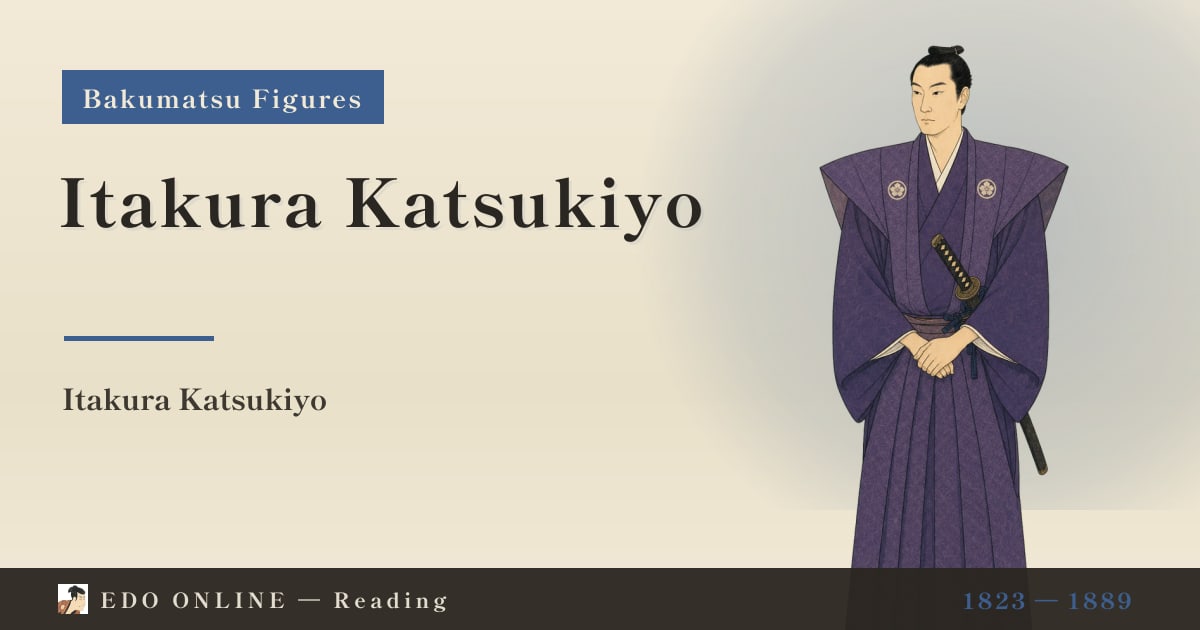
When the Tokugawa shogunate handed power back to the emperor, one man was sitting in the chair of chief senior councillor. Itakura Katsukiyo — grandson of Matsudaira Sadanobu, who had run the Kansei Reforms two generations earlier.
Contents
Who Was Itakura Katsukiyo?
Itakura was a daimyo of the Bitchu-Matsuyama domain who rose to serve as senior councillor (roju) in the last years of the shogunate.
His career splits in two.
As a daimyo. He promoted the Confucian scholar Yamada Hokoku and, through him, rebuilt the ruined finances of Bitchu-Matsuyama (today Takahashi city, Okayama).
As a shogunal minister. He became roju in 1862, served the fourteenth shogun Tokugawa Iemochi and the fifteenth Tokugawa Yoshinobu, and was present at the return of power to the emperor in 1867.
Then, in the Boshin War, he went north rather than submit with Yoshinobu — and kept fighting all the way to Hakodate.
He was born on 14 February 1823 and died on 6 April 1889.
Itakura Katsukiyo, Grandson of a Reformer
Katsukiyo was born the eighth son of Matsudaira Sadanaga, whose own father was Matsudaira Sadanobu, the man behind the Kansei Reforms.
A reforming councillor's grandson thus became a councillor himself.
In 1842 he married into the house of Itakura Katsutoshi, lord of Bitchu-Matsuyama, as an adopted son-in-law, and succeeded to the domain in 1849. The Itakura were hereditary Tokugawa vassals — a house with the road into the shogunal cabinet already open to it.
The domain he inherited, however, was financially finished.
Itakura Katsukiyo and Yamada Hokoku's Reforms
This is the part of Katsukiyo's record that still stands highest.
He promoted a scholar named Yamada Hokoku. Hokoku came from farming and merchant stock, not from a high-ranking family. Katsukiyo made him head of the domain academy and then handed him the domain's finances outright.
Hokoku's programme was austerity, new products, and the cleaning up of the domain's paper currency. Bitchu-Matsuyama iron and tobacco were sold in Edo, the debt came down, and reserves were built. It counts among the most successful domain-finance turnarounds of the Bakumatsu era.
The pattern — a lord reaching past rank to promote a man and then leaving him to it — is the same one you see with Nabeshima Naomasa and Shimazu Nariakira. The domains that rose in this period generally started by changing who they appointed.
Itakura Katsukiyo, the Last Chief Councillor
He became a shrine-and-temple magistrate in 1857 but was dismissed in 1859, reportedly after clashing with Ii Naosuke over the punishments of the Ansei Purge.
He was back in office in 1861 and rose to senior councillor in 1862, and from there he sat through the hardest years the shogunate had.
On 9 November 1867 came the Taisei Hokan, the return of power to the emperor. Katsukiyo was chief senior councillor at that moment — the last head of the shogunate's cabinet.
Why Itakura Katsukiyo Fought On to Hakodate
After the defeat at Toba-Fushimi in 1868, Yoshinobu left Osaka for Edo and eventually submitted. Katsukiyo did not.
He travelled from Edo north through the Tohoku domains and across to Ezo, fighting on to the fortress of Goryokaku at Hakodate with Enomoto Takeaki and the others.
Back home, Bitchu-Matsuyama was declared an enemy of the court and had to face the imperial army with no lord present. It was Yamada Hokoku who surrendered the domain without a fight and saved it from abolition. While the lord fought on, his retainer preserved the domain.
Loyalty to a house, and the survival of a domain: in Katsukiyo's life the two finally came apart.
Itakura Katsukiyo's Death and Grave
On 4 July 1869 Katsukiyo returned to Tokyo and gave himself up. The next day he was placed in the indefinite custody of the Annaka domain.
He was pardoned by special decree on 14 February 1872.
In 1876 he was appointed a priestly official of the Ueno Tosho-gu, the shrine to Tokugawa Ieyasu. The shogunate's last councillor ended up serving at the shrine of the shogunate's founder.
He died on 6 April 1889, aged sixty-six. His grave is at Kichijo-ji in Honkomagome, Bunkyo ward, Tokyo.
Itakura Katsukiyo Timeline
| Year | Event |
|---|---|
| 14 Feb 1823 | Born the eighth son of Matsudaira Sadanaga |
| 1842 | Adopted as son-in-law by Itakura Katsutoshi of Bitchu-Matsuyama |
| 1849 | Succeeds to the domain |
| 1850s | Promotes Yamada Hokoku and pushes through the domain reforms |
| 1857 | Appointed shrine-and-temple magistrate |
| 1859 | Dismissed, during the Ansei Purge |
| 1862 | Becomes senior councillor |
| 9 Nov 1867 | Present as chief councillor at the Taisei Hokan |
| 1868 | After Toba-Fushimi, fights north through Tohoku and on to Ezo |
| 4 Jul 1869 | Returns to Tokyo and surrenders; held by the Annaka domain |
| 14 Feb 1872 | Pardoned |
| 1876 | Becomes a priestly official of the Ueno Tosho-gu |
| 6 Apr 1889 | Dies, aged 66 |
For others who held the shogunate up in the same years see Oguri Tadamasa and Katsu Kaishu; for the Ezo campaign, Enomoto Takeaki and Otori Keisuke.
Related reading
Abe Juro — The Former Member Who Talked
He deserted the Shinsengumi and rejoined under another name, shot at Kondo Isami as one of the Goryō Eji, and then grew apples in Sapporo. His late-Meiji testimony is where the ranking of the corps' best swordsmen comes from.
Ando Hayataro — The Shinsengumi's Record-Breaking Archer
He set the standing national record in the long-range shooting at the Tōdai-ji Great Buddha Hall, sending 8,685 arrows the length of the corridor. Nearly fifty, he joined the Shinsengumi and died of wounds taken in the back garden of the Ikedaya.
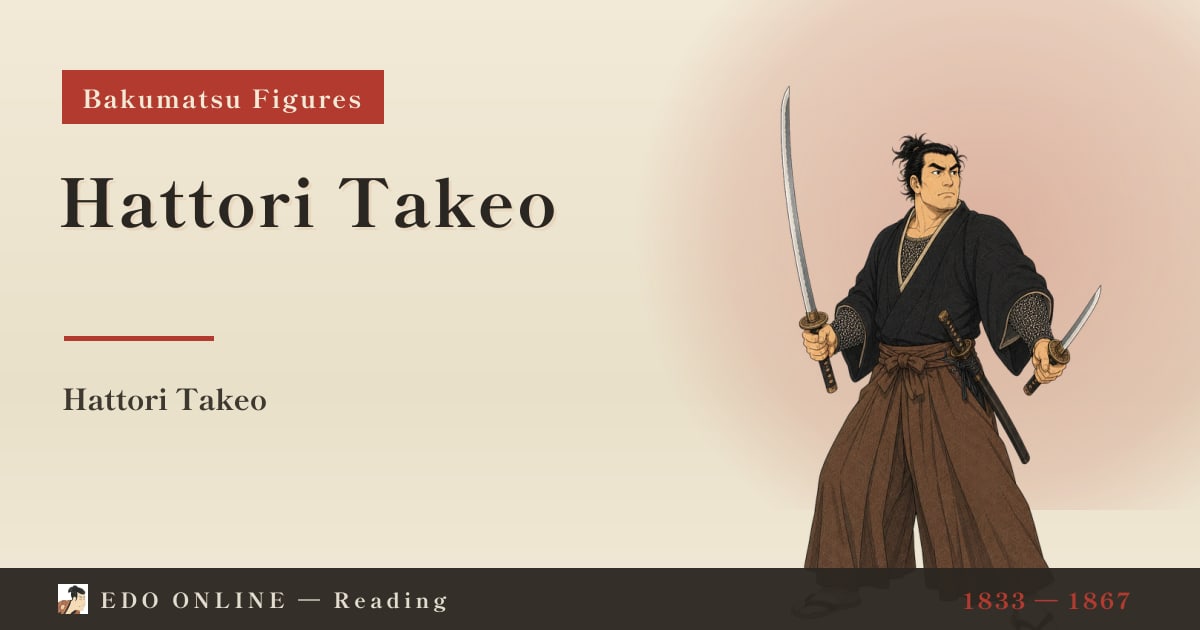
Hattori Takeo — Two Swords at Aburanokoji
A two-sword master and fencing instructor of the Shinsengumi who defected with the Goryō Eji. At Aburanokōji he alone wore mail, held a wall against the whole corps, and fell with more than twenty wounds.