
Shimazu Nariakira — The Satsuma Lord Who Modernized Before the Black Ships
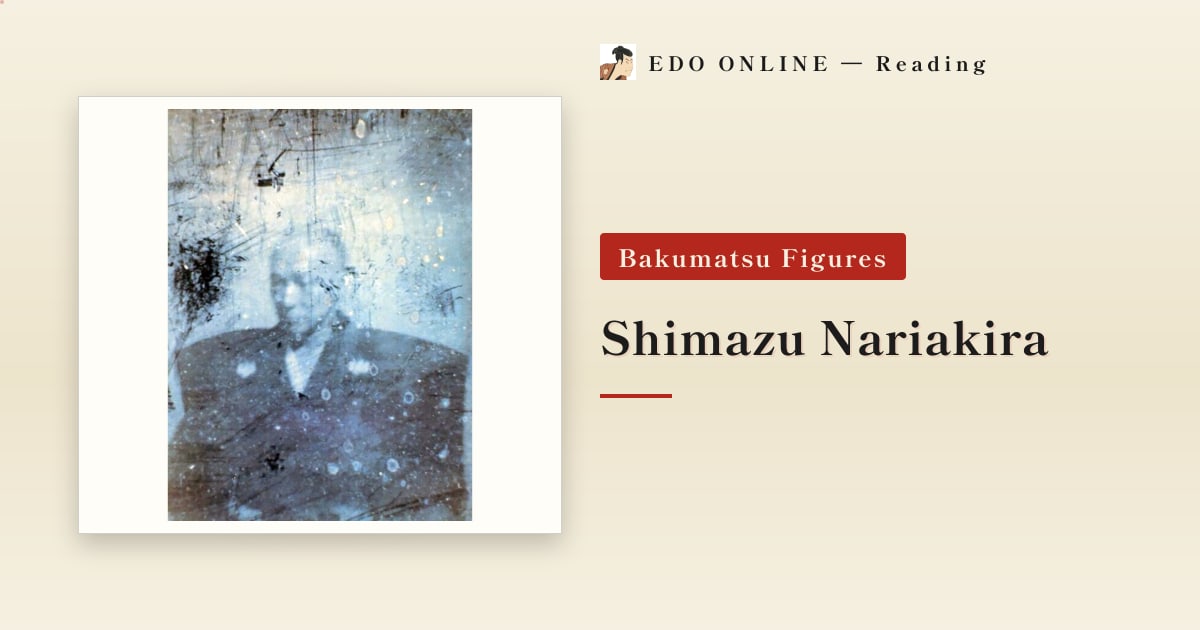
There was a daimyo running Western-style factories in his own domain before the Black Ships arrived. Shimazu Nariakira, lord of Satsuma, is remembered as one of the wise lords of the Bakumatsu.
Contents
Who Was Shimazu Nariakira?
Two things.
He modernized his domain. Reverberatory furnaces, blast furnaces, shipbuilding, glass, spinning, and photography — Nariakira assembled in Satsuma a great complex of Western science and technology, the Shuseikan enterprises.
He drew out talented men. Saigo Takamori, whom Nariakira personally selected, and Okubo Toshimichi, who first came to notice in Nariakira's time, would go on to lead the Meiji Restoration. Without the ground Nariakira made, the leading figures of the Restoration would not have emerged.
He was born in 1809 into the Shimazu house, lords of Satsuma.
Shimazu Nariakira and the Oyura Disturbance
Nariakira was known for his brilliance from a young age. But his road to the lordship was not smooth.
His father, Narioki, was slow to hand over the succession, and a faction backed instead a younger son borne by Narioki's concubine Oyura. Nariakira's supporters and the younger son's supporters clashed in a disturbance that split the domain — the Oyura Disturbance.
Many of the retainers who backed Nariakira were punished in the affair. He did not reach the lordship until 1851, already past forty.
It was a late start, but from there he threw himself into reform at furious speed.
Shimazu Nariakira's Shuseikan Enterprises
What Nariakira built in Satsuma was the Shuseikan.
In the castle town of Kagoshima he raised a complex of Western-style works: reverberatory furnaces to melt iron, cannon casting, Western ship construction, glass and ceramics, cotton spinning. He set out to import Western industrial technology wholesale, on the domain's own strength.
Remarkably, this went forward at roughly the same time as the arrival of the Black Ships, or earlier. Where many domains stirred into motion only under foreign pressure, Nariakira was already acting, reading ahead.
Nariakira took a keen interest in photography himself. One of the earliest photographs of a Japanese subject is said to be a portrait of him — an anecdote emblematic of a daimyo who put his own hand to the West's new technology.
How Shimazu Nariakira Raised Saigo and Okubo
Of all Nariakira left behind, the greatest may have been men.
Nariakira sought out able men from among low-ranking retainers and promoted them. The foremost example is Saigo Takamori, whom Nariakira recognized, who worked as his instrument and became deeply devoted to him. It is well known that Saigo revered "Lord Nariakira" all his life.
Okubo Toshimichi was also recognized in Nariakira's time, though his political rise came mainly after Nariakira's death, under his brother Hisamitsu. That the leading men of the Restoration came, one after another, from a single neighborhood — Kajiya-cho — is told as part of Satsuma's singularity. It was Nariakira who made the place where such men could be used.
Shimazu Nariakira's Sudden Death
Nariakira's rule did not last long.
In 1858 Nariakira died suddenly in Kagoshima, aged forty-nine (fifty by the traditional count). He is said to have fallen ill during a military exercise in high summer and died very quickly. The cause is given as illness, with cholera among the proposals; the suddenness later gave rise to a poisoning theory, without any firm evidence for it.
His sudden death was a heavy blow to Satsuma. Some hold that had he lived, the Restoration might have come sooner, and in a different form.
Having lost his lord, Saigo Takamori is said to have wished to follow him in death. That is how large a presence Nariakira was to Saigo.
Shimazu Nariakira's Legacy
The Shuseikan enterprises Nariakira built were scaled back for a time after his death but not wholly extinguished. Later revived, they became a source of Satsuma's strength.
The site of the Shuseikan survives in Kagoshima today. Related facilities and gardens are included among the components of a World Heritage listing, as markers of the starting point of Japan's modernization.
A lord who anticipated modernization, raised the men of the Restoration, and died suddenly with his work half done — Nariakira is indispensable to any account of the Bakumatsu.
Shimazu Nariakira Timeline
| Year | Event |
|---|---|
| 1809 | Born into the Shimazu house, lords of Satsuma |
| 1851 | Becomes lord of Satsuma after the Oyura Disturbance |
| 1850s | Advances the Shuseikan enterprises; modernizes the domain |
| around then | Draws out Saigo Takamori and Okubo Toshimichi |
| 1858 | Dies suddenly in Kagoshima, aged 49 |
For the men he raised see Saigo Takamori and Okubo Toshimichi.
Related reading
Abe Juro — The Former Member Who Talked
He deserted the Shinsengumi and rejoined under another name, shot at Kondo Isami as one of the Goryō Eji, and then grew apples in Sapporo. His late-Meiji testimony is where the ranking of the corps' best swordsmen comes from.
Ando Hayataro — The Shinsengumi's Record-Breaking Archer
He set the standing national record in the long-range shooting at the Tōdai-ji Great Buddha Hall, sending 8,685 arrows the length of the corridor. Nearly fifty, he joined the Shinsengumi and died of wounds taken in the back garden of the Ikedaya.
Hattori Takeo — Two Swords at Aburanokoji
A two-sword master and fencing instructor of the Shinsengumi who defected with the Goryō Eji. At Aburanokōji he alone wore mail, held a wall against the whole corps, and fell with more than twenty wounds.