
Why Is Goryokaku Star Shaped? History and Guide
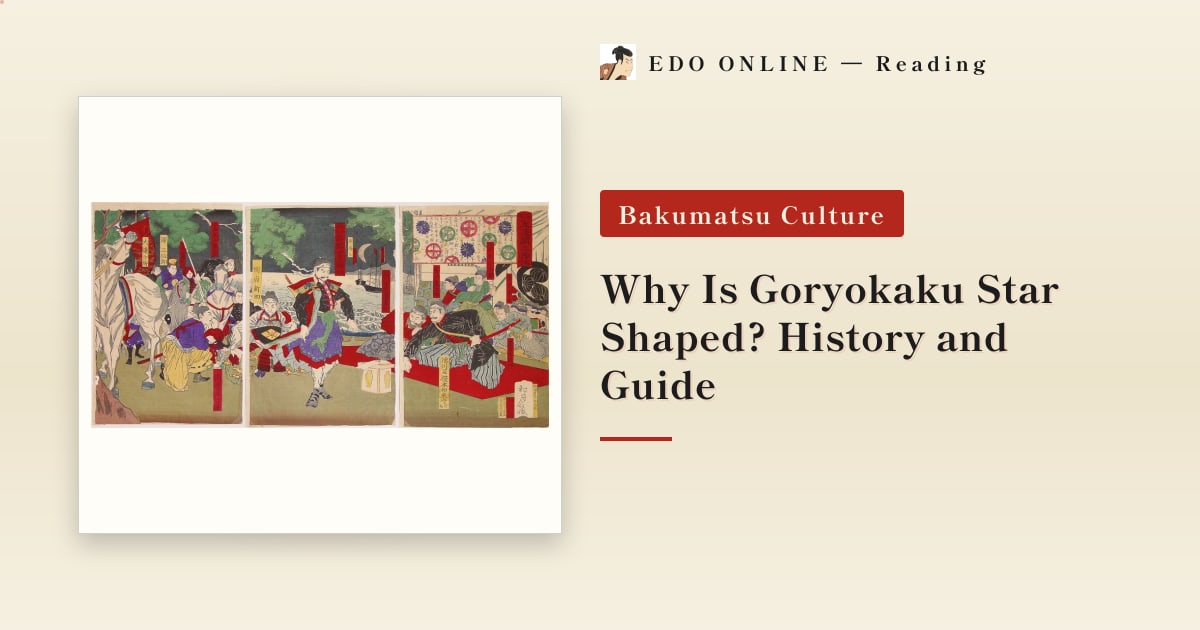
Seen from above, Goryōkaku is a five-pointed star. Nothing else in Japan looks like it, and the shape is not decoration: it is the Bakumatsu period rendered in earth and stone.
Contents
What is Goryokaku?
Goryōkaku is a European-style star fort built by the Tokugawa shogunate at Hakodate, on the island of Hokkaido.
| Item | Detail |
|---|---|
| Location | Hakodate, Hokkaido (then called Hakodate in Ezo) |
| Built | Begun 1857, completed 1864 |
| Designer | Takeda Ayasaburō, a scholar of Dutch learning |
| Built by | The Tokugawa shogunate |
| Purpose | To relocate the Hakodate magistracy and defend the newly opened port |
| Today | A national Special Historic Site and public park |
Star forts are rare in Japan, and Goryōkaku is the outstanding example. It was designed on principles entirely unlike those of a traditional Japanese castle.
Who built Goryokaku?
It was designed by Takeda Ayasaburō, from Ōzu in Iyo province, who studied Dutch learning at Ogata Kōan's Tekijuku and in Edo.
Takeda taught navigation, shipbuilding and gunnery at the shogunate's technical institute in Hakodate, and was involved in building warships. Goryōkaku represents the sum of that Western technical training.
The commissioning body was the shogunate, and the immediate cause was the opening of Hakodate as a treaty port. A harbour visited by foreign warships could not be defended from a conventional administrative compound, so the magistracy was moved inland and ringed with a modern fortification.
Construction began in 1857 and finished in 1864: seven years of work.
Why is Goryokaku star shaped?
The answer is to eliminate blind spots.
A traditional Japanese castle relied on high stone walls. Against swords, spears and bows, height worked.
Artillery changed the calculation. High walls became targets that could be battered down. The European response was the bastion system, in which the wall is broken into angled projections.
Each point of the star is a bastion. The arrangement provides two things:
- No dead ground. With a straight wall, attackers who reach its base cannot be fired upon. Projecting bastions allow defenders to sweep the face of the adjacent wall, leaving nowhere sheltered
- Crossfire. An attacking force is engaged from two bastions at once, from the flanks
So the star is not an aesthetic choice. It is the shape that follows from the requirement to be able to shoot back from any direction.
There is an irony, however. By the time Goryōkaku was finished, the design was already obsolete. Bastion forts assumed short artillery ranges; by the 1860s guns could drop shells directly into the interior from beyond the walls. The plan had also been reduced in scale during construction, weakening it further. In the fighting of 1869 the fort was shelled from higher ground nearby and never functioned as intended.
When was Goryokaku built, and what happened there?
Completed in 1864, it entered history five years later.
In 1868, as the Boshin War turned against the shogunate, Enomoto Takeaki refused to surrender, sailed north with the shogunal fleet and occupied Goryōkaku. Hijikata Toshizō, the Shinsengumi's vice-commander, was among his officers.
The imperial assault opened in May 1869. Hijikata was shot dead near the Ippongi barricade, and on 27 June the fort surrendered.
A fortress the shogunate built for itself became the last position the shogunate held, and warrior government ended inside it.
The magistracy building was demolished in the early Meiji period. The structure standing today was reconstructed in 2010.
What to see at Goryokaku
Goryōkaku Park is one of Hakodate's principal sights.
Goryōkaku Tower — an observation tower about 107 metres high. It is the only place from which the full star is visible, which makes it essential rather than optional. The observation deck holds displays on the Hakodate campaign and a statue of Hijikata Toshizō.
The Hakodate Magistracy — reconstructed in 2010 using period materials and methods, and open to visitors.
Cherry blossom — around 1,600 Yoshino cherry trees line the moat, making this one of Hokkaido's best-known blossom sites. The season is usually early May, considerably later than on Honshu. The ring of blossom seen from the tower is the signature spring view.
The moat and earthworks — walking out onto a bastion point makes the defensive logic immediately legible in a way that no diagram does.
Frequently asked questions
Why is Goryokaku star shaped?
To remove blind spots and allow crossfire from multiple bastions, following the European bastion system developed for the age of artillery.
Who designed Goryokaku?
Takeda Ayasaburō, a scholar of Dutch learning. The shogunate commissioned and built it.
When was Goryokaku built?
Construction began in 1857 and was completed in 1864.
What happened at Goryokaku?
It was the final stronghold of shogunal forces under Enomoto Takeaki during the Battle of Hakodate in 1868-69. Hijikata Toshizō was killed there.
When is the best time to see the cherry blossom?
Usually early May, when about 1,600 Yoshino cherries bloom around the moat.
For the man who died there see Hijikata Toshizō; for the wider conflict see the Boshin War.
Related reading
The Kiheitai — Takasugi's Army That Ignored Class
Raised in 1863 by Takasugi Shinsaku, the Kiheitai took commoners as soldiers. Why Choshu did it, how it differed from the regular army, what it won, and how the new government crushed it.
What Was Aizu Domain? The House Code, the Byakkotai, the Siege
Aizu stayed loyal to the shogunate to the end and was destroyed for it. Why Matsudaira Katamori took the Kyoto post, what happened to the Byakkotai, and how the domain was punished.
What Was the Ansei Purge? Ii Naosuke's Crackdown Explained
Between 1858 and 1859 the shogunate's chief minister Ii Naosuke purged more than a hundred opponents and executed eight, including Yoshida Shoin. Why it happened and what it destroyed.