Who Was Katsu Kaishu? The Man Who Saved Edo from Destruction
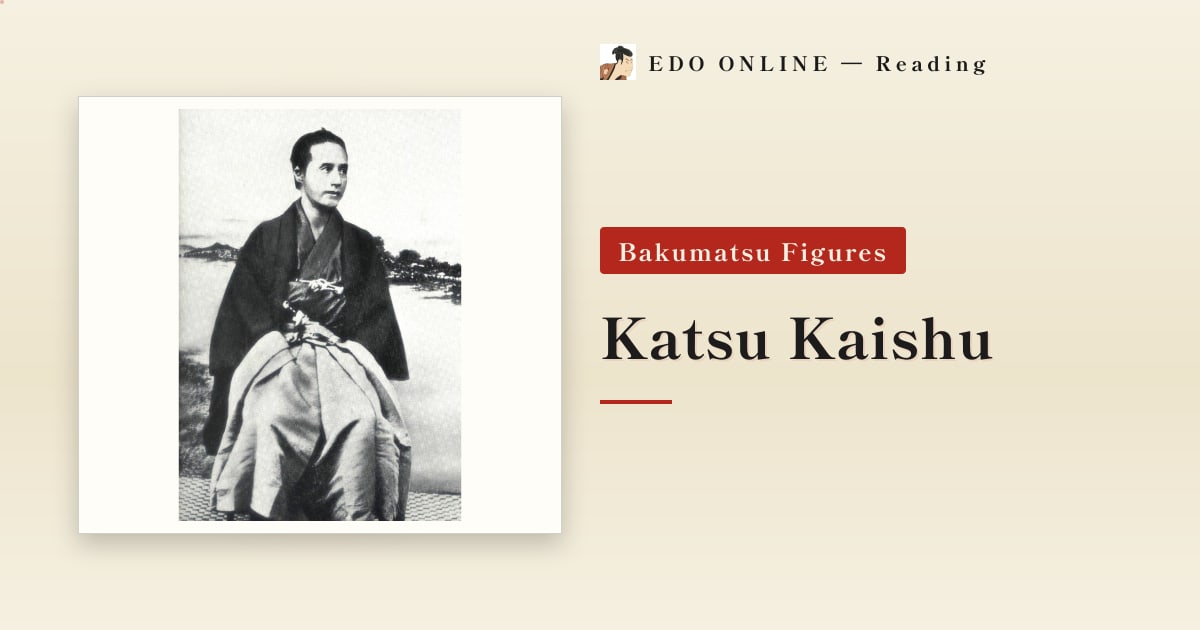
Katsu Kaishū served the Tokugawa shogunate while seeing more clearly than almost anyone that it was finished. His energy went into ensuring that its collapse cost as few lives as possible.
Contents
What did Katsu Kaishu do?
His decisive achievement was the bloodless surrender of Edo in 1868. Negotiating on the shogunate's behalf with Saigō Takamori, he arranged the handover of Edo Castle without a battle, sparing a city of more than a million people.
Before that he had done more than anyone to establish a modern Japanese navy, and had taught a generation of younger men — including Sakamoto Ryōma — who were nominally his enemies.
Katsu Kaishu's early life and the navy
Born in 1823 to a low-ranking shogunal retainer family in Edo, Katsu studied Dutch learning and concluded early that an island country needed a modern fleet.
He trained at the Nagasaki Naval Training Center, and in 1860 crossed the Pacific to America aboard the Kanrin Maru. Seeing the West at first hand permanently widened his frame of reference.
Katsu Kaishu and Sakamoto Ryoma
Katsu attracted young men regardless of their rank or allegiance. Ryōma, a fugitive from Tosa, was among them.
That a shogunal official was arguing for a navy belonging to the country rather than the shogunate made a deep impression on activists who were, formally, his opponents. Katsu had the unusual capacity to draw people across the lines of the conflict.
Katsu Kaishu and the bloodless surrender of Edo
As the Boshin War turned against the shogunate, Katsu was left holding responsibility for the losing side.
With the imperial army approaching Edo and a date set for a general assault, he met Saigō Takamori. In exchange for the shogun's submission, the attack was cancelled and Edo Castle was surrendered without fighting.
The number of lives that decision saved cannot be calculated.
When did Katsu Kaishu die?
Katsu remained involved in public life after the Restoration, mediating between the new government and the former shogunal retainers, and served as navy minister.
He died on 19 January 1899, aged seventy-five — one of the very few participants who lived to see the whole arc of the period from the Black Ships to modern Japan.
Why did Katsu Kaishu never kill anyone?
In an age of political murder, Katsu never killed a man.
He explained why himself, in the collection of his late-life conversations known as Hikawa Seiwa. As a shogunal official versed in Western learning he was repeatedly a target during the years of anti-foreign violence. He did not draw because drawing invites the other man to draw, and killing leaves a grudge behind.
The best-known detail is that he tied the hilt of his sword to its scabbard so that it could not be drawn quickly — physically preventing his own hand from reaching for it. He had trained under Shimada Toranosuke and held a licence in the Jikishinkage school, which makes the discipline more striking rather than less.
The man who spared Edo also spared every individual he met. That consistency is the key to him.
Katsu Kaishu's father, Katsu Kokichi
The Katsu family were shogunal retainers of the lowest and poorest rank. Their samurai status had in fact been purchased: Katsu's great-grandfather, a blind man from Echigo known as Yoneyama Kengyō, made money in moneylending and bought the family's standing.
His father Katsu Kokichi was notorious. He held no proper post, spent his life in brawling and wandering, and retired early. The memoir he wrote of it, Musui's Story, is startlingly frank for a samurai document and is read today as a source on the lives of the lower warrior class.
Poverty, low status, and a father who made no attempt to keep up appearances. This is why Katsu was indifferent to rank, and why he could take a fugitive like Ryōma as a student.
Where is Katsu Kaishu's grave?
His grave is at Senzokuike Park in Ōta ward, Tokyo, where he is buried with his wife Tami.
Beside it stands a monument Katsu erected in memory of Saigō Takamori, later moved to the site. He honoured his old adversary for the rest of his life and worked to restore Saigō's reputation after his death. Senzokuike was land Katsu loved, and he kept a villa there in his later years.
What was Katsu Kaishu like?
The first thing anyone notes is how bluntly he spoke. Hikawa Seiwa has him dissecting the Tokugawa house he had served, and assessing Meiji politicians, with equal lack of deference. It is bracing to read, and it made him enemies.
Underneath is a consistent refusal to flatter himself about reality. He served the shogunate while recognising its limits, and declined to fight battles that could not be won. Edo was the largest instance of that principle.
Photographs show a notably handsome man, and he is still sometimes listed among the good-looking figures of the period. He himself appears to have been entirely uninterested, living out his last years in modest circumstances.
Timeline of Katsu Kaishu's life
| Year | Event |
|---|---|
| 1823 | Born in Honjo, Edo, son of Katsu Kokichi |
| c. 1850 | Opens a school of Dutch learning |
| 1855 | Sent to the Nagasaki Naval Training Center |
| 1860 | Crosses to America aboard the Kanrin Maru |
| 1862 | Appointed to naval office; Sakamoto Ryōma becomes his student |
| 1864 | Opens the Kobe naval school, closed the following year |
| Mar 1868 | Meets Saigō Takamori; Edo is surrendered without a battle |
| 1872 | Enters the Meiji government; later navy minister |
| 19 Jan 1899 | Dies, aged 75 |
Frequently asked questions
Who was Katsu Kaishu?
A shogunal official who built Japan's early modern navy and negotiated the bloodless surrender of Edo Castle in 1868.
Did Katsu Kaishu ever kill anyone?
No. He deliberately avoided drawing his sword throughout the period, and is said to have tied his hilt to the scabbard to make drawing difficult.
What was Katsu Kaishu's relationship with Sakamoto Ryoma?
Ryōma became his student after leaving Tosa, despite the two men formally being on opposite sides.
Where is Katsu Kaishu buried?
At Senzokuike Park in Ōta ward, Tokyo, alongside a monument he raised to Saigō Takamori.
For the man across the table at Edo see Saigō Takamori; for his most famous student see Sakamoto Ryōma.
Related reading
Abe Juro — The Former Member Who Talked
He deserted the Shinsengumi and rejoined under another name, shot at Kondo Isami as one of the Goryō Eji, and then grew apples in Sapporo. His late-Meiji testimony is where the ranking of the corps' best swordsmen comes from.
Ando Hayataro — The Shinsengumi's Record-Breaking Archer
He set the standing national record in the long-range shooting at the Tōdai-ji Great Buddha Hall, sending 8,685 arrows the length of the corridor. Nearly fifty, he joined the Shinsengumi and died of wounds taken in the back garden of the Ikedaya.
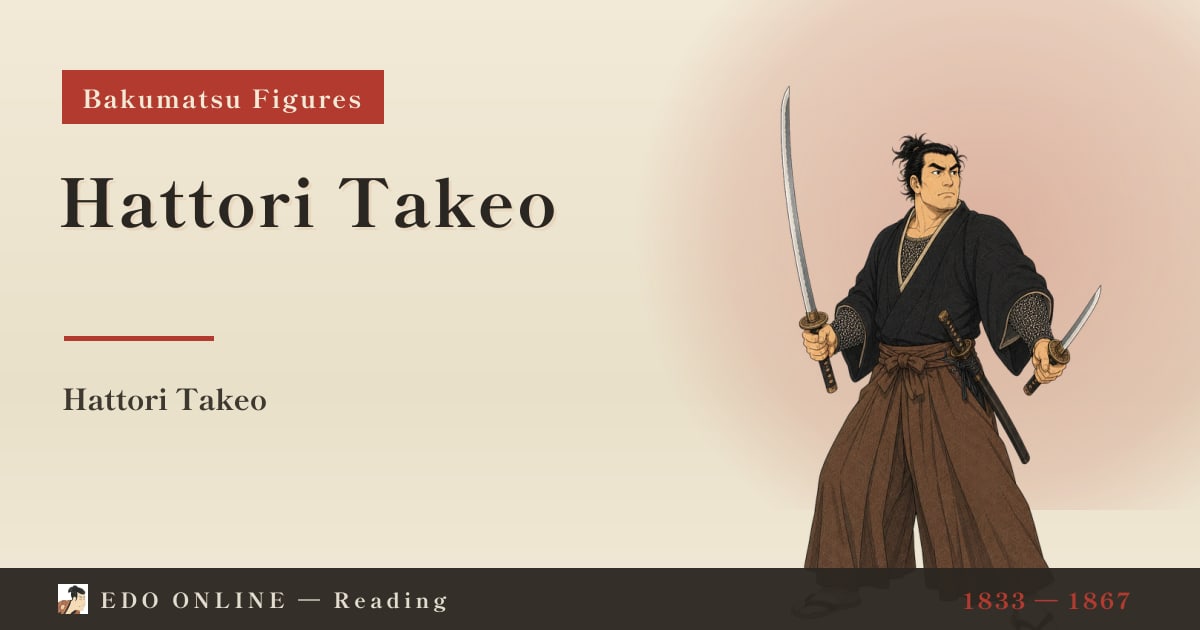
Hattori Takeo — Two Swords at Aburanokoji
A two-sword master and fencing instructor of the Shinsengumi who defected with the Goryō Eji. At Aburanokōji he alone wore mail, held a wall against the whole corps, and fell with more than twenty wounds.