Oguri Tadamasa — He Built Yokosuka, Then Was Beheaded by the New Government
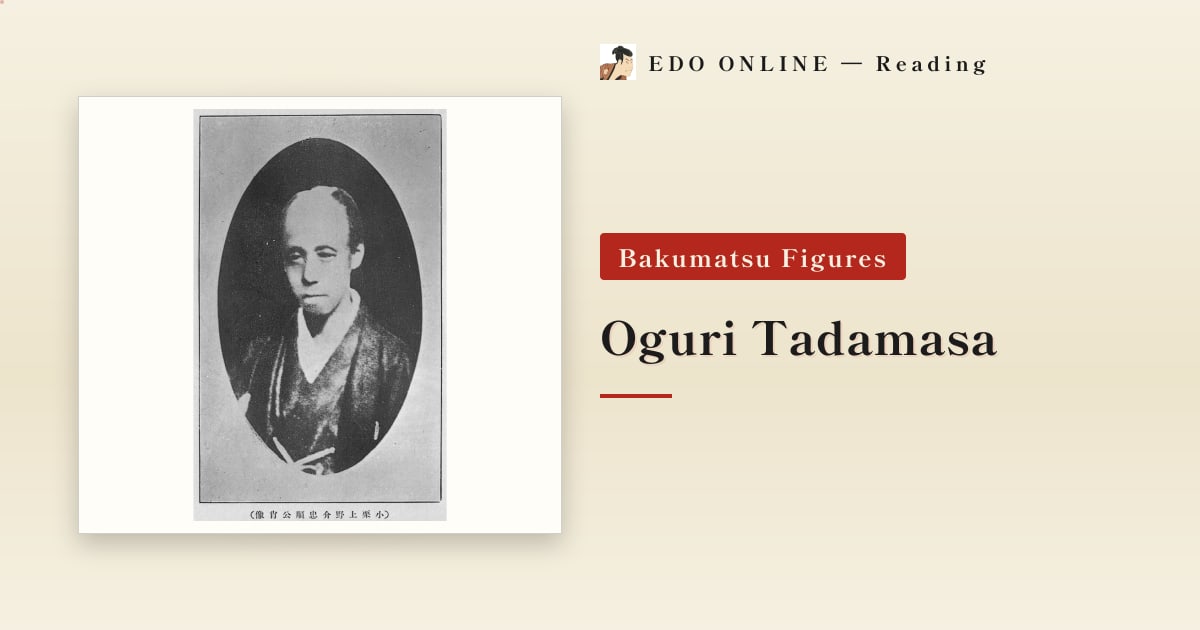
A man built a shipyard that lasted a century, in the last years of the government that paid for it. Oguri Tadamasa. The new government beheaded him.
Contents
Who Was Oguri Tadamasa?
Oguri was a shogunal bannerman and an administrator who held the offices of finance magistrate and several others.
Three things define him.
He went to America. He joined the 1860 embassy as inspector, travelling to exchange the ratifications of the commercial treaty.
He built the Yokosuka works. With French assistance he founded the Yokosuka iron foundry, later the Yokosuka shipyard — which went on serving as Japan's naval arsenal long after the shogunate was gone.
He argued for fighting on. After the defeat at Toba-Fushimi he pressed for resistance in council at Edo Castle, was overruled, and lost every office he held.
He was born in 1827 and died in 1868.
How Oguri Tadamasa Had the Gold Assayed in America
Oguri became a shogunal inspector in 1859.
The following year the embassy to the United States sailed, to exchange ratifications of the Treaty of Amity and Commerce. Oguri went as its overseer.
What he did there says a good deal about him.
The exchange rate between the Japanese koban and the American dollar was in dispute, and Japan was being held to unfavourable terms.
At the American mint, Oguri had Japanese and American gold coins actually assayed — the gold content measured and compared. He then argued from the numbers that the ratio did not match the metal.
He answered an argument with a measurement. The episode is among the best-known of the embassy — though he did not secure a revision of the exchange terms. The logic was conceded; the treaty was not changed.
Oguri Tadamasa and the Yokosuka Ironworks
Back home he held one senior office after another: foreign magistrate, finance magistrate, naval magistrate, city magistrate of Edo. For a period he had the shogunate's finances and its military administration in one pair of hands.
The project he pushed hardest was the Yokosuka iron foundry.
The premise was simple: stop buying warships and become able to build them. That required a foundry, a shipyard, and a school to train engineers.
Oguri worked with the French minister Léon Roches to bring in French technology and personnel. Ground was broken on 15 November 1865 — the twenty-seventh day of the ninth lunar month of Keio 1.
He is said to have remarked at the time that the works would remain in Japan even if the shogunate fell. The exact wording varies between accounts — but the substance held.
Yokosuka passed to the Meiji government and became the arsenal of the Imperial Japanese Navy. A Tokugawa legacy underwrote the navy of the government that destroyed the Tokugawa.
Why Oguri Tadamasa Wanted to Fight On
In January 1868 the shogunate's army lost at Toba-Fushimi and Tokugawa Yoshinobu returned from Osaka to Edo.
In council, Oguri argued for resistance.
His case was not sentiment. The new government's forces had long supply lines and no navy. The shogunate had a fleet and Yokosuka behind it. Hold them at Hakone, then strike their rear from the sea — a military calculation.
Yoshinobu chose submission. Katsu Kaishu and Takahashi Deishu, among others, held him to that course.
Oguri was stripped of every post.
How Oguri Tadamasa Died at Gonda Village
Out of office, Oguri withdrew to his fief at Gonda village in Kozuke province, in what is now Takasaki, Gunma Prefecture.
He believed he had left politics.
The new government's forces came for him anyway — an administrator from the centre of the shogunate who had argued for war.
In May 1868 he was seized and beheaded on the bank of the Karasu River. There was no meaningful investigation.
He was forty.
Oguri Tadamasa's Reputation
Oguri was filed for a long time under "the losing side."
What he left, though, is concrete: the Yokosuka shipyard, French-style military reform, a plan for something close to a joint-stock trading company, proposals for postal service and railways. A large share of what the Meiji government did was the continuation of work Oguri had started.
There is a story that, after Japan's naval victory at Tsushima, former navy men conveyed their thanks to Oguri's surviving family — that the fleet could fight because Yokosuka existed. It comes down as anecdote, and the details vary.
Oguri Tadamasa's Grave
His grave is at Tozen-ji in Kurabuchi, Takasaki, Gunma Prefecture, near where he died. The area is presented locally as "Oguri's village," with a small museum.
The man who built the shogunate's shipyard lies in a mountain village.
Oguri Tadamasa Timeline
| Year | Event |
|---|---|
| 1827 | Born into the Oguri, a shogunal bannerman house |
| 1859 | Appointed shogunal inspector |
| 1860 | Sails with the embassy to the United States; proves the currency discrepancy by assay |
| early 1860s | Foreign, finance, naval and Edo city magistrate |
| Nov 1865 | Breaks ground on the Yokosuka iron foundry with Léon Roches |
| Jan 1868 | Argues for resistance after Toba-Fushimi; stripped of all offices |
| May 1868 | Captured at Gonda and beheaded on the Karasu River, aged 40 |
For those who chose submission see Katsu Kaishu and Takahashi Deishu; for the shogun he served, Tokugawa Yoshinobu.
Related reading
Abe Juro — The Former Member Who Talked
He deserted the Shinsengumi and rejoined under another name, shot at Kondo Isami as one of the Goryō Eji, and then grew apples in Sapporo. His late-Meiji testimony is where the ranking of the corps' best swordsmen comes from.
Ando Hayataro — The Shinsengumi's Record-Breaking Archer
He set the standing national record in the long-range shooting at the Tōdai-ji Great Buddha Hall, sending 8,685 arrows the length of the corridor. Nearly fifty, he joined the Shinsengumi and died of wounds taken in the back garden of the Ikedaya.
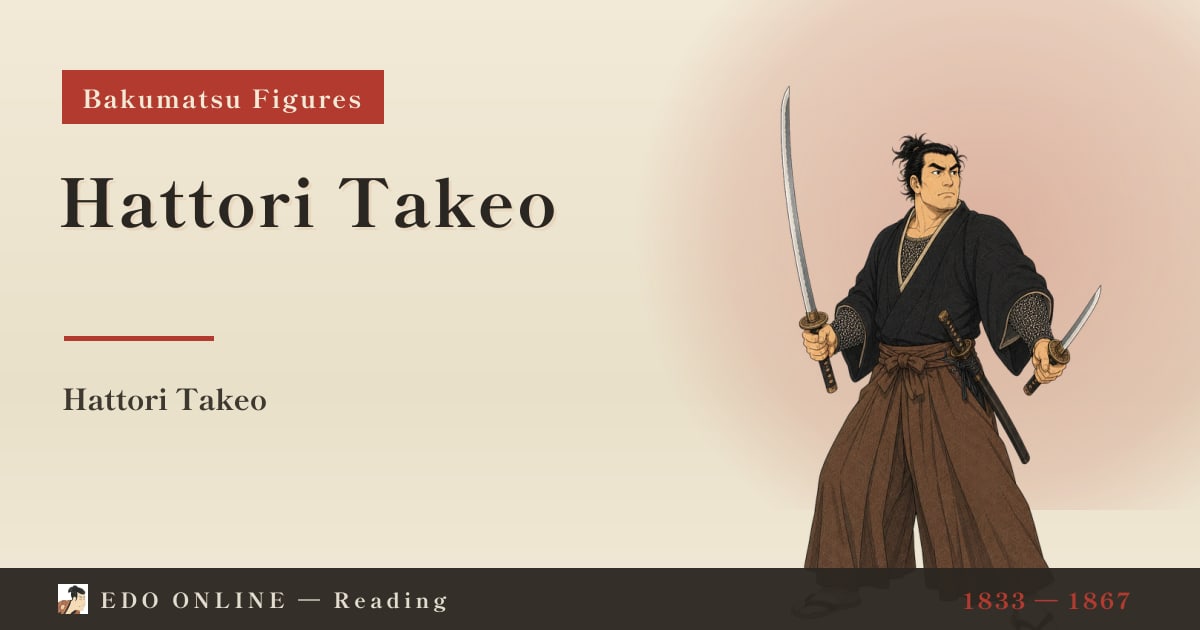
Hattori Takeo — Two Swords at Aburanokoji
A two-sword master and fencing instructor of the Shinsengumi who defected with the Goryō Eji. At Aburanokōji he alone wore mail, held a wall against the whole corps, and fell with more than twenty wounds.