Enomoto Takeaki — The Rebel Admiral Who Became a Cabinet Minister
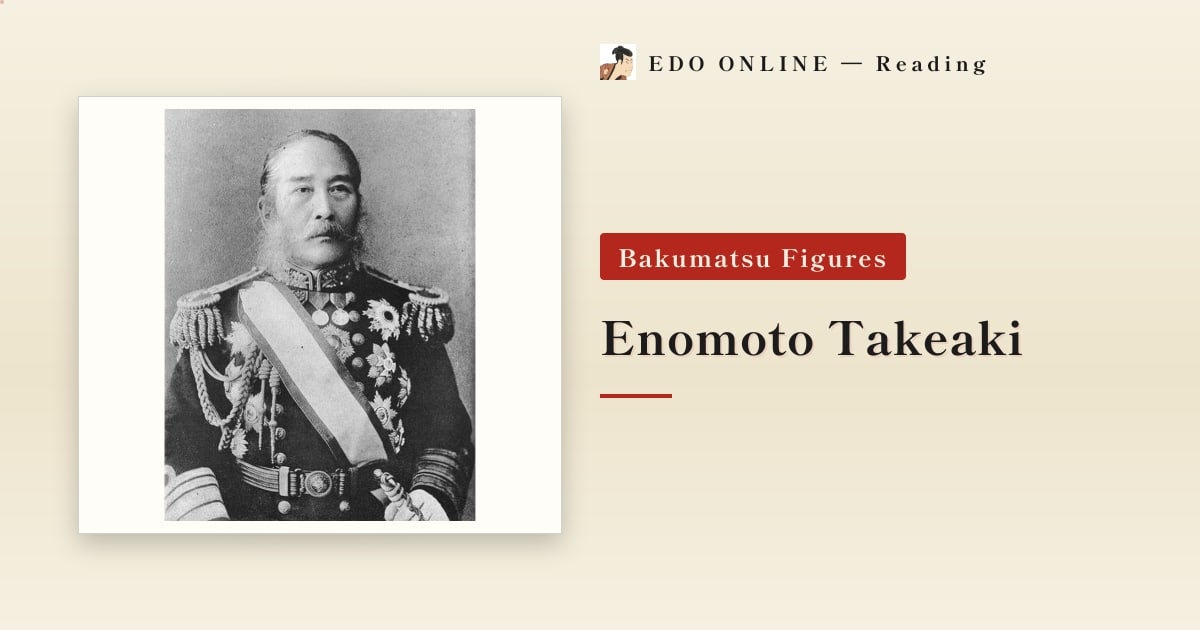
The man who held out longest against the new government, fortified inside Goryokaku, went on to serve that same government as a cabinet minister, repeatedly. Enomoto Takeaki had one of the strangest careers of his generation.
Contents
Who Was Enomoto Takeaki?
Three distinct lives.
A shogunal naval officer. He studied in the Netherlands, learned naval science and international law, and brought home the warship Kaiyo Maru.
Head of a breakaway regime. In the final phase of the Boshin War he led the fleet out of Edo, seized Hakodate and Goryokaku, and fought the imperial forces from there.
A Meiji statesman. Defeated and imprisoned, he was released and went on to hold four different ministries.
The commander of the losing side became a minister of the winning one. How that happened is the central question about him.
Enomoto Takeaki in Holland and the Kaiyo Maru
Born in Edo in 1836 to a shogunal retainer family, Enomoto studied at the Shoheizaka academy and then at the Nagasaki Naval Training Center.
In 1862 the shogunate sent students to the Netherlands, Enomoto among them. What he acquired there was not only seamanship but international law.
After nearly five years he returned with the Kaiyo Maru, a warship the shogunate had commissioned — among the most powerful vessels in Japanese waters — and effectively commanded her.
Why Enomoto Takeaki Sailed North to Ezo
In 1868 Edo Castle was surrendered without a fight, through the negotiation between Katsu Kaishu and Saigo Takamori.
Enomoto refused to accept it. Taking the fleet out of Edo Bay was not simple defiance: he intended to secure land where displaced shogunal retainers could live.
Settle Ezo, put the former retainers on it, and hold the northern frontier. With Russian expansion a live concern, this was not a fantasy.
After taking Hakodate, the officers elected their leadership by ballot, and Enomoto received the most votes, taking the title sosai — head of the administration. The arrangement is often called the Ezo Republic, though that name was applied later rather than claimed at the time.
They did not, however, declare independence. Their formal position was a petition to the court for permission to develop Ezo — a supplicant's posture maintained to the end.
Enomoto Takeaki's Defeat at Goryokaku
Imperial forces landed in 1869. The Kaiyo Maru had already run aground and sunk off Esashi, and with her went the naval advantage.
Hijikata Toshizo was killed at Hakodate in this campaign. Goryokaku was encircled, and Enomoto surrendered.
Why Was Enomoto Takeaki Spared?
He was taken to Tokyo and imprisoned. As the head of the last armed resistance, execution was the expected outcome, and there were strong voices in the government demanding it.
He was released after two and a half years. Two reasons are usually given.
Kuroda Kiyotaka campaigned for his life. Kuroda, the commander who had accepted his surrender, thought the man too valuable to kill and lobbied hard — reportedly shaving his head as a gesture of appeal.
And Enomoto had sent the enemy a book. On surrendering, he passed to the opposing commander the treatise on international maritime law he had brought back from the Netherlands. Knowledge that would simply burn if the fortress burned, handed to the side that was going to win.
The gesture captures him. What he was trying to preserve was not the shogunate as an institution but the knowledge and people the country would need.
Japan at that moment had almost no one who understood northern development, international law, and naval matters at once. Kuroda's intercession and Enomoto's technical expertise are both thought to have contributed to the commutation, though no source states the government's collective reasoning directly.
Enomoto Takeaki in the Meiji Government
After his release Enomoto joined the Hokkaido Colonization Office — the man who had gambled everything on Ezo now developing it from the government's side.
He then served as minister to Russia, negotiating the exchange of Sakhalin and the Kurils, and afterward held the communications, education, foreign affairs, and agriculture-and-commerce portfolios.
Not everyone approved. Among former shogunal men, his transformation was resented, and Fukuzawa Yukichi's public criticism of how he conducted himself is well known. The charge that he failed to go down with his lord followed him for life.
He died in 1908 at seventy-two, after a period of illness.
Enomoto Takeaki Timeline
| Year | Event |
|---|---|
| 1836 | Born in Edo to a shogunal retainer family |
| c. 1856 | Studies at the Nagasaki Naval Training Center |
| 1862 | Sent to the Netherlands to study naval science and international law |
| 1867 | Returns with the warship Kaiyo Maru |
| 1868 | Rejects the surrender of Edo and sails north with the fleet |
| late 1868 | Seizes Hakodate and Goryokaku; elected sosai |
| 1869 | Surrenders; imprisoned in Tokyo |
| 1872 | Released; joins the Colonization Office |
| 1875 | Negotiates the Treaty of Saint Petersburg as minister to Russia |
| 1908 | Dies, aged 72 |
For the campaign itself see Goryokaku and the Boshin War.
Related reading
Abe Juro — The Former Member Who Talked
He deserted the Shinsengumi and rejoined under another name, shot at Kondo Isami as one of the Goryō Eji, and then grew apples in Sapporo. His late-Meiji testimony is where the ranking of the corps' best swordsmen comes from.
Ando Hayataro — The Shinsengumi's Record-Breaking Archer
He set the standing national record in the long-range shooting at the Tōdai-ji Great Buddha Hall, sending 8,685 arrows the length of the corridor. Nearly fifty, he joined the Shinsengumi and died of wounds taken in the back garden of the Ikedaya.
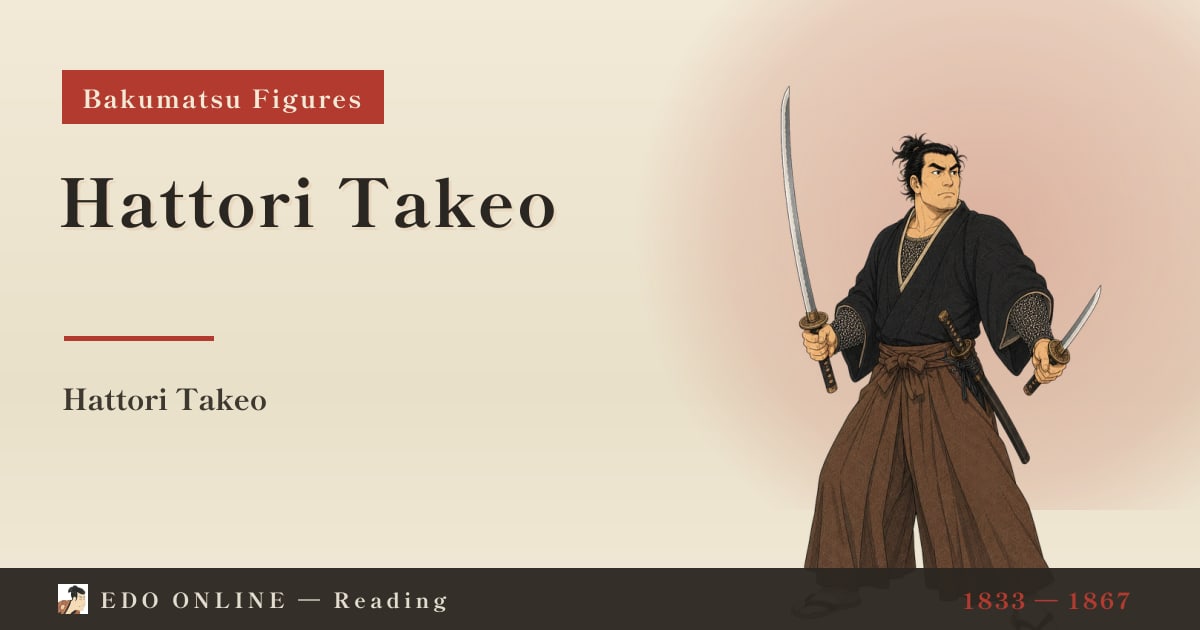
Hattori Takeo — Two Swords at Aburanokoji
A two-sword master and fencing instructor of the Shinsengumi who defected with the Goryō Eji. At Aburanokōji he alone wore mail, held a wall against the whole corps, and fell with more than twenty wounds.