Oishi Kuwajiro — The Shinsengumi's Reputed Assassin
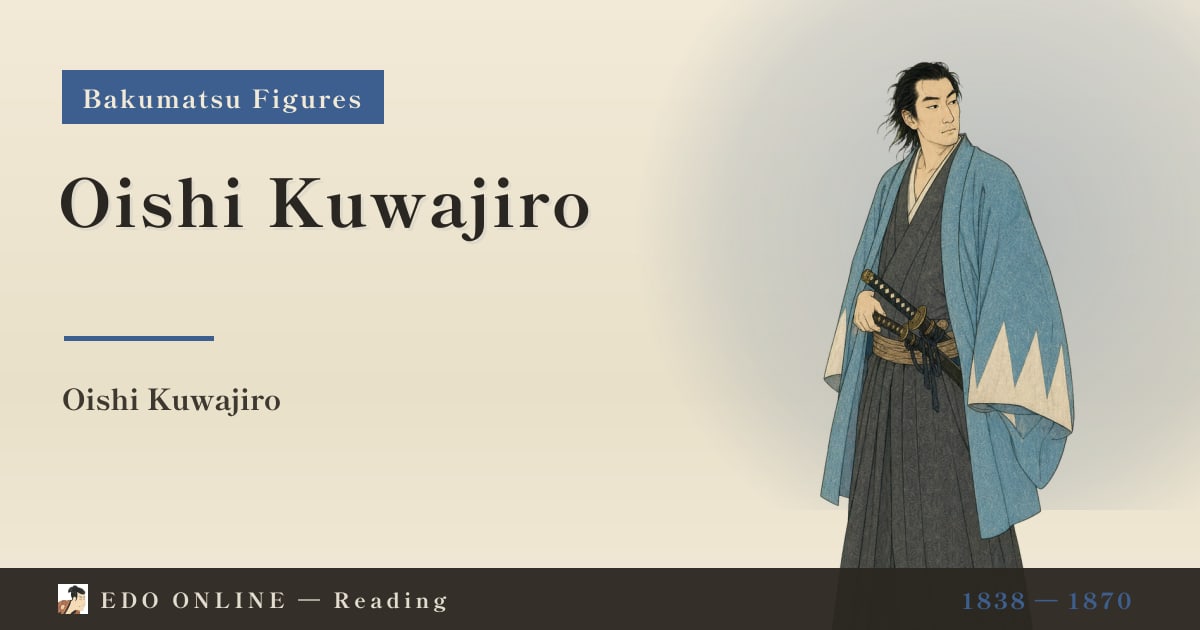
One Shinsengumi man is remembered as "Kuwajirō the killer." Ōishi Kuwajirō. The nickname comes from a book that cannot be trusted.
Contents
Who Was Oishi Kuwajiro?
Ōishi was an inspector of the Shinsengumi.
He was born in 1838, eldest son of Ōishi Sutejirō, an attendant of the Hitotsubashi house — one of the three cadet Tokugawa lines.
What is firmly established is that he assassinated Ito Kashitaro in the Aburanokōji affair of November 1867.
He was beheaded for that killing on 3 November 1870. Because his birth is dated only to the year, his age is either thirty-one or thirty-two.
How Oishi Kuwajiro Reached the Shinsengumi
His route in is a shogunal retainer's son dropping down a class and re-entering.
He left home over some trouble — a matter involving a woman, by one account — and took live-in work with a carpenter at Hino in Musashi province.
That carpenter did work for the household of Satō Hikogorō. Hikogorō was the village headman of Hino, married to Hijikata Toshizo's elder sister, and kept a Tennen Rishin-ryū fencing hall in his own house.
Ōishi began training there. His nominal school was Ono-ha Ittō-ryū, but through this connection he also learned Tennen Rishin-ryū.
He joined the corps during Kondo Isami's Edo recruiting drive after the Ikedaya Incident in 1864.
Yamazaki Susumu's investigation diary of May 1865 places him by then in the first unit under Okita Soji.
In September 1866 he led a detachment in the Sanjō noticeboard affair, and when the corps was raised to shogunal retainer status in June 1867 he was appointed inspector.
How Much of "Kuwajiro the Killer" Is True?
Every account of Ōishi arrives at the same line: that he was assigned chiefly to assassination and feared as "Kuwajirō the killer."
This needs care.
The source is Nishimura Kanefumi's Shinsengumi Shimatsuki. Nishimura's work is known to contain a great deal of fabrication, and anything resting on it carries substantial doubt.
Separately, though, there is a record of him being rated as a swordsman. The Shidankai Sokkiroku, compiled from the testimony of old men in the Taishō era, has Ōishi named repeatedly alongside Okita Soji as a fighter of note.
So: "he was good with a sword" is supported from more than one direction, while "assassination was his job" is doubtful. The two claims should be kept apart.
That said, Ōishi did in fact kill Ito Kashitaro. The nickname may be invention; the act was not.
Oishi Kuwajiro and the Aburanokoji Affair
In the Aburanokōji affair of November 1867, Ōishi assassinated Ito Kashitaro.
Itō had been the corps' staff officer before breaking away with the Goryō Eji as an imperial loyalist. The method was this: Kondo Isami invited him to a banquet at his mistress's house, and Ōishi's party lay in wait on the road home.
In the Tenmaya affair that December he served with Saito Hajime as bodyguard to the Kishū retainer Miura Kyūtarō.
After the defeat at Toba-Fushimi in January 1868 the corps withdrew to Edo. When Kondo Isami raised the Kōyō Chinbutai, Ōishi went ahead into Kai province as its advance party.
When that force was routed in March, he disappeared.
Oishi Kuwajiro's Arrest and the Ryoma Accusation
He went into hiding in Edo with his wife and children.
Around December 1868 he was arrested after being deceived by Mitsui Ushinosuke, a former member of the corps he had been close to.
Another version exists: that, destitute, he called on Kanō Washio — one of the Itō faction who had joined the imperial army — begging for a post, was refused and arrested. No record supports this, and it contradicts the testimony of Kanō's comrade Abe Jūrō.
Once in custody, Ōishi was accused of assassinating Sakamoto Ryoma at the Ōmiya.
Unable to withstand severe torture, he confessed to it.
He later retracted the confession and said the Mimawarigumi had done it. Responsibility for the Ōmiya killing is now generally placed with the Mimawarigumi, Sasaki Tadasaburo among them, and Ōishi's confession is treated as a statement extracted under torture.
The episode is a plain demonstration of what such confessions are worth.
On 3 November 1870 he was beheaded for the murder of Ito Kashitaro.
On that same day Soma Kazue, the corps' last commander, was exiled to Niijima on suspicion in the same killing. The sentences arising from Itō's death were carried out together.
His eldest son Raitarō, fearing investigation, changed his name to Honma Utakichi and set up as a tortoiseshell craftsman in Shitaya.
Frequently asked questions
Who was Oishi Kuwajiro?
An inspector of the Shinsengumi. He assassinated the corps' staff officer Ito Kashitaro in the Aburanokōji affair of 1867.
Was "Kuwajiro the killer" a real nickname?
It comes from Nishimura Kanefumi's heavily fabricated account and is doubtful. That he was a capable swordsman, however, is supported by other sources.
Did Oishi Kuwajiro assassinate Sakamoto Ryoma?
There is no reliable evidence that he did. He confessed under torture and then retracted, naming the Mimawarigumi, who are generally held responsible for the Ōmiya killing.
How did Oishi Kuwajiro die?
He was beheaded on 3 November 1870 for the murder of Ito Kashitaro, aged thirty-one or thirty-two.
Oishi Kuwajiro Timeline
| Year | Event |
|---|---|
| 1838 | Born eldest son of an attendant of the Hitotsubashi house |
| After leaving home | Works for a carpenter at Hino; trains at Satō Hikogorō's fencing hall |
| Autumn 1864 | Joins the Shinsengumi in the Edo drive after the Ikedaya Incident |
| May 1865 | Assigned to the first unit under Okita Soji |
| Sep 1866 | Leads a detachment in the Sanjō noticeboard affair |
| Jun 1867 | Appointed inspector as the corps becomes shogunal retainers |
| Nov 1867 | Assassinates Ito Kashitaro at Aburanokōji |
| Dec 1867 | Guards Miura Kyūtarō with Saito Hajime in the Tenmaya affair |
| Mar 1868 | Disappears when the Kōyō Chinbutai is routed |
| c. Dec 1868 | Arrested; accused of assassinating Sakamoto Ryoma |
| 3 Nov 1870 | Beheaded for Itō's murder, aged thirty-one or thirty-two |
For the man he killed see Ito Kashitaro; for the man exiled the same day, Soma Kazue; for the roster, the Shinsengumi members; for the corps, the Shinsengumi.
Related reading
Abe Juro — The Former Member Who Talked
He deserted the Shinsengumi and rejoined under another name, shot at Kondo Isami as one of the Goryō Eji, and then grew apples in Sapporo. His late-Meiji testimony is where the ranking of the corps' best swordsmen comes from.
Ando Hayataro — The Shinsengumi's Record-Breaking Archer
He set the standing national record in the long-range shooting at the Tōdai-ji Great Buddha Hall, sending 8,685 arrows the length of the corridor. Nearly fifty, he joined the Shinsengumi and died of wounds taken in the back garden of the Ikedaya.
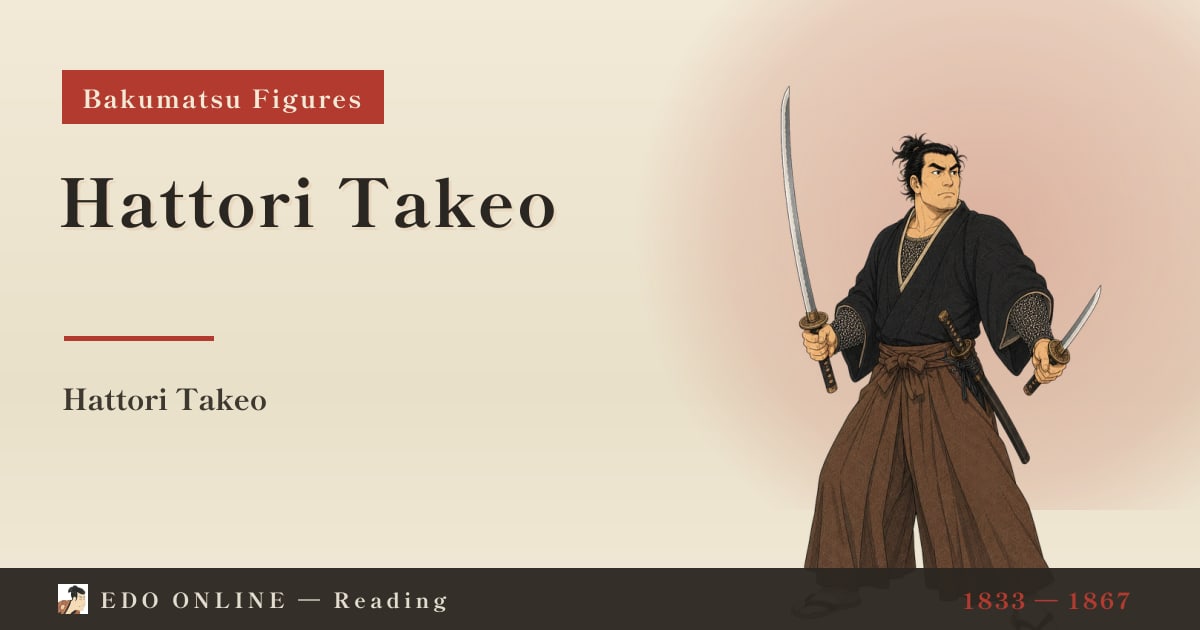
Hattori Takeo — Two Swords at Aburanokoji
A two-sword master and fencing instructor of the Shinsengumi who defected with the Goryō Eji. At Aburanokōji he alone wore mail, held a wall against the whole corps, and fell with more than twenty wounds.