Who Was Sakamoto Ryoma? Life, Achievements and Assassination
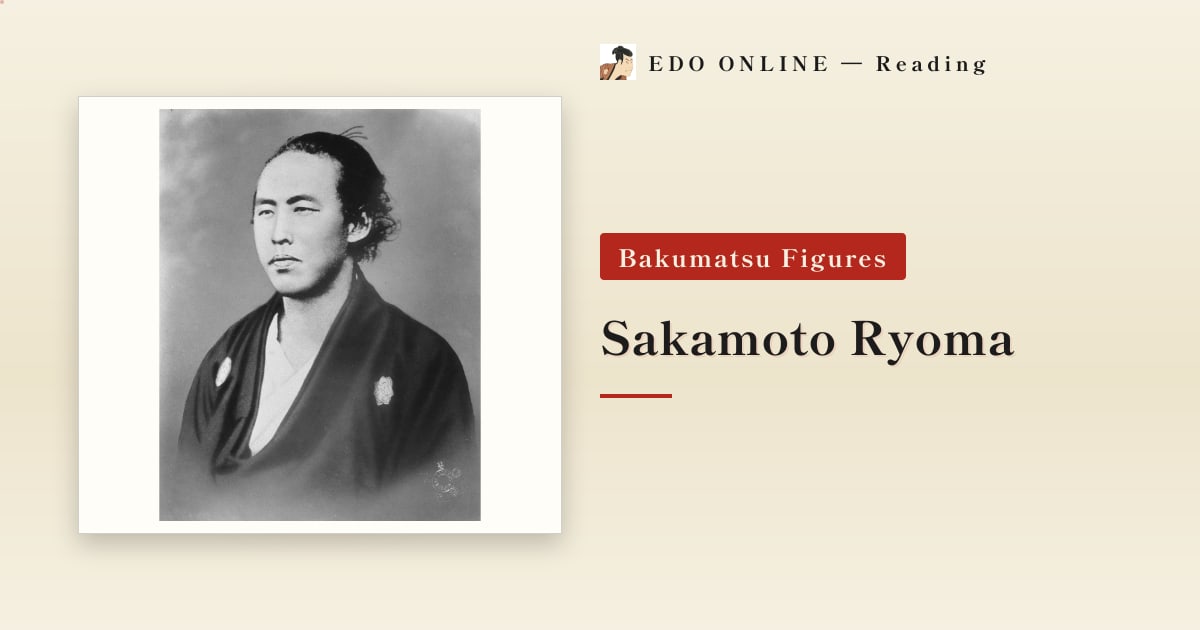
Among the many activists of the Bakumatsu, few are remembered as vividly as Sakamoto Ryōma. Though only a low-ranking samurai, he helped bind together the bitter rivals Satsuma and Chōshū and set in motion the current that swept away the shogunate. His life lasted barely thirty-one years.
Contents
What did Sakamoto Ryoma actually do?
Ryōma is often described in sweeping terms, so it helps to be specific. Three concrete achievements stand out.
| Achievement | What it meant |
|---|---|
| Brokered the Satsuma-Chōshū Alliance | Brought two domains that had recently fought each other into a secret pact against the shogunate |
| Founded the Kaientai | A private trading and shipping company, remarkable for treating commerce as a political instrument |
| Shaped the case for the return of power | Argued for transferring authority to the imperial court without civil war |
What distinguishes him is the method rather than the goal. Many activists wanted the shogunate gone; Ryōma pursued it through negotiation, trade and ships rather than assassination.
Sakamoto Ryoma's early life in Tosa
Ryōma was born in 1836 in Kōchi, the castle town of Tosa domain. His family were gōshi, a lower grade of samurai; the Sakamoto house had in fact purchased its samurai standing from merchant origins.
Tosa enforced an unusually rigid divide between the upper jōshi and the lower gōshi. Ryōma grew up on the wrong side of that line, and the experience appears to have shaped his lifelong indifference to rank.
As a young man he trained in swordsmanship, travelling to Edo to study the Hokushin Ittō style at the Chiba school. He was in the capital in 1853 when Perry's Black Ships arrived.
Why did Sakamoto Ryoma leave his domain?
In 1862 Ryōma committed the serious offence of leaving Tosa without permission. Desertion carried severe penalties and effectively made him an outlaw.
The decision paid off in an unexpected way. He met Katsu Kaishū, a shogunal official who, despite serving the very government the activists opposed, argued that Japan needed a modern navy. Ryōma became his student.
From Nagasaki he then built a trading and shipping venture that became the Kaientai. Moving the country through commerce and ships, rather than swords, was an unusual idea for the time.
The Satsuma-Choshu Alliance
Ryōma's place in history rests above all on the Satsuma-Chōshū Alliance of 1866.
The two domains had recently been shooting at each other in Kyoto. Chōshū had been branded an enemy of the court; Satsuma had helped put it there. Yet neither could check the shogunate alone.
Ryōma and Nakaoka Shintarō shuttled between them for months. When the two sides finally met in Kyoto, neither would raise the subject first, since to do so would look like pleading. Ryōma, arriving late, is said to have broken the deadlock by pressing Satsuma to acknowledge Chōshū's position.
The Terada-ya incident
Two years before his death, Ryōma nearly died in a separate attack.
In March 1866, days after the alliance was sealed, officers raided the Terada-ya inn in Fushimi where he was staying. Oryō, who was bathing downstairs, is said to have run up to warn him. Ryōma fought them off with a pistol given to him by Takasugi Shinsaku, taking deep wounds to his hand before escaping to the Satsuma residence.
He then travelled to the hot springs of Kirishima with Oryō to recover, a journey often described as Japan's first honeymoon.
Note that a different, unrelated incident at the same inn in 1862 involved a purge of Satsuma retainers. The two are frequently confused.
Who killed Sakamoto Ryoma?
On 10 December 1867, Ryōma was attacked at the Ōmiya, a soy sauce merchant's house in Kyoto, together with Nakaoka Shintarō. He was thirty-one. The identity of the killers has never been settled.
The Kyoto Mimawarigumi. The most widely accepted theory today. After the Restoration, a former member named Imai Nobuo admitted involvement, and the unit's commander Sasaki Tadasaburō is thought to have ordered it. Ryōma was, from the shogunate's point of view, a clear threat.
The Shinsengumi. The immediate suspicion at the time. Evidence left at the scene pointed their way and several members were detained, but nothing conclusive emerged.
A Satsuma conspiracy. A later theory holding that factions favouring armed overthrow removed Ryōma because the peaceful transfer of power undercut their case. The documentary support is weak.
What can be said with confidence is only that Ryōma was a genuine threat to the shogunate. Beyond that, the question remains open.
Nakaoka was not killed outright and survived two days. His account is the closest thing to eyewitness testimony we have, but he could not identify the attackers.
Timeline of Sakamoto Ryoma's life
| Year | Event |
|---|---|
| 1836 | Born into a gōshi family in Tosa |
| 1853 | Studies swordsmanship in Edo; Perry arrives |
| 1862 | Leaves Tosa without permission; becomes Katsu Kaishū's student |
| 1865 | Founds the Kameyama Shachū in Nagasaki, later the Kaientai |
| Mar 1866 | Satsuma-Chōshū Alliance concluded; attacked at the Terada-ya |
| 1867 | The shogun returns political authority to the emperor |
| 10 Dec 1867 | Assassinated at the Ōmiya in Kyoto, aged 31 |
What was Sakamoto Ryoma like?
The best evidence for his character is his letters, an unusually large number of which survive. Those to his elder sister Otome are casual, full of jokes, and willing to laugh at his own failures. The voice is direct and entirely unstuffy.
He refused to be constrained by rank in a domain obsessed with it, deserted at great personal risk, studied under an official of the enemy government, and moved freely between two domains that hated each other. A striking indifference to position and label runs through everything he did.
The bold, romantic hero of later novels and television is substantially an invention. For the historical Ryōma, the letters remain the safest guide.
Sakamoto Ryoma's grave and related sites
Ryōma is buried at Kyoto Ryozen Gokoku Shrine in eastern Kyoto, alongside Nakaoka Shintarō. The surrounding hillside holds the graves of many Bakumatsu activists.
- Kōchi, Kaminomachi — his birthplace, marked by a monument
- Ōmiya site, Kyoto — a stone marker on Kawaramachi Street
- Terada-ya, Fushimi — the inn where he was attacked
- Nagasaki — the site of the Kameyama Shachū
- Katsurahama, Kōchi — the well-known statue facing the Pacific
Frequently asked questions
Who was Sakamoto Ryoma?
A low-ranking samurai from Tosa domain who left his domain, founded a trading company, and brokered the alliance between Satsuma and Chōshū that made the fall of the shogunate possible.
Who killed Sakamoto Ryoma?
It has never been established. The Kyoto Mimawarigumi is the leading theory, based on a former member's confession after the Restoration.
How old was Sakamoto Ryoma when he died?
Thirty-one. He was assassinated in December 1867, a month after the shogun returned power to the emperor.
Why is Sakamoto Ryoma so famous in Japan?
His reputation grew substantially after his death, particularly through twentieth-century novels. He was less prominent in his own lifetime than his modern fame suggests.
For the alliance he brokered see the Satsuma-Chōshū Alliance; for the men around him, see Nakaoka Shintarō and Katsu Kaishū.
Related reading
Abe Juro — The Former Member Who Talked
He deserted the Shinsengumi and rejoined under another name, shot at Kondo Isami as one of the Goryō Eji, and then grew apples in Sapporo. His late-Meiji testimony is where the ranking of the corps' best swordsmen comes from.
Ando Hayataro — The Shinsengumi's Record-Breaking Archer
He set the standing national record in the long-range shooting at the Tōdai-ji Great Buddha Hall, sending 8,685 arrows the length of the corridor. Nearly fifty, he joined the Shinsengumi and died of wounds taken in the back garden of the Ikedaya.
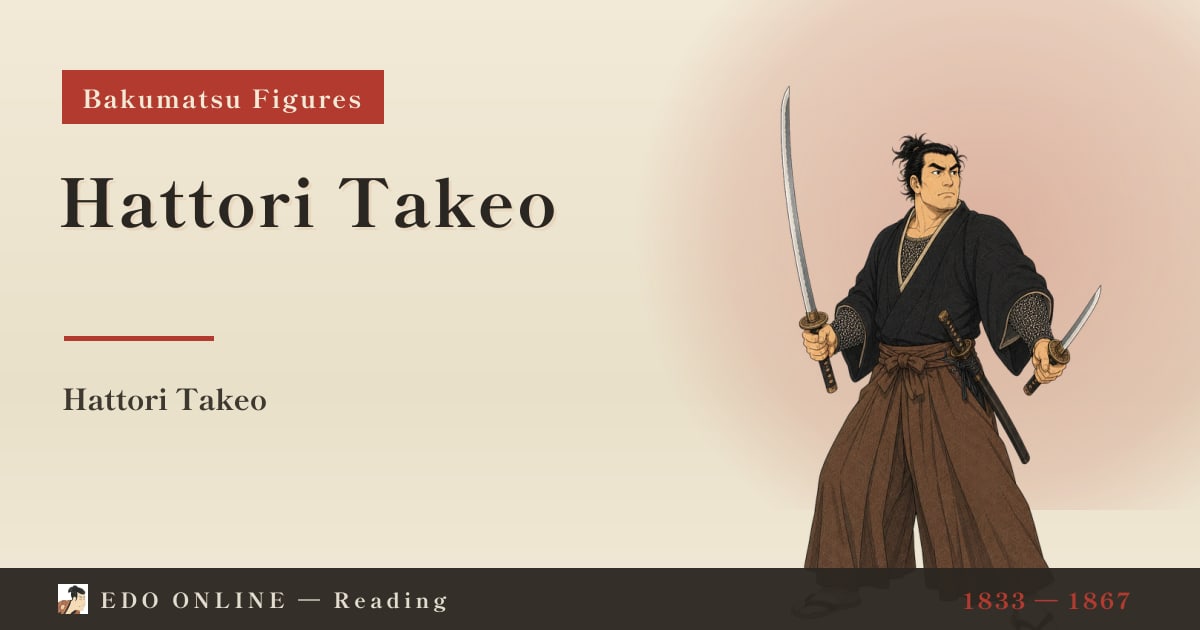
Hattori Takeo — Two Swords at Aburanokoji
A two-sword master and fencing instructor of the Shinsengumi who defected with the Goryō Eji. At Aburanokōji he alone wore mail, held a wall against the whole corps, and fell with more than twenty wounds.