Matsudaira Shungaku — The Lord Who Loosened the Shogunate to Save It
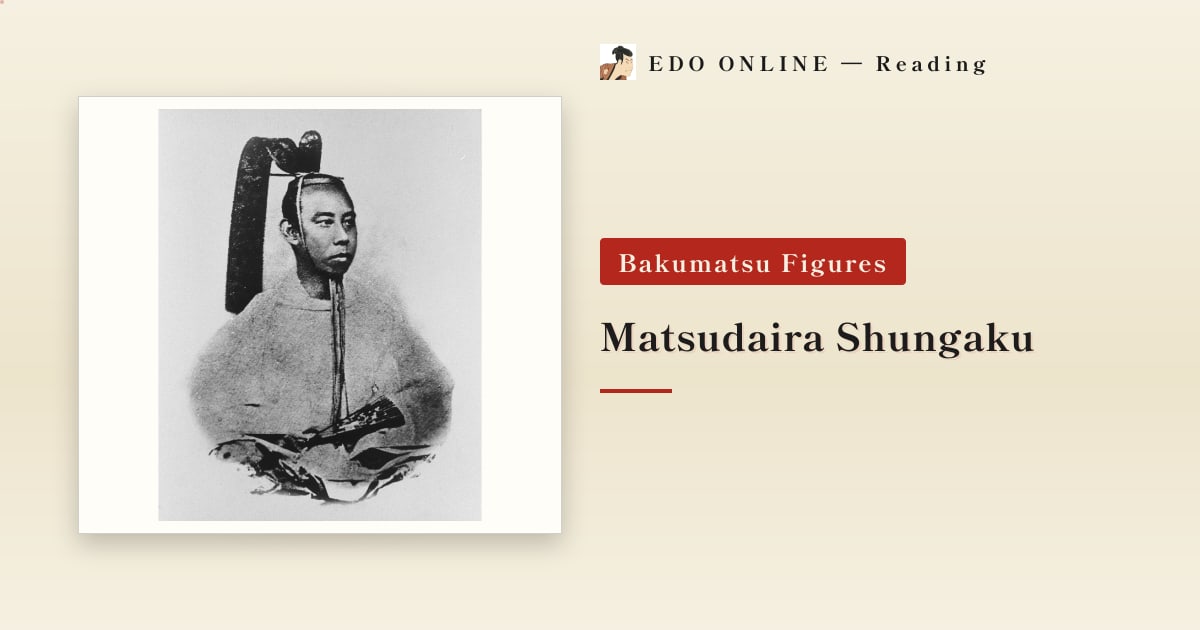
One daimyo tried to save the shogunate by dismantling the machinery that held it together. Matsudaira Shungaku, lord of Fukui.
Contents
Who Was Matsudaira Shungaku?
Shungaku was the sixteenth lord of Fukui domain in Echizen. His given name was Yoshinaga; Shungaku was his art name.
Three things define him.
A domain reformer. He promoted talented men from low-ranking retainer and domain-physician families — Hashimoto Sanai and Yuri Kimimasa — and rebuilt Fukui's finances and schooling.
A reformer of the shogunate. As president of political affairs from 1862 he pushed changes including the relaxation of alternate attendance.
A man who wanted the Tokugawa to land softly. After the return of power to the court he joined Yamauchi Yodo in opposing the punishment of Tokugawa Yoshinobu.
He was born in 1828 and died in 1890.
Matsudaira Shungaku's Tokugawa Blood
Shungaku was born into the Tayasu Tokugawa, one of the three cadet houses closest to the shogun's own line.
While still in his early teens he became lord of Fukui — a domain descended from Tokugawa Ieyasu's second son, and of very high standing.
Shogunal blood, and a great domain. That position dictated how he acted for the rest of his life: he was born with standing to tell the shogunate what he thought.
Why Matsudaira Shungaku Hired Without Regard to Rank
The first thing that stands out in his administration is whom he promoted.
Hashimoto Sanai was a domain physician's son, not of high warrior stock. Shungaku placed him at the centre of Fukui's diplomacy and reform.
Yuri Kimimasa was a low-ranking retainer. Shungaku handed him the domain's finances, and Yuri rebuilt them with paper money and raw-silk exports.
Those two appointments made Fukui's Bakumatsu. Sanai on politics, Yuri on money — neither of whom would have reached the centre on birth.
Matsudaira Shungaku, the Succession and the Ansei Purge
Shungaku was at the centre of the faction backing Hitotsubashi Yoshinobu for shogun.
His reasoning was explicit: a national crisis is no place for a child shogun. The older, abler Yoshinobu should succeed. He used Hashimoto Sanai to work the domains and the court.
The winner was the tairo, Ii Naosuke, who installed Tokugawa Iemochi of Kii and ordered the commercial treaty with the United States concluded without imperial sanction. The signatories were not Ii himself but Japan's plenipotentiaries, Inoue Kiyonao and Iwase Tadanari.
Then came the Ansei Purge.
Shungaku was forced into retirement and placed under house arrest. Hashimoto Sanai was executed.
Shungaku grieved for Sanai and is said to have spoken of it for years afterwards. A retainer of twenty-five had died in his place, for work done on his instructions.
Matsudaira Shungaku as President of Political Affairs
When Ii was killed at the Sakuradamon Incident, the politics shifted.
In 1862 Shungaku's confinement ended and he took a newly created office, president of political affairs — ranking near the old chief-minister post at the top of the shogunate.
What he moved on there was alternate attendance.
The system required daimyo to travel periodically to Edo. The processions were ruinously expensive, and that was the point: deliberately draining the domains' finances kept them from rebelling.
Shungaku relaxed it. He cut the frequency of attendance and released the daimyo from the requirement to keep their wives and children resident in Edo.
This was a decision to remove, voluntarily, the central control device of a 250-year-old regime.
The aim was to let the domains put the freed money into armaments and raise the country's overall defence. The effect was that the shogunate lost its hold on the daimyo in Edo.
He loosened the shogunate's grip in order to save the shogunate. The contradiction runs through his whole reform programme.
Matsudaira Shungaku at the Kogosho Council
In 1867 Tokugawa Yoshinobu returned governing authority to the court.
That December the restoration of direct imperial rule was proclaimed, and a council met the same night to decide Yoshinobu's punishment.
Shungaku objected, alongside Yamauchi Yodo: you cannot strip a man of titles and lands without summoning him.
Iwakura Tomomi and the Satsuma party overruled them. Thirty years of backing Yoshinobu ended in that room.
Matsudaira Shungaku's Later Years
After the Restoration Shungaku served the new government, holding posts including minister of civil affairs and of finance — a Tokugawa kinsman in Meiji office.
He did not stay long, and spent his later years writing and recollecting. He is also known as a daimyo who left a written record of the period.
He died in 1890, aged sixty-one.
Of the four wise lords, Shimazu Nariakira died in 1858 and Yamauchi Yodo in 1872. Shungaku outlived both, into the year after Japan's constitution was promulgated — though Date Munenari survived him until 1892.
Matsudaira Shungaku Timeline
| Year | Event |
|---|---|
| 1828 | Born into the Tayasu Tokugawa |
| 1830s | Becomes sixteenth lord of Fukui |
| 1850s | Promotes Hashimoto Sanai and Yuri Kimimasa; reforms the domain |
| 1858 | Backs Yoshinobu for shogun and loses |
| 1859 | Retired and confined in the Ansei Purge; Hashimoto Sanai executed |
| 1862 | Becomes president of political affairs; relaxes alternate attendance |
| 1867 | Opposes the punishment of Tokugawa Yoshinobu in council |
| Meiji era | Serves as minister of civil affairs and of finance, then withdraws to write |
| 1890 | Dies, aged 61 |
For the other wise lords see Shimazu Nariakira and Yamauchi Yodo; for the men he promoted, Hashimoto Sanai and Yuri Kimimasa.
Related reading
Abe Juro — The Former Member Who Talked
He deserted the Shinsengumi and rejoined under another name, shot at Kondo Isami as one of the Goryō Eji, and then grew apples in Sapporo. His late-Meiji testimony is where the ranking of the corps' best swordsmen comes from.
Ando Hayataro — The Shinsengumi's Record-Breaking Archer
He set the standing national record in the long-range shooting at the Tōdai-ji Great Buddha Hall, sending 8,685 arrows the length of the corridor. Nearly fifty, he joined the Shinsengumi and died of wounds taken in the back garden of the Ikedaya.
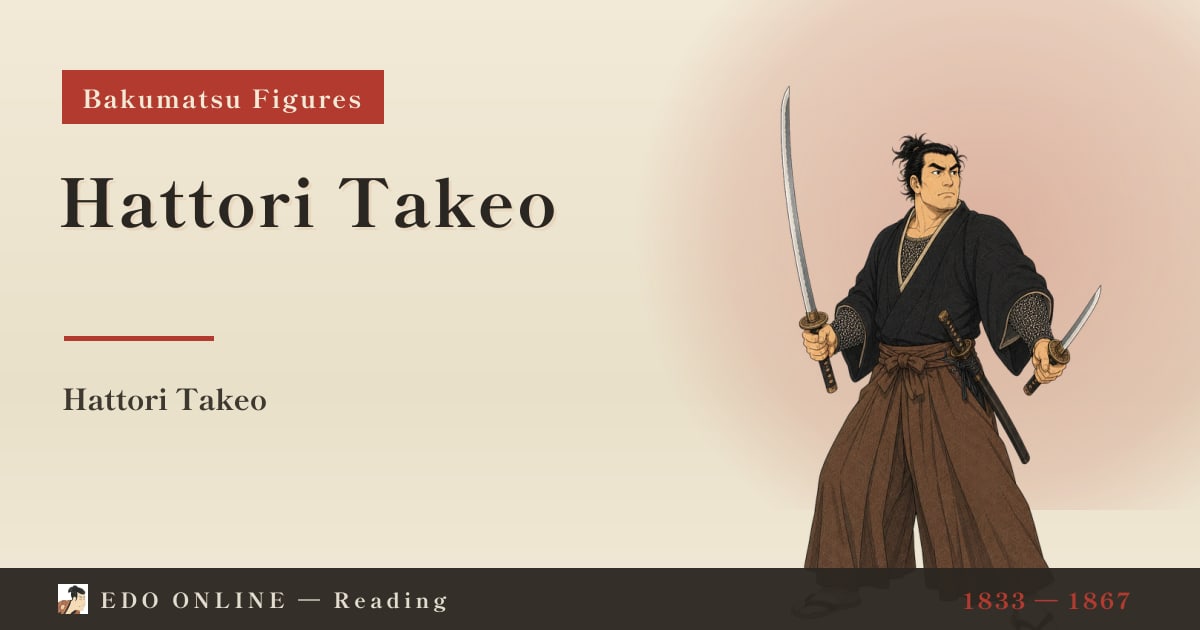
Hattori Takeo — Two Swords at Aburanokoji
A two-sword master and fencing instructor of the Shinsengumi who defected with the Goryō Eji. At Aburanokōji he alone wore mail, held a wall against the whole corps, and fell with more than twenty wounds.