Yamauchi Yodo — The Drunken Lord Who Talked the Shogun Into Resigning
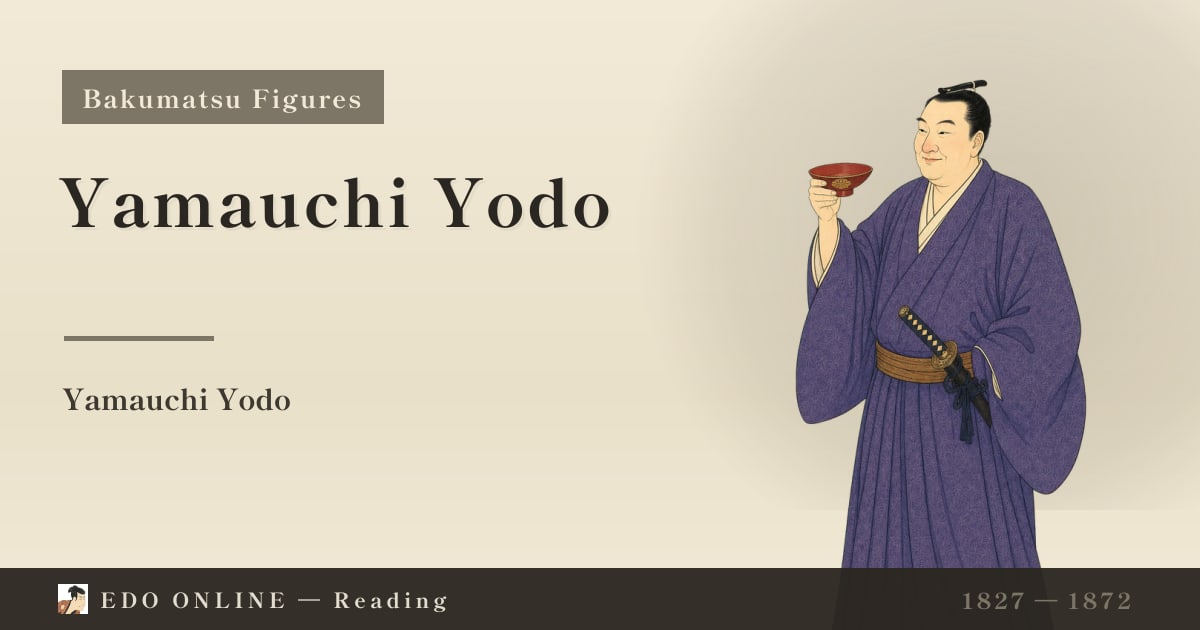
One daimyo called himself "the drunken marquis of the whale sea." That was Yamauchi Yodo, lord of Tosa — and the man who talked the last shogun into handing power back to the emperor.
Contents
Who Was Yamauchi Yodo?
Yodo was the fifteenth lord of Tosa domain, in what is now Kochi Prefecture. His given name was Toyoshige; Yodo was the art name he wrote and drank under.
His record breaks into three parts.
A reformer. He promoted a man named Yoshida Toyo and set about repairing the domain's finances and its army.
A persecutor. He broke the Tosa Loyalist Party led by Takechi Hanpeita, and ordered Takechi to commit suicide.
The author of a proposal that ended an era. In 1867 he formally urged Tokugawa Yoshinobu to return the government to the imperial court — the direct trigger for the single largest political decision of the period.
He was born in 1827, into a branch house of the ruling Yamauchi family.
Yamauchi Yodo from a Branch House to the Lordship
Yodo was never meant to rule. He was born into a cadet line of the lord's family and spent his youth reading and drinking in a side residence.
Then in 1848 the sitting lord died suddenly. With no suitable heir, Yodo was pulled out of the branch house and made the fifteenth lord of Tosa.
That accidental accession shaped everything after it. Tosa was split by an unusually rigid internal caste line — upper samurai, brought in by the Yamauchi after 1600, and country samurai descended from retainers of the family the Yamauchi had displaced. Yodo stood with the upper samurai to the end.
As lord he elevated Yoshida Toyo, a man of modest rank, to drive reform. Toyo's students would become the next generation running Tosa.
Yamauchi Yodo, the "Drunken Marquis"
You cannot describe Yodo without the drinking.
He styled himself Geikai Suiko — "the drunken marquis of the whale sea," the whale sea being the Pacific off Tosa. For a daimyo to advertise himself as a drunk was, in itself, remarkable.
He wrote poetry in Chinese, practised calligraphy, and loved argument. Brilliant, and unable to stop once he started drinking — contemporary accounts converge on that description with unusual consistency.
He is counted among the "four wise lords" of the late Tokugawa era, alongside Matsudaira Shungaku of Fukui, Date Munenari of Uwajima, and Shimazu Nariakira of Satsuma — reform-minded rulers who insisted on a voice in national affairs.
Yamauchi Yodo and the Ansei Purge
In the fight over the shogunal succession, Yodo backed Hitotsubashi Yoshinobu. The winner was the tairo, or chief minister, Ii Naosuke.
In 1859 Yodo was forced into retirement and placed under house arrest, in the wake of the Ansei Purge. He kept real control of Tosa even without the title — but during those blank years another force grew inside his domain.
How Yamauchi Yodo Broke the Tosa Loyalist Party
While Yodo was sidelined, the Tosa Loyalist Party under Takechi Hanpeita captured domain policy. In 1862 they assassinated Yoshida Toyo, Yodo's own man.
When the politics in Kyoto turned, Yodo recovered his authority — and went after them.
Takechi was imprisoned, interrogated at length, and ordered to disembowel himself in the summer of 1865. Party members including Okada Izo were executed.
Yodo was not rejecting loyalism itself. What he rejected was low-ranking samurai deciding the domain's policy for it. To the end, he believed a domain was whatever its lord said it was.
Yamauchi Yodo and the Proposal to Return Power
In 1867 that same man moved history.
Goto Shojiro, carrying an idea developed with Sakamoto Ryoma, put a scheme to Yodo: have the shogun hand the government back voluntarily. Destroying the shogunate by force meant civil war. Let the Tokugawa resign instead.
Yodo accepted it, and in the tenth lunar month of 1867 formally advised Tokugawa Yoshinobu to return governing authority to the throne. On 9 November 1867 Yoshinobu submitted exactly that petition — the Taisei Hokan.
It did not abolish the shogunate. The Tokugawa house kept its lands and its armies, and formal abolition came with the imperial proclamation two months later.
It landed days before a secret order to destroy the shogunate reached Satsuma and Choshu. Yodo's proposal cut in front of the Satsuma–Choshu alliance and its plan for a military solution.
The Night Yamauchi Yodo Lost at the Kogosho Council
It did not hold.
On 3 January 1868 the imperial court proclaimed the restoration of direct rule, and a council met that night to decide whether to strip Yoshinobu of his titles and lands.
Yodo objected furiously. You cannot sentence a man without summoning him, he argued — and he had been drinking.
Iwakura Tomomi shut him down by asserting that the decision was the emperor's own will. The council went Satsuma's way, and the Boshin War followed within weeks.
Yodo's design — a soft landing for the Tokugawa without a war — died in that room.
Yamauchi Yodo's Death and Grave
Yodo held office briefly under the new government and soon quit. What remained was poetry and drink.
He died in 1872, aged forty-four. He is said to have kept drinking to the end.
His grave is at Oi Park in Shinagawa, Tokyo — not in Tosa, but on the grounds of the Yamauchi family's old Edo residence. The city he had travelled to under the alternate attendance system is where he stayed.
Yamauchi Yodo Timeline
| Year | Event |
|---|---|
| 1827 | Born into a branch house of the Yamauchi family |
| 1848 | Becomes fifteenth lord of Tosa after the sitting lord dies suddenly |
| 1850s | Promotes Yoshida Toyo; counted among the "four wise lords" |
| 1859 | Forced into retirement after the Ansei Purge |
| 1862 | The Tosa Loyalist Party assassinates Yoshida Toyo |
| 1865 | Orders Takechi Hanpeita to commit suicide |
| 1867 | Advises Tokugawa Yoshinobu to return power to the court |
| 1867 | Opposes Yoshinobu's punishment and is overruled by Iwakura Tomomi |
| 1872 | Dies, aged 44 |
For his Tosa contemporaries see Sakamoto Ryoma, Takechi Hanpeita and Nakaoka Shintaro; for the resignation itself, Taisei Hokan.
Related reading
Abe Juro — The Former Member Who Talked
He deserted the Shinsengumi and rejoined under another name, shot at Kondo Isami as one of the Goryō Eji, and then grew apples in Sapporo. His late-Meiji testimony is where the ranking of the corps' best swordsmen comes from.
Ando Hayataro — The Shinsengumi's Record-Breaking Archer
He set the standing national record in the long-range shooting at the Tōdai-ji Great Buddha Hall, sending 8,685 arrows the length of the corridor. Nearly fifty, he joined the Shinsengumi and died of wounds taken in the back garden of the Ikedaya.
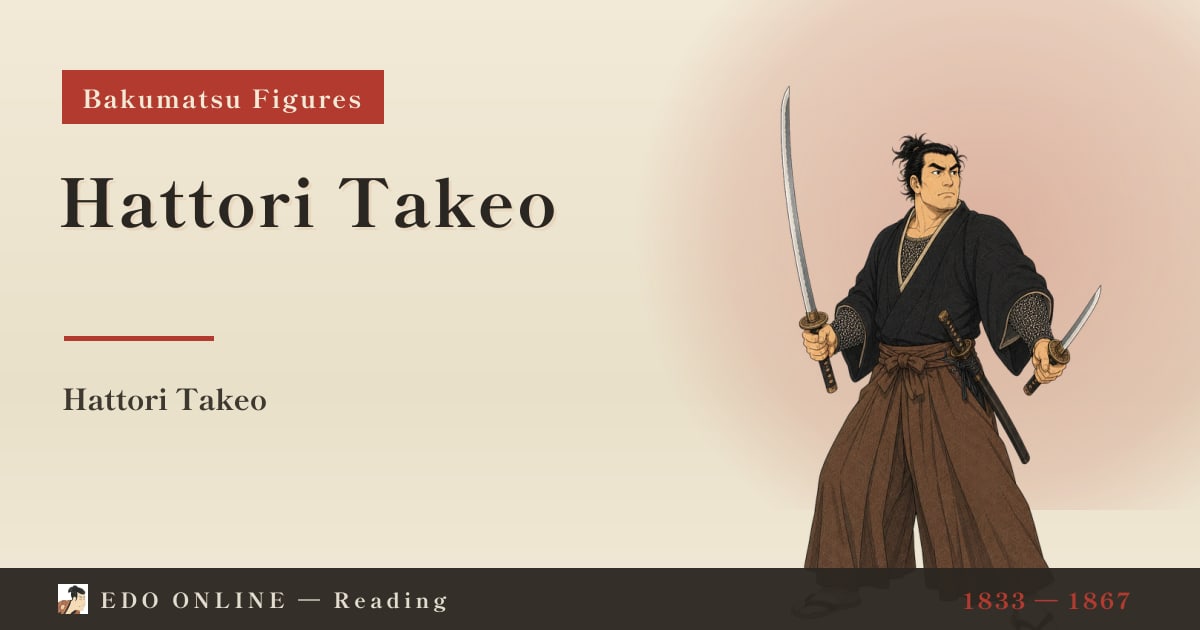
Hattori Takeo — Two Swords at Aburanokoji
A two-sword master and fencing instructor of the Shinsengumi who defected with the Goryō Eji. At Aburanokōji he alone wore mail, held a wall against the whole corps, and fell with more than twenty wounds.