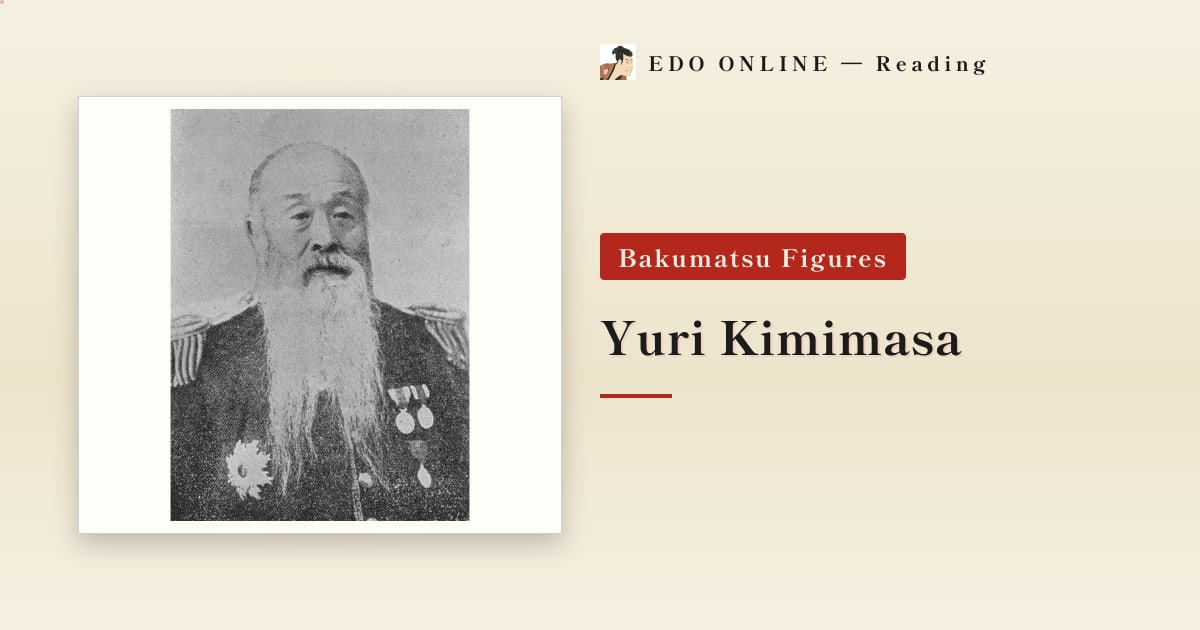
Yuri Kimimasa — Japan's First Government Banknote, and Brick-Built Ginza
Sakamoto Ryoma decided that one particular man should handle the new government's money. That man was Yuri Kimimasa, a junior retainer of Fukui.
Contents
Who Was Yuri Kimimasa?
Yuri rose from Fukui domain retainer to the man running Meiji state finance. He was born Mitsuoka Hachiro.
Three things define him.
He fixed Fukui's finances. With domain paper money and raw-silk exports he turned a failing domain's books around.
He issued Japan's first government banknote, the Dajokan note — manufacturing money for a government that had none.
He rebuilt Ginza in brick. As governor of Tokyo he turned a burned-out district into Japan's first planned Western-style streetscape.
He was born in 1829 and died in 1909.
Yuri Kimimasa's Paper Money and Raw Silk
Mitsuoka Hachiro was a junior retainer. His birth did not put him anywhere near domain policy.
The man who raised him up was the lord of Fukui, Matsudaira Shungaku, who hired without regard to rank — and who promoted Hashimoto Sanai in the same period.
What Mitsuoka did was aggressive economic policy for its time.
He set up a domain office to collect and sell produce, aggregating what the territory produced and marketing it in bulk.
He issued domain paper money — notes backed by the domain alone, worthless if confidence failed. He got them circulating.
He exported raw silk. Yokohama had opened and raw silk had become Japan's largest export. Fukui rode that.
The domain's finances improved. Running an economy on paper money and exports was, in effect, a rehearsal for what he would later do at national scale.
When Sakamoto Ryoma Came to See Yuri Kimimasa
In 1867 Sakamoto Ryoma travelled to Fukui.
Mitsuoka was under house confinement over a domain matter at the time. Ryoma sought out where he was staying and urged him to take charge of the new government's finances.
Ryoma is said to have remarked that the accounts of a new state could be handled by nobody else. The exact wording differs between accounts.
The meeting took place on 25 November 1867. Fifteen days later, Ryoma was assassinated in Kyoto.
The idea survived him. Mitsuoka was summoned by the new government and put in charge of financial administration.
Yuri Kimimasa and the Dajokan Note
In 1868 the new government was in a desperate position.
It was fighting a war with no money. Tokugawa revenues had not been fully seized, and contributions from the domains were limited. The Boshin War could not be sustained.
Yuri's answer was the Dajokan note — paper money issued by the government.
It was Japan's first nationally circulating government banknote. Its metal backing was inadequate. It ran on the proposition that the new government would honour it — a gamble.
It was the Fukui domain note, at national scale.
The problems came. Disruption from forcing it into circulation, counterfeiting, loss of value. Criticism was heavy, and Yuri was held responsible for much of it.
But the war and the first years of the government were paid for with it.
Yuri Kimimasa and the Charter Oath
There is one more piece of work under his name.
The Charter Oath, proclaimed on 6 April 1868 — the fourteenth day of the third lunar month — set out the new government's basic principles.
Its first draft was written by Yuri. Fukuoka Takachika of Tosa revised it, and Kido Takayoshi worked it further into the final text.
He wrote the first draft of the document containing the famous clause that assemblies should be widely convoked and all matters decided by public discussion.
Yuri Kimimasa and Ginza Brick Town
In 1872 Yuri became governor of Tokyo.
That same year a great fire burned out the Ginza district.
Yuri decided to rebuild the site as a Western city: brick buildings in rows, widened roads, pavements, street trees and gas lamps — Japan's first planned Western-style district.
It was called Ginza Brick Town.
Opinions differ on it. Brick suited the Japanese climate badly, held damp, and was disliked as a place to live. Tenancy lagged and some buildings stood empty.
But this is where "Ginza" as a symbol of modern Japan begins — the result of deciding to rebuild a district differently in the immediate aftermath of a fire.
Yuri Kimimasa's Later Years
Yuri later sat in the Senate and the House of Peers, and died in 1909, aged seventy-nine.
A man who printed domain notes in Bakumatsu Fukui lived past the Russo-Japanese War.
What he handled was consistently the same mechanism: making money out of confidence. Domain notes, government notes, and the redevelopment of a district. Standing value up where there was no capital was Yuri Kimimasa's line of work.
Yuri Kimimasa Timeline
| Year | Event |
|---|---|
| 1829 | Born a junior Fukui retainer, as Mitsuoka Hachiro |
| 1850s | Promoted by Matsudaira Shungaku to run domain finance |
| 1850s–60s | Rebuilds Fukui's finances with a produce office, paper money and raw-silk exports |
| 25 Nov 1867 | Sakamoto Ryoma visits Fukui to recruit him; Ryoma is killed fifteen days later |
| 6 Apr 1868 | The Charter Oath is proclaimed; Yuri wrote its first draft |
| 1868 | Issues the Dajokan note, Japan's first national government banknote |
| 1872 | Governor of Tokyo; builds Ginza Brick Town after the fire |
| late Meiji | Senate and House of Peers |
| 1909 | Dies, aged 79 |
For the lord who promoted him see Matsudaira Shungaku; for his contemporary in Fukui, Hashimoto Sanai; for the man who recruited him, Sakamoto Ryoma.
Related reading
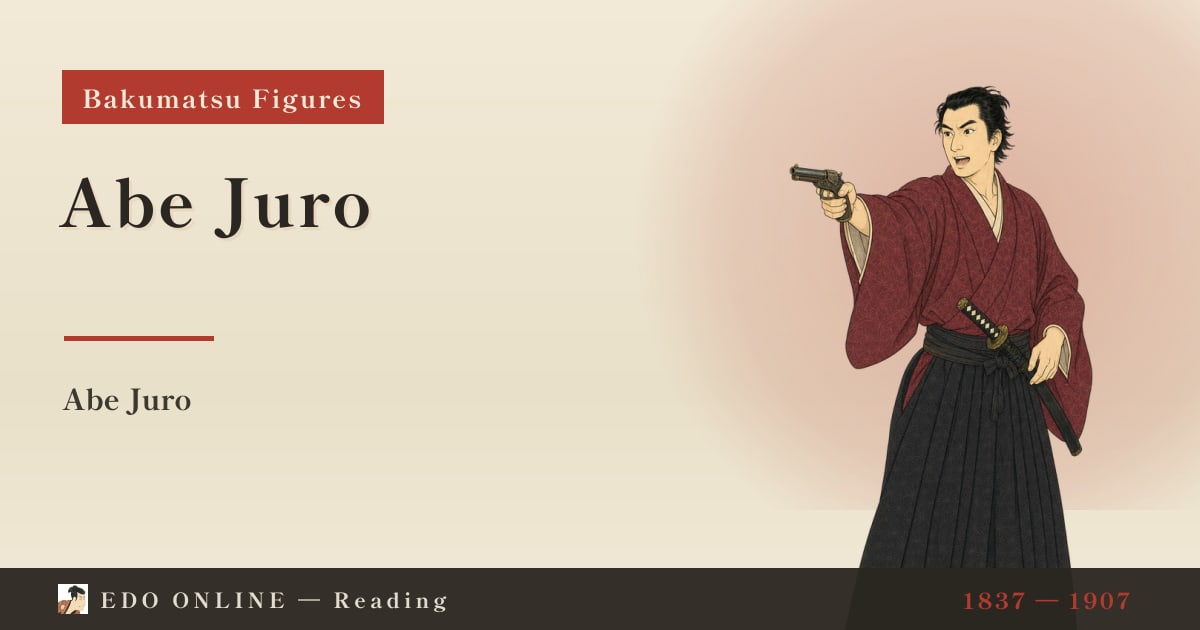
Abe Juro — The Former Member Who Talked
He deserted the Shinsengumi and rejoined under another name, shot at Kondo Isami as one of the Goryō Eji, and then grew apples in Sapporo. His late-Meiji testimony is where the ranking of the corps' best swordsmen comes from.
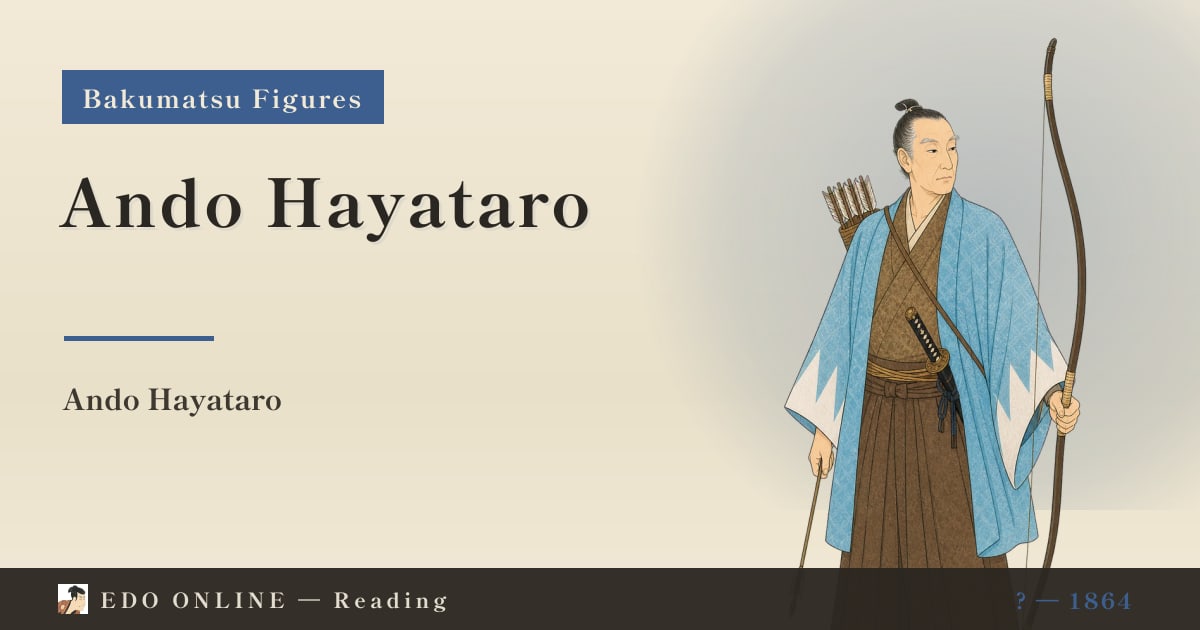
Ando Hayataro — The Shinsengumi's Record-Breaking Archer
He set the standing national record in the long-range shooting at the Tōdai-ji Great Buddha Hall, sending 8,685 arrows the length of the corridor. Nearly fifty, he joined the Shinsengumi and died of wounds taken in the back garden of the Ikedaya.
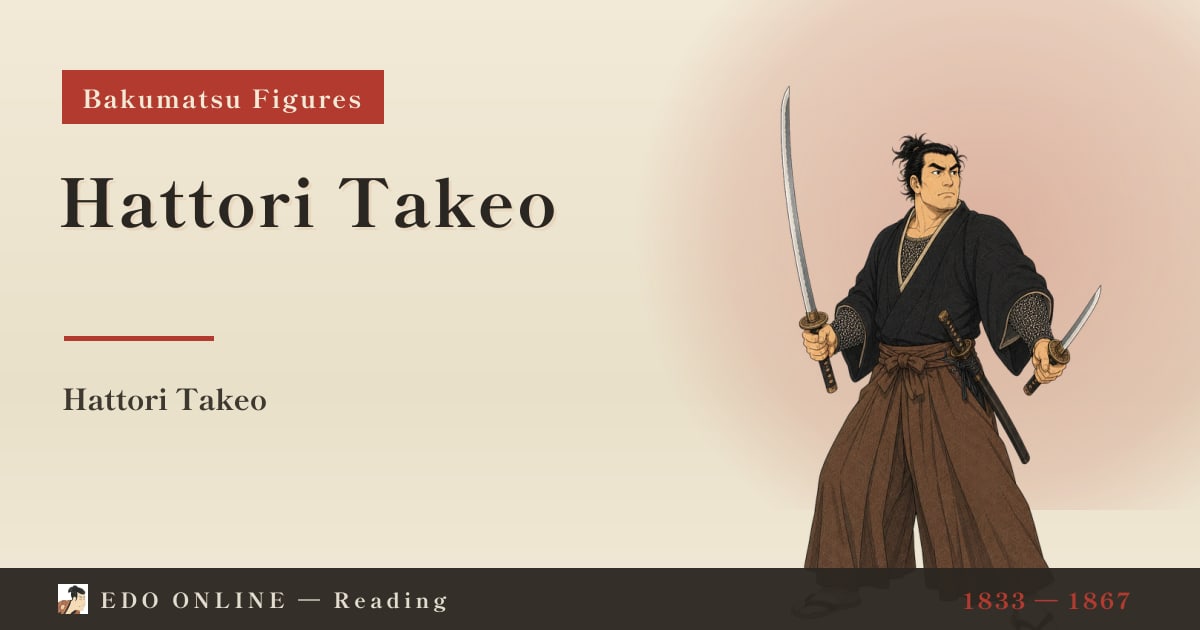
Hattori Takeo — Two Swords at Aburanokoji
A two-sword master and fencing instructor of the Shinsengumi who defected with the Goryō Eji. At Aburanokōji he alone wore mail, held a wall against the whole corps, and fell with more than twenty wounds.