What Was Sankin Kotai? Purpose and Cost Explained
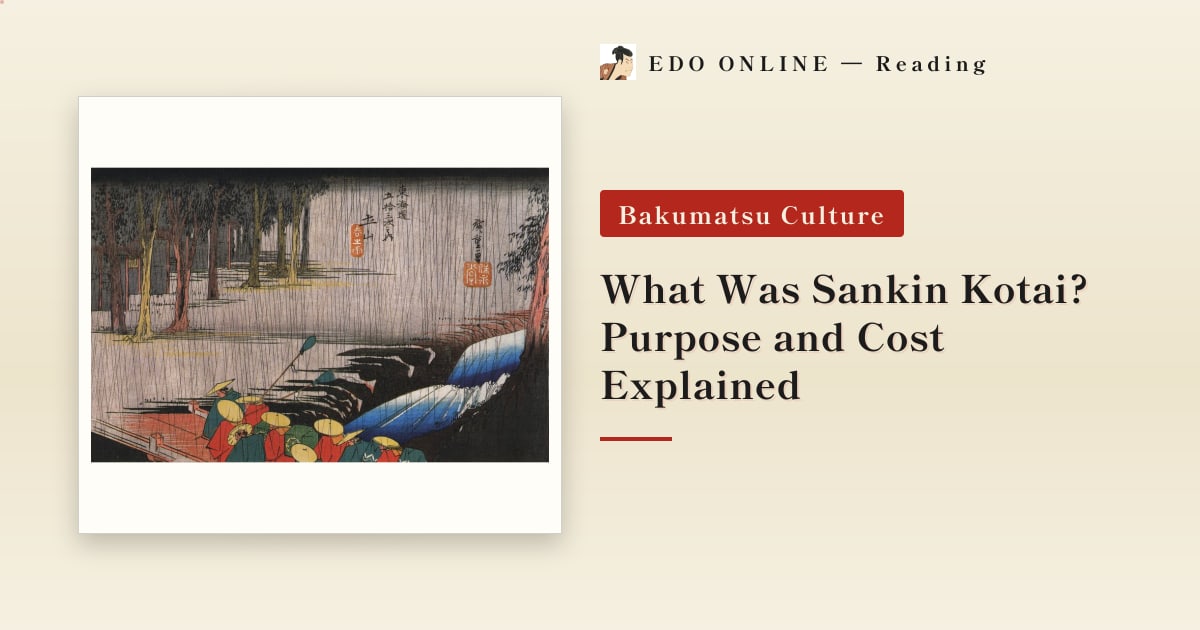
The daimyo procession moving along a highway is one of the defining images of Tokugawa Japan. The system that produced it was sankin kōtai, alternate attendance — and no other single mechanism did more to keep the shogunate in power for 260 years.
Contents
What was sankin kotai?
Sankin kōtai was the requirement that every daimyo in Japan spend alternate years in Edo attending the shogun, and the intervening years in his own domain.
| Item | Detail |
|---|---|
| Made compulsory | 1635 for outside lords; 1642 for hereditary vassals |
| Instituted by | The third shogun, Tokugawa Iemitsu, through the Laws for Warrior Houses |
| Requirement | Alternate years in Edo and in the domain |
| Wives and children | Kept permanently in Edo, effectively as hostages |
| Ended | Relaxed in 1862; gone with the shogunate in 1868 |
Sankin means attendance on the shogun in Edo; kōtai the rotation back to the domain. A daimyo spent roughly half his adult life in the capital.
Domains near Edo, and remote ones such as Tsushima and Matsumae, operated on different cycles.
What was the purpose of sankin kotai?
The most common explanation is that it was designed to drain the daimyo financially. The drain was real; that it was the purpose is doubtful.
The system's actual objectives were these.
Enacting the relationship between shogun and lord. Sankin kōtai was formally military service — an obligation owed by vassal to overlord. Requiring each daimyo to travel to Edo and appear before the shogun re-performed that hierarchy on a fixed schedule. The processions were armed and organised as military formations precisely because that is what they were.
Holding the families. Wives and heirs remained in Edo permanently. A rebellious lord would lose his family first. This was a far more reliable restraint than any physical control of the domains.
Keeping lords away from home. Spending half of every cycle in Edo left less scope for building an independent power base in the provinces.
Financial exhaustion was a consequence, not a design. The burden certainly weakened the domains, but no contemporary source shows the shogunate intending it, and the idea appears to be a later interpretation.
How much did sankin kotai cost?
The burden was severe: estimates suggest between 10 and 30 per cent of a domain's annual expenditure.
The costs fell into three categories.
- The journey — lodging, food, porters and horses, scaling with the size of the procession
- Maintaining the Edo residences — upper, middle and lower compounds, permanently staffed
- Appearances — equipment and dress for the procession, since visible economy implied a decline in the house's standing
The Edo residences cost more than the travel. Each daimyo was required to keep a permanent second household in the capital, indefinitely.
Domains responded with a range of economies. Processions were swollen at provincial boundaries and thinned once past them; innkeepers were negotiated down; the display was reserved for stretches where it would be seen. A working compromise between appearance and expenditure was standard practice.
How large were the processions?
| Domain size | Approximate numbers |
|---|---|
| Kaga (1,020,000 koku) | 2,000-4,000 |
| Mid-sized domain (c. 100,000 koku) | Several hundred |
| Small domain (10,000-20,000 koku) | Several dozen |
Travel covered roughly 30 to 40 kilometres a day. Kanazawa to Edo took about twelve days; Kagoshima more than forty.
Commoners were expected to clear the road as a procession passed. They were not, however, all required to prostrate themselves. Travellers generally stepped aside, and the universal kneeling seen in period drama is heavily exaggerated.
What did sankin kotai change?
The system reshaped Japan in ways nobody intended.
Highways and post towns. The five great roads were developed and post towns prospered along them. Regular mass movement built the country's transport infrastructure.
Economic circulation. Sustained daimyo spending in Edo helped make it one of the largest cities in the world, while regional products flowed toward the capital and a money economy spread nationally.
A shared culture. Retainers moving repeatedly between Edo and home carried language, scholarship, techniques and fashions with them. A common cultural sphere that crossed dialect boundaries owes much to this circulation of people.
Chronic domain debt. Many domains ran permanent deficits. The wave of domain reform efforts in the late Tokugawa period responds directly to this structural problem.
When was sankin kotai abolished?
The system broke down in the final years of the shogunate. Under the Bunkyū reforms of 1862, attendance was reduced to once every three years and families were permitted to return home.
The reason was strategic. After the arrival of the Black Ships, domains needed to arm themselves for coastal defence, and the shogunate could no longer justify tying up their men and money in Edo.
The relaxation undermined the shogunate itself. With lords able to remain in their domains, the strong outer domains consolidated their strength. That Chōshū and Satsuma were able to build forces capable of defeating the shogunate is not unrelated to this change.
An attempt to restore the old system in 1864 was widely ignored. The framework was effectively dead before it disappeared formally with the shogunate in 1868. A system that had held the daimyo in place for 230 years ended at almost the same moment as the government it protected.
Frequently asked questions
What was sankin kotai?
The requirement that daimyo spend alternate years in Edo attending the shogun, made compulsory in 1635 by the third shogun Tokugawa Iemitsu.
What was the purpose of sankin kotai?
To enact the vassal relationship as military service, to hold the daimyo's families in Edo as hostages, and to prevent lords from consolidating power at home. Financial exhaustion was a by-product rather than an aim.
How expensive was sankin kotai?
Estimates put it at 10 to 30 per cent of a domain's annual spending, with the permanent Edo residences costing more than the journeys.
When did sankin kotai end?
It was substantially relaxed in 1862 and disappeared with the collapse of the shogunate in 1868.
For the pressure that broke the system see the Black Ships; for where the daimyo ended up see the Boshin War.
Related reading
The Kiheitai — Takasugi's Army That Ignored Class
Raised in 1863 by Takasugi Shinsaku, the Kiheitai took commoners as soldiers. Why Choshu did it, how it differed from the regular army, what it won, and how the new government crushed it.
What Was Aizu Domain? The House Code, the Byakkotai, the Siege
Aizu stayed loyal to the shogunate to the end and was destroyed for it. Why Matsudaira Katamori took the Kyoto post, what happened to the Byakkotai, and how the domain was punished.
What Was the Ansei Purge? Ii Naosuke's Crackdown Explained
Between 1858 and 1859 the shogunate's chief minister Ii Naosuke purged more than a hundred opponents and executed eight, including Yoshida Shoin. Why it happened and what it destroyed.