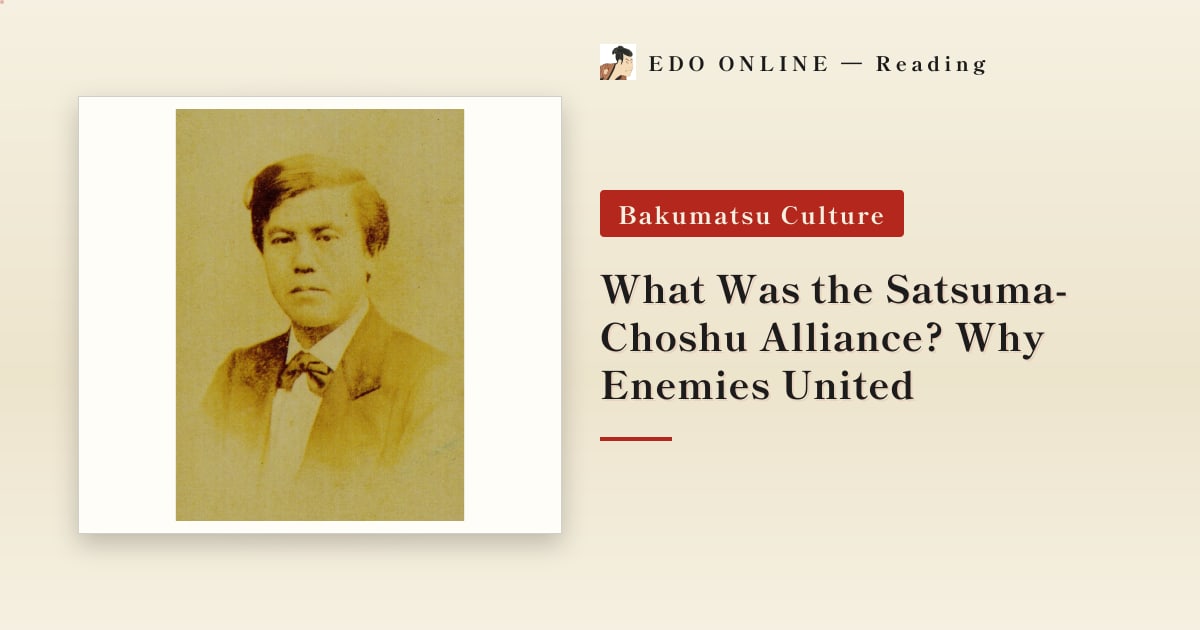
What Was the Satsuma-Choshu Alliance? Why Enemies United
The current that swept away the Tokugawa shogunate was set in motion by a single secret agreement. The Satsuma-Chōshū Alliance bound together two domains that had been shooting at each other barely a year earlier.
Contents
What was the Satsuma-Choshu Alliance?
A secret military and political pact concluded on 7 March 1866 in Kyoto between Satsuma and Chōshū.
| Item | Detail |
|---|---|
| Date | 7 March 1866 |
| Place | The Kyoto residence of the Satsuma retainer Komatsu Tatewaki |
| Parties | Satsuma: Saigō Takamori, Komatsu Tatewaki. Chōshū: Kido Takayoshi |
| Brokers | Sakamoto Ryōma, Nakaoka Shintarō |
| Nature | A secret understanding, never formalised as a treaty document |
Why were Satsuma and Choshu enemies?
To see how improbable this alliance was, you have to see how much the two sides hated each other.
In the coup of August 1863, Satsuma allied with Aizu to expel Chōshū from Kyoto. In the Kinmon incident the following year, the two domains exchanged fire around the imperial palace itself. Chōshū was declared an enemy of the court and lost many of its best men.
Chōshū coined a slogan for its adversaries: the Satsuma bandits and the Aizu villains. It is said that a Chōshū retainer speaking civilly to a Satsuma man risked disapproval from his own side.
Chōshū had then been forced into submission by the first shogunal expedition and was fighting for its existence as a domain.
Why did they agree?
The alliance happened because the two sides needed each other for different reasons.
Chōshū's position. Declared an enemy of the throne, facing a second shogunal expedition, and blocked by shogunal pressure from buying weapons through foreign merchants. Isolated, it faced destruction.
Satsuma's position. Its trust in the shogunate had collapsed. If Chōshū were crushed, Satsuma would be next in line — and a restored shogunal authority served Satsuma no better than it served Chōshū.
What bridged them was the arms trade. Chōshū could not buy weapons; so weapons were purchased in Satsuma's name and passed to Chōshū. Ryōma's Kameyama Shachū handled the transactions.
The practical arrangement came first and the political alliance followed. That is the real shape of the Satsuma-Chōshū Alliance.
How did Sakamoto Ryoma broker it?
Even with interests aligned, the personal resentment did not simply evaporate.
When Saigō and Kido finally met in Kyoto, they are said to have spent days without raising the subject. Whoever spoke first would appear to be asking for help, and neither would do it, though both needed the agreement.
Ryōma, arriving late, is credited with breaking the impasse by pressing Saigō to acknowledge Chōshū's position openly.
Nakaoka Shintarō's contribution was equally important and less remembered. He had spent long periods in Chōshū and had the confidence of Takasugi Shinsaku and others in its leadership, while also meeting Saigō repeatedly. Precisely because both men were domainless fugitives, neither side lost face by dealing through them.
The six articles
The agreement ran to six points. In substance:
- If the shogunate attacked Chōshū, Satsuma would send troops in support
- If Chōshū gained the advantage, Satsuma would work at court to clear its name
- Even if Chōshū were defeated, Satsuma would work to prevent its destruction
- If the shogunate obstructed Satsuma's mediation, Satsuma would fight it
In short: a guarantee that Chōshū would not be abandoned. For a domain facing annihilation, that was everything.
The text survives because Kido wrote out the terms and sent them to Ryōma, who endorsed the letter in red ink confirming their accuracy. No formal treaty was signed; that endorsement is the evidence the alliance existed.
Satsuma-Choshu Alliance timeline
| Year | Event |
|---|---|
| Aug 1863 | Coup expels Chōshū from Kyoto |
| Jul 1864 | Kinmon incident; Chōshū declared an enemy of the court |
| 1864 | First shogunal expedition; Chōshū submits |
| 1865 | Weapons begin to be bought in Satsuma's name |
| 7 Mar 1866 | The alliance is concluded |
| Jun 1866 | Second shogunal expedition; the shogunal army is defeated |
| Oct 1867 | Return of power to the emperor |
| Jan 1868 | The Boshin War begins |
What the alliance changed
Three months after it was signed, the shogunate launched its second expedition against Chōshū — and lost. Satsuma refused to contribute troops, and a Chōshū army equipped with modern rifles pushed the shogunal forces back on every front.
The shogunate could not defeat a single domain. That fact, publicly demonstrated, told the country that shogunal power was gone. From this point overthrowing it became a realistic option, and events moved quickly to the return of power, the imperial restoration and civil war.
The alliance also had a long afterlife. The Meiji government was dominated by men from these two domains for decades, a pattern known as hanbatsu or domain clique politics, and criticism of it fed the later movement for representative government.
Frequently asked questions
When was the Satsuma-Choshu Alliance signed?
On 7 March 1866, in Kyoto.
Who made the Satsuma-Choshu Alliance?
Saigō Takamori and Komatsu Tatewaki for Satsuma, Kido Takayoshi for Chōshū, with Sakamoto Ryōma and Nakaoka Shintarō acting as intermediaries.
Why was it secret?
Chōshū was formally an enemy of the court. Open association would have exposed Satsuma to the same charge.
Does any evidence of the alliance survive?
Yes. A letter in which Kido set out the terms, endorsed in red ink by Sakamoto Ryōma, still exists.
For the brokers see Sakamoto Ryōma and Nakaoka Shintarō; for the principals see Saigō Takamori and Kido Takayoshi.
Related reading
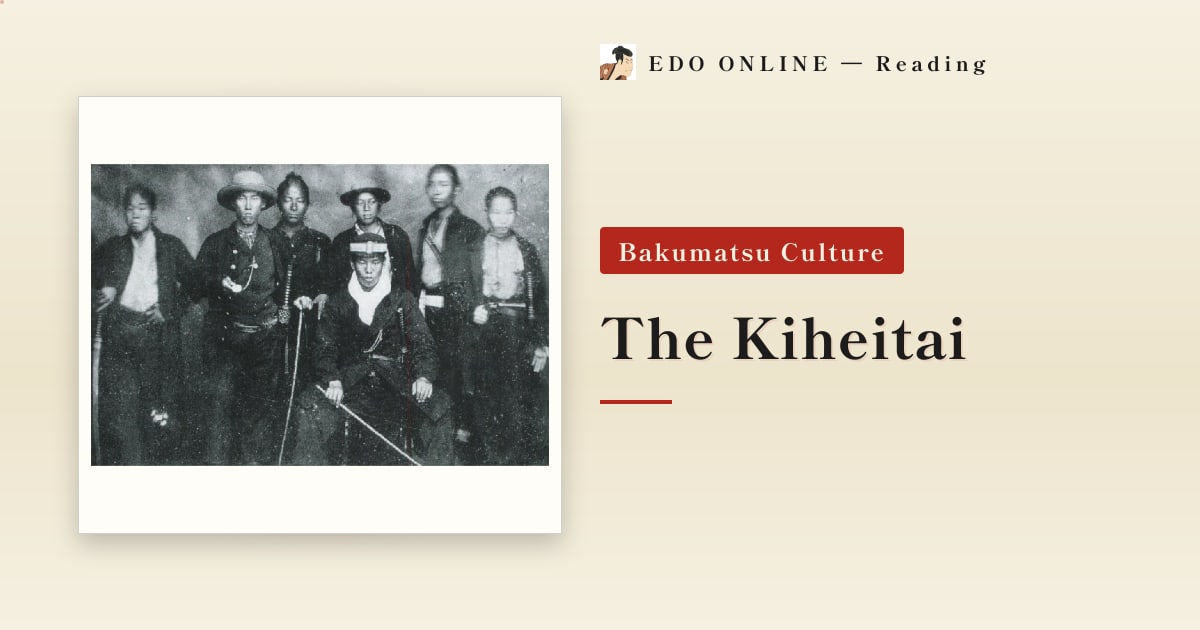
The Kiheitai — Takasugi's Army That Ignored Class
Raised in 1863 by Takasugi Shinsaku, the Kiheitai took commoners as soldiers. Why Choshu did it, how it differed from the regular army, what it won, and how the new government crushed it.
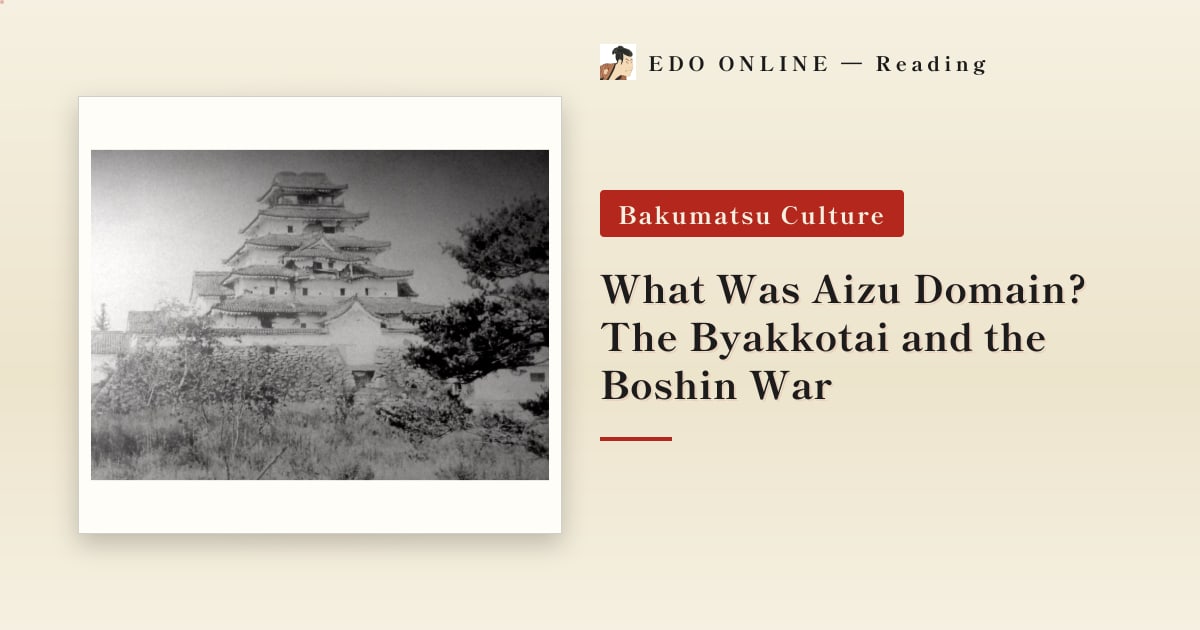
What Was Aizu Domain? The House Code, the Byakkotai, the Siege
Aizu stayed loyal to the shogunate to the end and was destroyed for it. Why Matsudaira Katamori took the Kyoto post, what happened to the Byakkotai, and how the domain was punished.
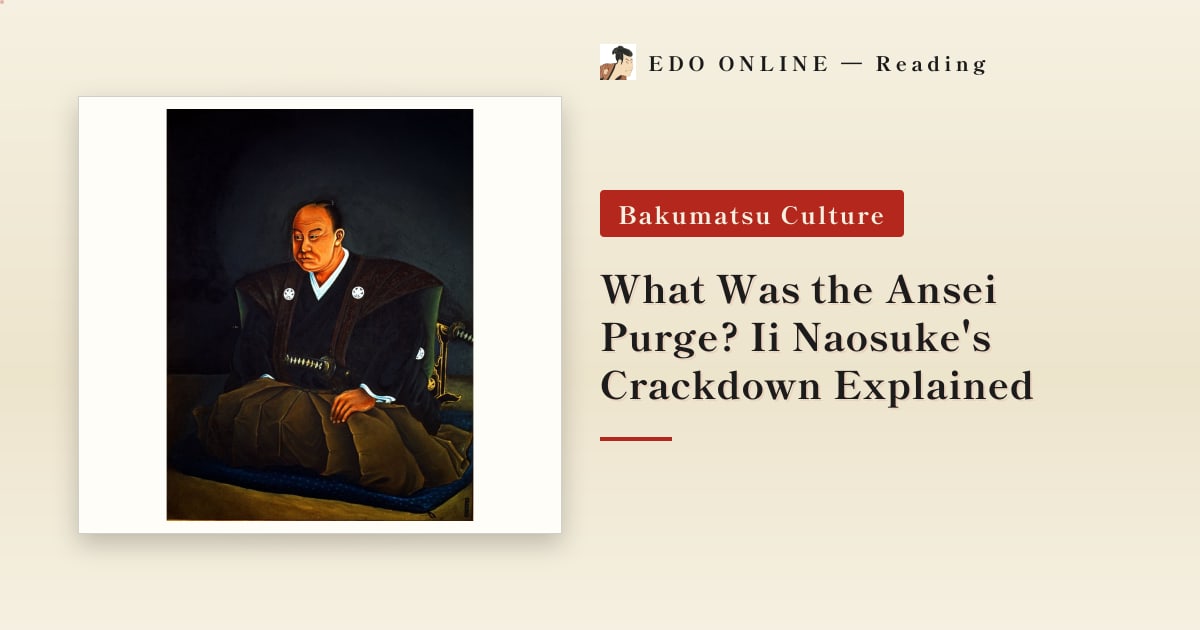
What Was the Ansei Purge? Ii Naosuke's Crackdown Explained
Between 1858 and 1859 the shogunate's chief minister Ii Naosuke purged more than a hundred opponents and executed eight, including Yoshida Shoin. Why it happened and what it destroyed.