
Shimada Kai — The Shinsengumi Man Who Lived to Write It Down
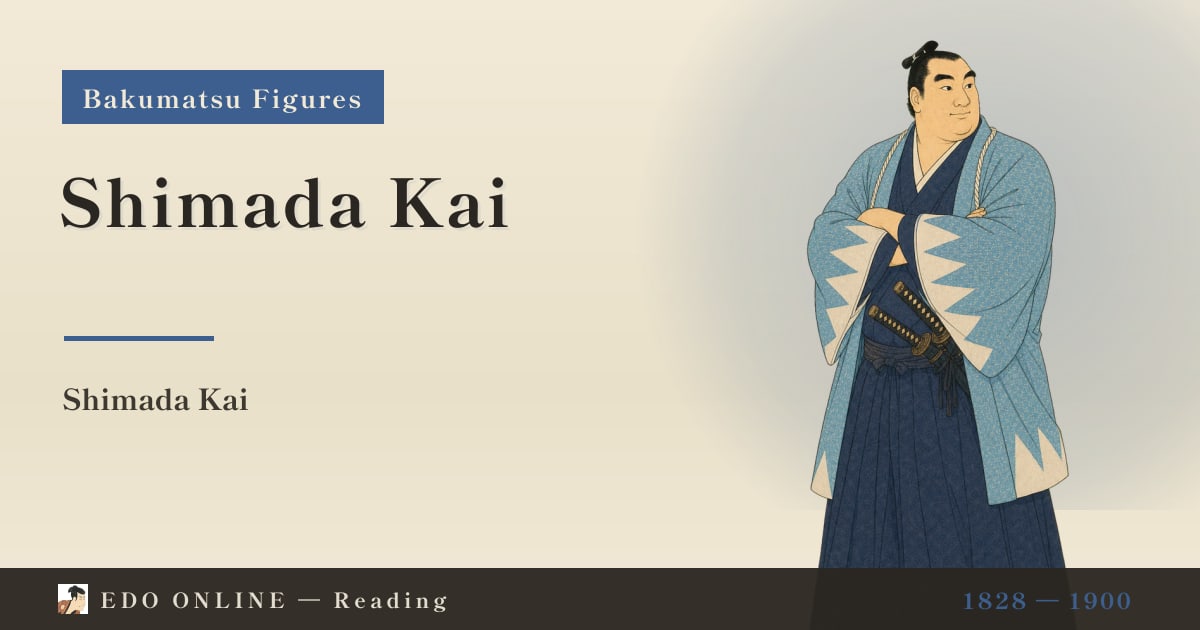
What we know about the Shinsengumi rests heavily on what the survivors wrote down. Shimada Kai was one of the men doing the writing.
Contents
Who Was Shimada Kai?
Shimada was a member of the Shinsengumi, serving as an inspector — shoshi shirabeyaku concurrently kansatsu — and later as a corporal of the second unit.
He was born on 29 February 1828 in Ōso village in Mino province, now part of Gifu city, the second son of a village headman.
By Shinsengumi standards he was old. Six years older than Kondo Isami, seven older than Hijikata Toshizo.
And he fought all the way to Hakodate and lived until 1900, dying at seventy-two — among the longest-lived men the corps produced.
How Shimada Kai Reached the Shinsengumi
Shimada's early life was a series of adoptions.
Adopted young into the Naganawa family of Ishida village, then handed to his maternal grandfather when his adoptive father died. It was there he took up swordsmanship, and he is said to have won a tournament held inside Nagoya castle.
That win got him noticed. He was adopted by Shimada Sai, a retainer of the Ōgaki domain, and inherited the Shimada name he is known by.
He went to Edo to train at the Tsubouchi Shuma school of Shingyōtō-ryū, and there met Nagakura Shinpachi, who was serving as an assistant instructor. That connection is what eventually carried Shimada into the Shinsengumi.
Around May 1863 he followed Nagakura to Kyoto and joined the Mibu Rōshi, the corps' predecessor. When it was renamed the Shinsengumi he took up the post of inspector.
Shimada Kai's Size and Strength
Most of what is told about Shimada concerns his body.
He stood around 180 centimetres — enormous for the period — and was famously strong. He did well in the sumo exhibitions the corps staged, and the men called him "Riki-san," roughly "Strongman."
The best-known anecdote comes from the retreat at Toba-Fushimi. Seeing Nagakura Shinpachi unable to get over a mud wall under the weight of his gear, Shimada held out his rifle, told him to grab hold, and hauled him up over the top.
He also had, incongruously, an enormous sweet tooth. He is said to have cooked a cauldron of shiruko — sweet bean soup — and eaten the whole thing himself, having added so much sugar that it drew threads, so that no other man in the corps could touch it.
The details rest on later recollection and cannot be corroborated. The size and the strength, however, are attested by more than one witness.
Shimada Kai and the Ikedaya Incident
In June 1864 Shimada did the work his post existed for.
He is credited with a part in the arrest of Furutaka Shuntarō, the event that set the Ikedaya Incident in motion. Furutaka was a courier for the Chōshū-aligned imperial loyalists, and his interrogation led to the raid on the inn.
The job was investigation before it was killing. Yamazaki Susumu held the same post, and no account of why the Shinsengumi actually functioned in Kyoto can leave this function out.
In the Aburanokōji affair of 13 December 1867 he fought Hattori Takeo blade to blade. On 12 January 1868, when survivors of the Goryō Eji ambushed Kondo Isami, Shimada was riding as his escort. When Kondo was shot in the saddle, it was Shimada who drove his horse clear and saved his life.
Shimada Kai After the Restoration
He surrendered at Hakodate in June 1869, was confined until November, and was placed in the custody of the Nagoya domain.
Released, he opened a fencing school in Kyoto. It did not keep him. He also tried selling lemonade and sundries; neither took, and he lived in real poverty.
He turned down an offer of a post in the new government. When Enomoto Takeaki sent word that he would like to renew their acquaintance and that Shimada should come to his lodgings, Shimada is said to have replied that the man who wants the meeting is the one who ought to do the walking.
In 1886 he became a night watchman at Nishi Hongan-ji.
The posting had a history. The Shinsengumi had quartered at Nishi Hongan-ji from 1865 to 1867, to the considerable annoyance of the temple. The temple the corps had once imposed itself on was now walked, night after night, by an old man who had been one of them.
He collapsed on duty there and died on 20 March 1900. Nagakura Shinpachi attended the funeral.
What Shimada left behind was paper. He kept his diary, the corps' rosters, and objects from those years. He recited prayers daily for the dead, and carried a cloth inscribed with the posthumous Buddhist names of Kondo Isami and Hijikata Toshizo inside his robe.
That material underwrites modern Shinsengumi scholarship. It is now held at the Ryōzen Museum of History in Kyoto.
Why Shimada Kai Is Worth Reading About
Accounts of the Shinsengumi concentrate on Kondo Isami, Hijikata Toshizo and Okita Soji. None of the three left an account of himself.
The men who wrote were the men who lived. Nagakura Shinpachi's recollections, the testimony around Saito Hajime, and Shimada's diary and hoard.
The Shinsengumi is still talked about because men like Shimada moved from fighting to recording. It was not the sword that preserved them. It was the paper.
Frequently asked questions
Who was Shimada Kai?
An inspector and second-unit corporal of the Shinsengumi. He fought to Hakodate and, after the Restoration, left the diary and papers that survive as source material.
When did Shimada Kai die?
On 20 March 1900, aged seventy-two, after collapsing while on duty as a night watchman at Nishi Hongan-ji.
How big was Shimada Kai?
Around 180 centimetres, very large for the period, and strong enough to be a draw in the corps' sumo exhibitions, where the men nicknamed him "Riki-san."
Was Shimada Kai the same person as Shimada Torinosuke?
No. Shimada Torinosuke was a Jikishinkage-ryū swordsman who taught Katsu Kaishu; he had no connection to the Shinsengumi.
Shimada Kai Timeline
| Year | Event |
|---|---|
| 1828 | Born in Ōso village, Mino province, second son of a village headman |
| Childhood | Adopted into the Naganawa family, later inherits the Shimada name in Ōgaki |
| Edo years | Trains in Shingyōtō-ryū at the Tsubouchi school; meets Nagakura Shinpachi |
| May 1863 | Joins the Mibu Rōshi; becomes an inspector in the Shinsengumi |
| Jun 1864 | Helps arrest Furutaka Shuntarō, leading to the Ikedaya Incident |
| 13 Dec 1867 | Fights Hattori Takeo in the Aburanokōji affair |
| 12 Jan 1868 | Drives Kondo Isami's horse clear of an ambush, saving his life |
| Jan 1868 | Joins Nagakura's forlorn-hope charge at Toba-Fushimi |
| Jun 1869 | Surrenders at Hakodate; confined until November |
| 1886 | Becomes a night watchman at Nishi Hongan-ji |
| 20 Mar 1900 | Dies at Nishi Hongan-ji, aged seventy-two |
For other members see Kondo Isami, Hijikata Toshizo and Nagakura Shinpachi; for the roster, the Shinsengumi members; for the corps, the Shinsengumi.
Related reading
Abe Juro — The Former Member Who Talked
He deserted the Shinsengumi and rejoined under another name, shot at Kondo Isami as one of the Goryō Eji, and then grew apples in Sapporo. His late-Meiji testimony is where the ranking of the corps' best swordsmen comes from.
Ando Hayataro — The Shinsengumi's Record-Breaking Archer
He set the standing national record in the long-range shooting at the Tōdai-ji Great Buddha Hall, sending 8,685 arrows the length of the corridor. Nearly fifty, he joined the Shinsengumi and died of wounds taken in the back garden of the Ikedaya.
Hattori Takeo — Two Swords at Aburanokoji
A two-sword master and fencing instructor of the Shinsengumi who defected with the Goryō Eji. At Aburanokōji he alone wore mail, held a wall against the whole corps, and fell with more than twenty wounds.