
Ogata Shuntaro — The Shinsengumi Scholar Traced 145 Years Later
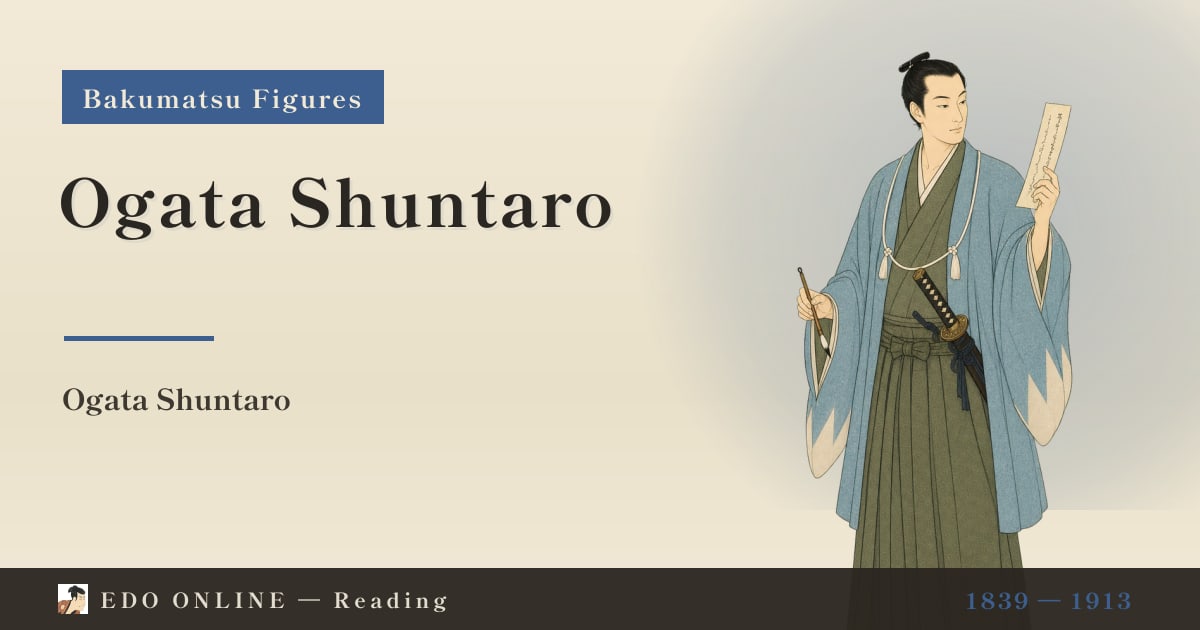
What became of this man was established in 2013 — a hundred and forty-five years after he disappeared from the record in the Boshin War.
Contents
Who Was Ogata Shuntaro?
Ogata was an inspector, the corps' instructor in letters, and an assistant vice-commander of the Shinsengumi.
His real surname was Mishima. "Ogata" is said to be the name of a warrior ancestor, which he adopted on joining.
He was born on 7 June 1839 at Kutami, in the Kumamoto domain's territory in Higo province — the same age as Nagakura Shinpachi.
He died on 13 June 1913, aged seventy-four.
Ogata Shuntaro Was Valued as a Civil Officer
He joined the Shinsengumi some time after 25 May 1863. By the organisation of that June he was already an assistant vice-commander.
That Kondo Isami trusted him is legible from who travelled with him.
The 1864 recruiting trip to Edo. Both missions to Chōshū, in 1865 and 1866. Ogata went on all of them without exception.
In the reorganisation of April 1865 he took the post of inspector and instructor in letters. He was evidently rated highly as a civil officer.
When the corps was raised to shogunal retainer status in June 1867, he ranked as a mimawarigumi officer.
He was, however, ordered to remain on duty at quarters during the Ikedaya Incident in June 1864 and did not take part. That December's marching roster lists him as captain of the fifth unit.
The very existence of an "instructor in letters" shows the limits of reading the Shinsengumi as a band of swordsmen. Takeda Kanryusai held the same instructorship, and the corps was also a body that taught reading, writing and military science.
Ogata Shuntaro and Saito Hajime at Aizu
At Toba-Fushimi in January 1868, Ogata served as an overseer.
He fell back to Osaka, returned to Edo, and stayed with the corps. Through the fighting at Katsunuma in Kai, he went on to Aizu.
He was routed at the battle of Bonari Pass on 6 October 1868.
The following day, a record places him lodging at the Saitōya outside the outer moat of Aizu-Wakamatsu with thirty-eight others, Saito Hajime — then calling himself Yamaguchi Jirō — among them. After that, nothing.
Here is the point worth holding. Only two assistant vice-commanders went with the Shinsengumi as far as Aizu: Ogata and Saito Hajime.
Hijikata Toshizo went north to Hakodate, Kondo Isami was beheaded at Itabashi, Harada Sanosuke fell at Ueno. The two who stayed and kept fighting in Aizu were these.
How Ogata Shuntaro Was Traced
For a very long time nobody knew.
His fellow member Nakajima Nobori recorded him as "missing"; Yokokura Jingorō said he "stayed in the castle." Around that, the accounts multiplied.
That he remained in Aizu and died there. That he fought on with Sendai men and surrendered at Sendai. That he went home to Kumamoto and taught fencing to the local police. That he took the name Koga Tanji in the Meiji era, was recruited into the Metropolitan Police alongside Saito Hajime, ran intelligence work, became a fire chief and died in the line of duty.
None of it could be confirmed.
Then, in 2013, Ogata's descendants donated a scroll of Chinese verse in his own hand to the Ryōzen Museum of History in Kyoto. Analysis of that scroll and the documents found with it settled his dates, his background and his later life.
On that evidence: Ogata spent some time in Aizu, returned home to Kumamoto, restored his real surname of Mishima, and married a woman of Kamoto in 1869.
In 1893 he adopted an heir from the Shiimochi district of what is now Kahoku in Yamaga, Kumamoto, and in 1903 moved there himself. In a hamlet called Suya he opened a village school, where the neighbourhood called him "Shungan-sensei."
The Shinsengumi's instructor in letters was running a school in a Kumamoto hamlet.
At Takunohara in Kahoku there survives a stone monument in his own calligraphy, commemorating the excavation of an irrigation channel. The town history records him there under the name Mishima Sengan.
In his last years an eye injury, probably taken in the Aizu campaign, had left him almost blind.
Ogata Shuntaro Never Talked About It
He did not tell those around him that he had been in the Shinsengumi.
In the margin of a document he wrote only "formerly of the Mibu Rōshi."
"Mibu Rōshi" was the corps' earlier name — and also what the townspeople of Kyoto called them, "the Mibu wolves," with contempt in it. That is what Ogata wrote himself down as. He did not use the name Shinsengumi.
A verse survives on one of his scrolls: that a man comes alone and returns alone, and that whether he comes or stays, it is a thing to be pitied.
Shimada Kai kept records, Nagakura Shinpachi wrote recollections, and Saito Hajime said almost nothing. Ogata belongs with Saitō.
And the life of the man who said nothing came out of a single sheet of paper in his descendants' keeping, a hundred and forty-five years later.
Frequently asked questions
Who was Ogata Shuntaro?
An assistant vice-commander, inspector and instructor in letters of the Shinsengumi. Kondo Isami trusted him and took him along on the Edo recruiting trip and both Chōshū missions.
When did Ogata Shuntaro die?
On 13 June 1913, aged seventy-four. He had long been recorded as missing; his dates were established by material found in 2013.
How was Ogata Shuntaro's later life discovered?
Through a scroll of Chinese verse in his own hand, donated by his descendants to the Ryōzen Museum of History in 2013, and the documents found with it.
Which senior Shinsengumi officers stayed as far as Aizu?
Only two assistant vice-commanders: Ogata Shuntarō and Saito Hajime. Both remained in Aizu after the rout at Bonari Pass.
Ogata Shuntaro Timeline
| Year | Event |
|---|---|
| 1839 | Born at Kutami in Higo province; real surname Mishima |
| 1863 | Joins the Shinsengumi; assistant vice-commander by June |
| Jun 1864 | Kept on duty at quarters during the Ikedaya Incident |
| Dec 1864 | Listed as captain of the fifth unit on the marching roster |
| Apr 1865 | Becomes inspector and instructor in letters |
| 1865–66 | Accompanies Kondo Isami on both missions to Chōshū |
| Jun 1867 | Ranks as a mimawarigumi officer on the corps' elevation |
| Jan 1868 | Serves as overseer at Toba-Fushimi |
| 6 Oct 1868 | Routed at Bonari Pass; disappears from the record the next day |
| 1869 | Returns to Kumamoto, restores the Mishima name and marries (established in 2013) |
| 1903 | Moves to Shiimochi and opens a village school at Suya |
| 13 Jun 1913 | Dies, aged seventy-four |
For the officer who stayed with him see Saito Hajime; for the man who kept the records, Shimada Kai; for the roster, the Shinsengumi members; for the corps, the Shinsengumi.
Related reading
Abe Juro — The Former Member Who Talked
He deserted the Shinsengumi and rejoined under another name, shot at Kondo Isami as one of the Goryō Eji, and then grew apples in Sapporo. His late-Meiji testimony is where the ranking of the corps' best swordsmen comes from.
Ando Hayataro — The Shinsengumi's Record-Breaking Archer
He set the standing national record in the long-range shooting at the Tōdai-ji Great Buddha Hall, sending 8,685 arrows the length of the corridor. Nearly fifty, he joined the Shinsengumi and died of wounds taken in the back garden of the Ikedaya.
Hattori Takeo — Two Swords at Aburanokoji
A two-sword master and fencing instructor of the Shinsengumi who defected with the Goryō Eji. At Aburanokōji he alone wore mail, held a wall against the whole corps, and fell with more than twenty wounds.