Takeda Kanryusai — The Shinsengumi Captain Made Obsolete
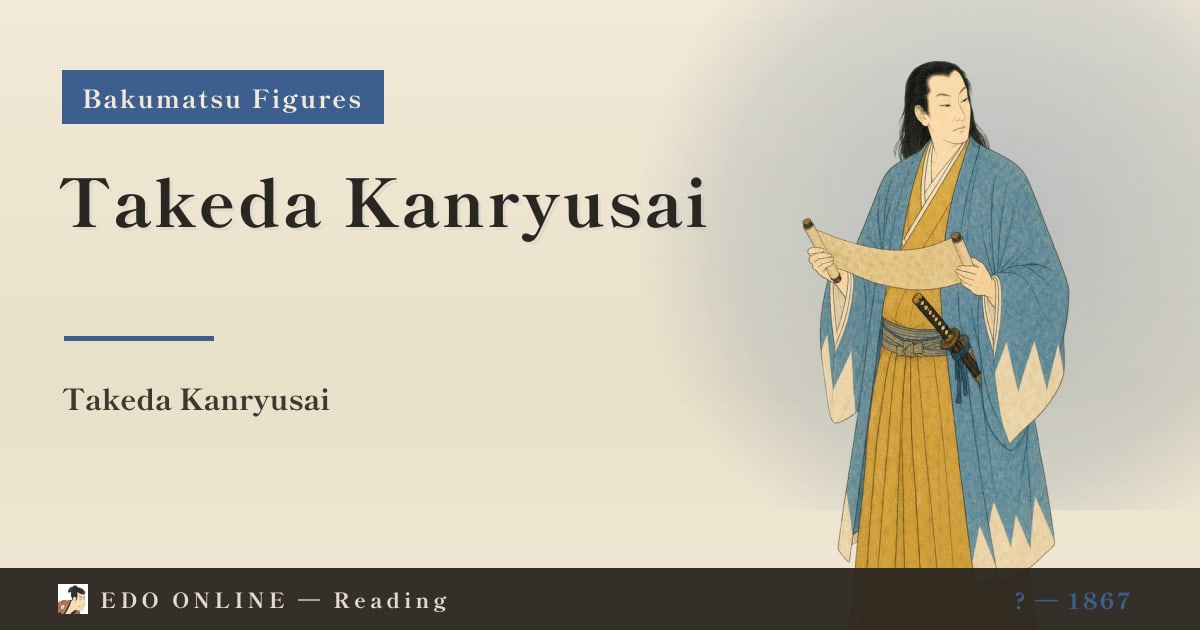
A man who rises on a skill falls when the skill goes out of date. In the Shinsengumi, that man was Takeda Kanryūsai.
Contents
Who Was Takeda Kanryusai?
Takeda was captain of the fifth unit of the Shinsengumi, its instructor in letters, and its officer for military affairs.
His real name was Fukuda Hiroshi. "Takeda Kanryūsai" was a name he adopted himself, after the Takeda clan of Kai. He built his credentials as a military scholar starting with the name.
He was born around 1833, said to have been a medical student of the Mori domain, a subsidiary of Matsue. Much of his early life is unestablished.
He was assassinated on the outskirts of Kyoto on 23 July 1867, after he had left the corps.
Takeda Kanryusai's Weapon Was Military Science
What made Takeda valuable to the Shinsengumi was not the sword.
In Edo he studied Kōshū-school military science, the Hōjō tradition — formations, dispositions, the movement of bodies of men.
The corps needed exactly that. Once it was an armed force policing Kyoto, individual swordsmanship was not enough. Moving as a unit requires a theory of how units move.
He joined in the second half of 1863, worked as a tactician in the corps' early drills, and in 1864 was promoted to assistant vice-commander. He went on to hold the fifth-unit captaincy along with the instructorships in letters and military affairs, running the corps' drill on the Kōshū system.
Kondo Isami valued him for both the scholarship and the fighting. Nishimura Kanefumi's account names him, alongside Ito Kashitaro, as one of the corps' accomplished martial men.
In September 1864, when Kondo travelled to Edo to recruit Ito Kashitaro, Takeda went with him alongside Nagakura Shinpachi and Ogata Shuntarō. He was being treated as a senior man.
Why Takeda Kanryusai Was Disliked
Almost everything preserved about Takeda is unflattering.
Shimozawa Kan's Tales of the Shinsengumi describes a man who flattered upwards and needled downwards. Nagakura Shinpachi and others made an enemy of him.
One story has him harassing a man during drill over a loose straw sandal at such length that a townsman watching wept from sheer vexation.
In April 1865 he summoned and interrogated rural samurai from Maji village in Tanba province. The torture applied was severe; the record notes the men were left aching in every limb and reduced to tears.
Most of this character assessment traces to Shimozawa Kan. His books are known to contain a great deal of embellishment and invention, and how much of the disliked-man portrait reflects the contemporary reality needs handling with care.
That said, the fact of his being detested by Nagakura and others is itself evidence that he stood isolated inside the corps.
Takeda Kanryusai's Fall and Death
What destroyed his position, on the usual account, was not personality but technology.
As the shogunate took up the French military system, Takeda's Kōshū-school science became obsolete — that is the explanation generally offered for his decline.
Once his value as a military scholar was gone, so was his reason for being there.
The causation is not established fact, however. The French military mission arrived in earnest in 1867, after the autumn of 1866 when Takeda left. "New drill made his military science worthless" is best read as a later interpretation.
From around 1866 he leaned towards the anti-shogunate position and tried to make contact with Ito Kashitaro. Kondo Isami refused him, and Ito is said to have refused him too.
With nowhere left to go, Takeda asked to be discharged. It was granted between late September and early October 1866, and he left the Shinsengumi.
On 23 July 1867 he was assassinated at Zenitori bridge on the Takeda road, by the Kamo river. Why is disputed: that his anti-shogunate activity in Kyoto had come to light, or that he was suspected of moving towards Satsuma. Neither is fixed by direct sources.
Saito Hajime is traditionally named as involved, but Saitō was at that time planted inside the Goryō Eji as an informer, which makes the timing doubtful. Who wielded the blade is not established.
Why Takeda Kanryusai Is Worth Reading About
The Shinsengumi's internal killings run through Serizawa Kamo, Yamanami Keisuke and Ito Kashitaro. Takeda's death is different in kind.
Serizawa was a fight over control. Yamanami was desertion. Ito was a split over politics. Takeda is widely read as the man who lost his place because the expertise he held stopped being worth anything.
His specialism could not keep pace with how fast the era moved. The rewriting of Japanese military organisation inside a few years is legible here as the decline of a single man.
Frequently asked questions
Who was Takeda Kanryusai?
Captain of the fifth unit of the Shinsengumi, and its instructor in letters and military affairs. He trained the corps in Kōshū-school military science. His real name was Fukuda Hiroshi.
Why was Takeda Kanryusai killed?
He was assassinated at Zenitori bridge on 23 July 1867, but the reason is unsettled: either his anti-shogunate activity after leaving the corps came to light, or he was suspected of moving towards Satsuma.
Did Saito Hajime kill Takeda Kanryusai?
That is the traditional account, but Saito Hajime was then planted inside the Goryō Eji as an informer, which makes it doubtful. The killer is not established.
Why did Takeda Kanryusai lose his standing in the corps?
The usual explanation is that the shogunate's adoption of the French military system made his Kōshū-school science obsolete. The French mission arrived in 1867, after he left, so the causation is not established fact.
Takeda Kanryusai Timeline
| Year | Event |
|---|---|
| c. 1833 | Born; said to have been a medical student of the Mori domain (early life unclear) |
| Edo years | Studies Kōshū-school military science and takes the name Takeda Kanryūsai |
| Late 1863 | Joins the Shinsengumi and runs its early drills as tactician |
| 1864 | Promoted assistant vice-commander; later fifth-unit captain and military instructor |
| Sep 1864 | Accompanies Kondo Isami to Edo with Nagakura Shinpachi |
| Apr 1865 | Interrogates rural samurai of Maji village in Tanba; severe torture is recorded |
| c. 1866 | His position inside the corps weakens (obsolete military science is one proposed cause) |
| Autumn 1866 | Turns towards the anti-shogunate side and is discharged at his own request |
| 23 Jul 1867 | Assassinated at Zenitori bridge on the Takeda road |
For other men killed from within see Serizawa Kamo, Yamanami Keisuke and Ito Kashitaro; for the roster, the Shinsengumi members; for the corps, the Shinsengumi.
Related reading
Abe Juro — The Former Member Who Talked
He deserted the Shinsengumi and rejoined under another name, shot at Kondo Isami as one of the Goryō Eji, and then grew apples in Sapporo. His late-Meiji testimony is where the ranking of the corps' best swordsmen comes from.
Ando Hayataro — The Shinsengumi's Record-Breaking Archer
He set the standing national record in the long-range shooting at the Tōdai-ji Great Buddha Hall, sending 8,685 arrows the length of the corridor. Nearly fifty, he joined the Shinsengumi and died of wounds taken in the back garden of the Ikedaya.
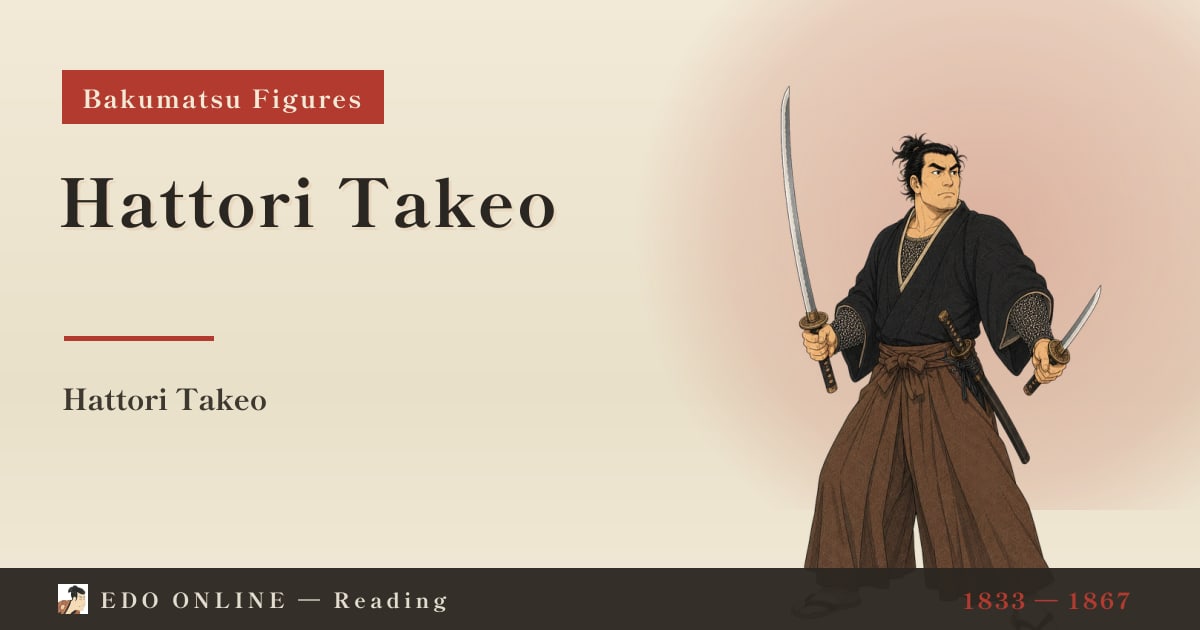
Hattori Takeo — Two Swords at Aburanokoji
A two-sword master and fencing instructor of the Shinsengumi who defected with the Goryō Eji. At Aburanokōji he alone wore mail, held a wall against the whole corps, and fell with more than twenty wounds.