Goto Shojiro — The Man Who Made Tosa Propose the Return of Power
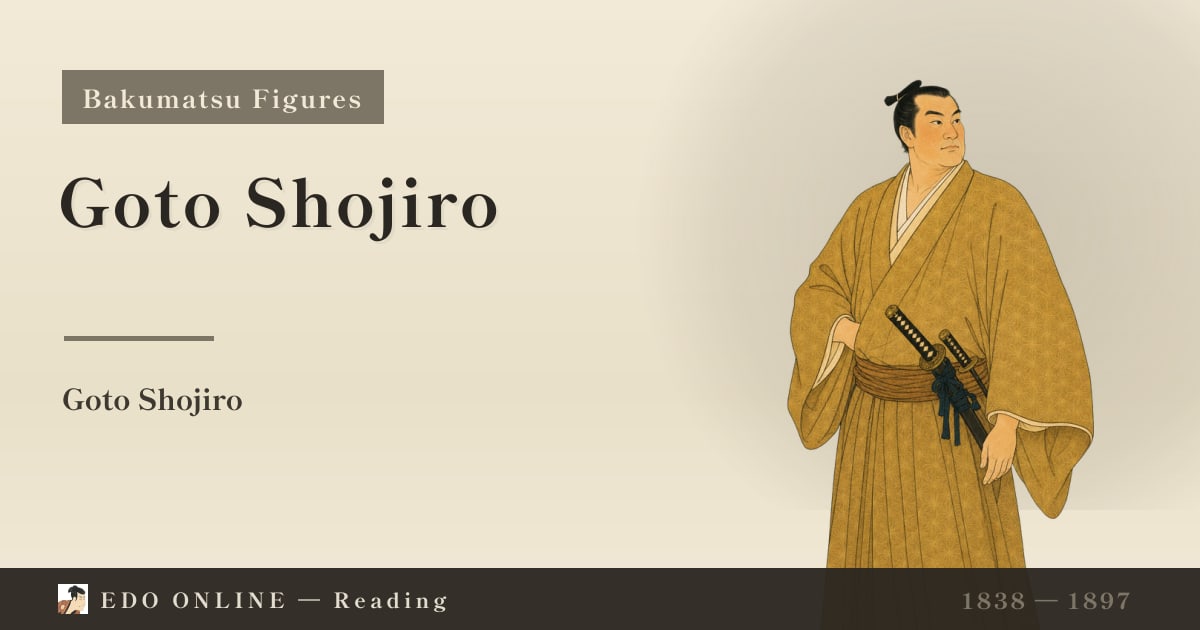
The proposal that the shogun hand power back to the emperor came from the Tosa domain. The man who drafted it into policy and moved the retired lord to sign was Goto Shojiro — who had also put Takechi Hanpeita on trial.
Contents
Who Was Goto Shojiro?
Goto was a politician from the upper samurai ranks of Tosa who held senior office through both the Bakumatsu and the Meiji era.
His career has three parts.
He ran Tosa's administration as chief councillor under Yamauchi Yodo, including its trading operations at Nagasaki.
He drove the petition for the return of power, taking up Sakamoto Ryoma's scheme and persuading Yodo to put it to the shogunate.
He survived into Meiji politics — councillor of state, founder-member of the Jiyuto, leader of a national opposition movement, and finally a cabinet minister. Very few Bakumatsu activists made it as far as party politics.
He was born on 13 April 1838 and died on 4 August 1897, aged fifty-nine.
Goto Shojiro and Yoshida Toyo
Goto was born into an upper-rank Tosa family but lost his father as a boy, and was taken in by his uncle Yoshida Toyo.
Toyo was the reformer Yamauchi Yodo had installed to run the domain, and his private academy produced Goto, Itagaki Taisuke and most of the rest of Tosa's reforming upper samurai.
In 1862 Toyo was assassinated by men of the Tosa Loyalist Party. Goto lost his position for a time and went to Edo to study navigation and English.
Why Goto Shojiro Executed the Tosa Loyalists
When Yodo pulled the domain's line back in 1864, Goto returned to power as inspector general, and became a domain councillor the following year.
His first task was the suppression of the Tosa Loyalist Party — the faction that had killed the uncle who raised him. Its leader Takechi Hanpeita was imprisoned and ordered to commit seppuku on 3 July 1865. Okada Izo was executed as well.
This is what makes Goto hard to sum up. The enlightened administrator behind the return of power was also the man who broke the loyalists and had them killed. Tosa's internal politics came very close to a family killing.
Goto Shojiro's Alliance with Sakamoto Ryoma
In early 1867 Goto met Sakamoto Ryoma at Nagasaki.
By rights the two could not have worked together. Ryoma was a fugitive from the domain, Goto the councillor who had destroyed his comrades. They allied anyway — Goto had the domain's money and ships, Ryoma the plan and the contacts, and each needed the other.
Ryoma's Kaientai operated as an arm of the domain, and the Nagasaki trade began to turn.
And Ryoma's design for a new state — the outline handed down as the "eight-point plan" — Goto took up as domain policy. The core of it: if the shogun returns power himself, the country avoids a war.
Goto Shojiro's Petition for the Return of Power
On 29 October 1867 Tosa submitted, in the name of the retired lord Yamauchi Yodo, a petition asking the shogun to return power to the throne. Goto did the work.
On 9 November 1867 Tokugawa Yoshinobu announced the Taisei Hokan.
It was a completely different road from the one Satsuma and Choshu were on, which ran through war. Tosa bet on ending the shogunate without fighting, and for a moment the bet paid. Fifty-five days later the restoration decree was proclaimed, and the Boshin War came anyway.
On 10 December 1867, Sakamoto Ryoma was assassinated in Kyoto.
Goto in the Meiji Era
Goto held one office after another: governor of Osaka, vice-minister of public works, president of the Chamber of the Left. He became a councillor of state in 1873 but resigned with Saigo Takamori and Itagaki Taisuke in the split over Korea policy.
In 1874 he co-signed, with Itagaki Taisuke, Eto Shinpei and Soejima Taneomi, the memorial calling for an elected assembly. Japan's parliamentary movement starts there.
He also went into business, taking over the Takashima coal mine from the government in 1874. It went badly, and he eventually sold it to Iwasaki Yataro of Mitsubishi.
He joined the founding of the Jiyuto (Liberal Party) in 1881 and in 1887 led the Daido Danketsu, a movement to unite the opposition. Then he crossed over: minister of communications from 1889 to 1892 and minister of agriculture and commerce from 1892 to 1894. He was made a count.
The switch drew criticism at the time — the man who had carried the banner of popular rights was now a minister of the government he had opposed.
Goto Shojiro's Death and Grave
He died on 4 August 1897, aged fifty-nine.
His grave is in Aoyama Cemetery in Tokyo, built in the same form as that of his fellow Tosa man Itagaki Taisuke.
Goto Shojiro Timeline
| Year | Event |
|---|---|
| 13 Apr 1838 | Born into an upper-rank Tosa samurai family |
| 1848 | Loses his father; raised by Yoshida Toyo |
| 1862 | Yoshida Toyo is assassinated; Goto loses office and studies in Edo |
| 1864 | Restored under Yamauchi Yodo as inspector general (councillor from 1865) |
| 3 Jul 1865 | Takechi Hanpeita is ordered to commit seppuku |
| Feb 1867 | Meets Sakamoto Ryoma at Nagasaki |
| 29 Oct 1867 | Tosa submits the petition for the return of power |
| 9 Nov 1867 | Tokugawa Yoshinobu announces the Taisei Hokan |
| 1873 | Becomes a councillor of state; resigns in the split over Korea |
| 1874 | Co-signs the memorial for an elected assembly; takes over the Takashima mine |
| 1881 | Joins the founding of the Jiyuto |
| 1887 | Leads the Daido Danketsu movement; made a count |
| 1889–92 | Minister of communications |
| 1892–94 | Minister of agriculture and commerce |
| 4 Aug 1897 | Dies, aged 59 |
His allies were Sakamoto Ryoma and Itagaki Taisuke; his lord was Yamauchi Yodo; the man he sent to his death was Takechi Hanpeita.
Related reading
Abe Juro — The Former Member Who Talked
He deserted the Shinsengumi and rejoined under another name, shot at Kondo Isami as one of the Goryō Eji, and then grew apples in Sapporo. His late-Meiji testimony is where the ranking of the corps' best swordsmen comes from.
Ando Hayataro — The Shinsengumi's Record-Breaking Archer
He set the standing national record in the long-range shooting at the Tōdai-ji Great Buddha Hall, sending 8,685 arrows the length of the corridor. Nearly fifty, he joined the Shinsengumi and died of wounds taken in the back garden of the Ikedaya.
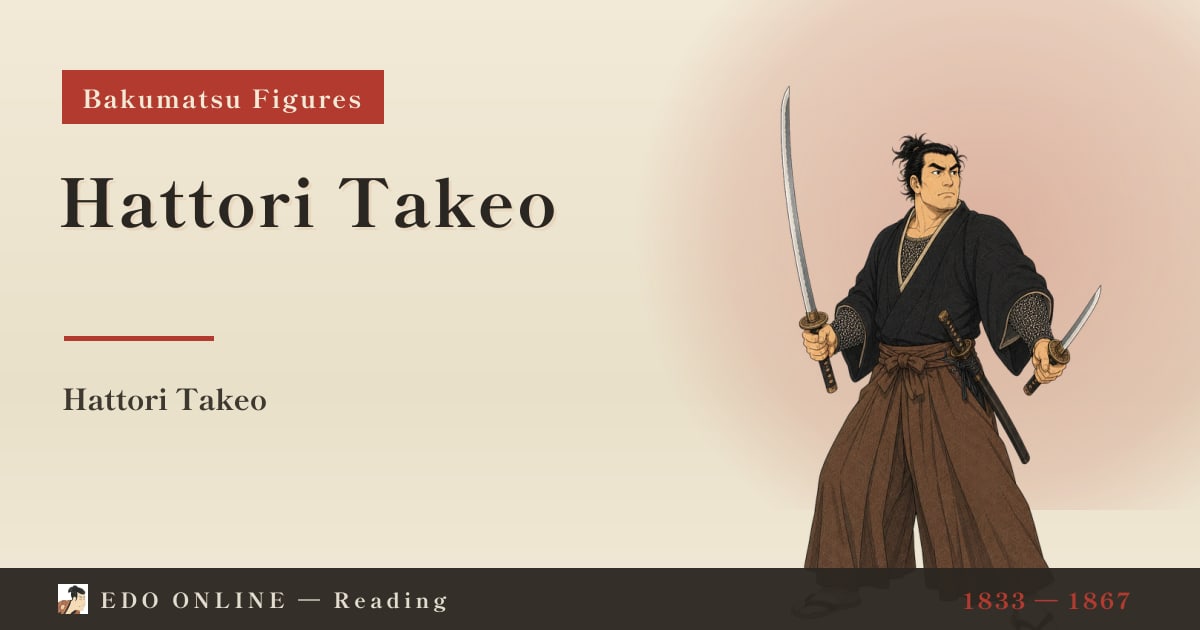
Hattori Takeo — Two Swords at Aburanokoji
A two-sword master and fencing instructor of the Shinsengumi who defected with the Goryō Eji. At Aburanokōji he alone wore mail, held a wall against the whole corps, and fell with more than twenty wounds.