Soejima Taneomi — The Foreign Minister Who Freed the Coolies
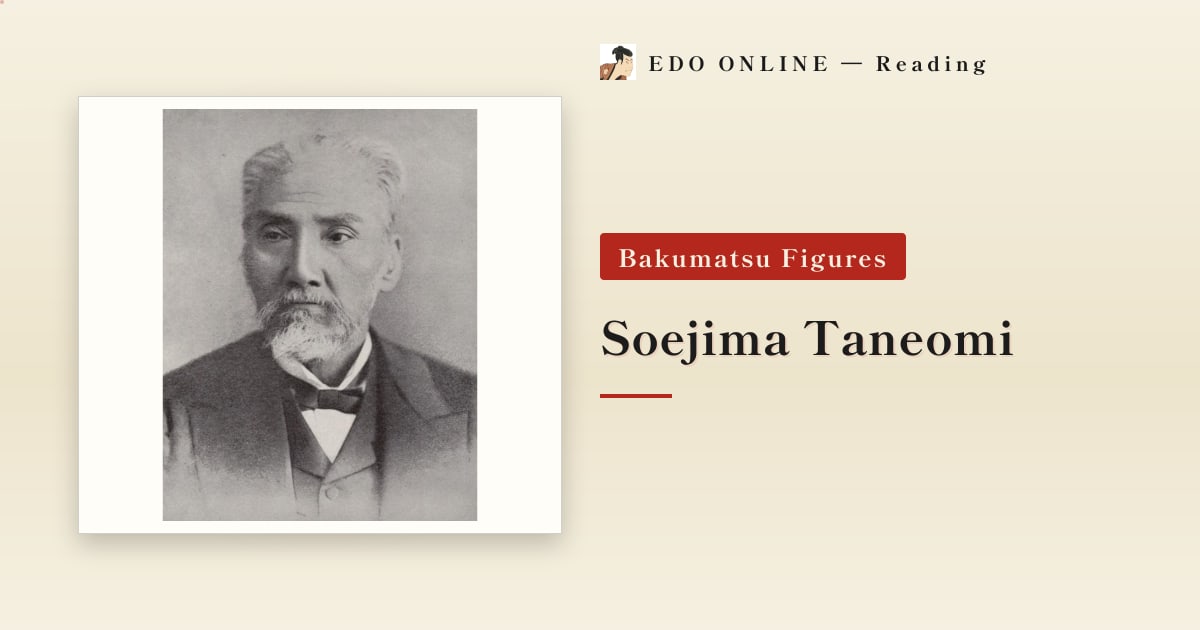
There is one case in which early Meiji Japan used its own courts to free people off a foreign ship. The man who drove it was the foreign minister, Soejima Taneomi.
Contents
Who Was Soejima Taneomi?
Three things.
Diplomacy. As foreign minister he handled negotiations with Qing China and the Maria Luz affair described below.
Politics. He resigned over the dispute on Korea policy and then signed the petition for an elected assembly, standing with Itagaki Taisuke and others in demanding a parliament.
Calligraphy. Under the name Sokai, he is held in high regard as a calligrapher to this day.
He was born in 1828 into a scholarly family of Saga domain in Hizen.
The Saga That Formed Soejima Taneomi
Saga occupied an unusual place in the Bakumatsu: responsible for guarding Nagasaki, it had early access to Western knowledge and, under its lord Nabeshima Naomasa, ran ahead of other domains technically.
Okuma Shigenobu and Eto Shinpei came from the same domain. Soejima was one of that group.
His family worked in national learning, and his elder brother Edayoshi Shin'yo shaped intellectual life in Saga. Soejima's foundation was kokugaku and classical Chinese learning, which set him apart from his fellow Saga men — though he was not cut off from Western studies, having learned English under Guido Verbeck at the domain's Chienkan school.
Soejima Taneomi and the Maria Luz Incident
In 1872 came the case that defines his name.
A Chinese labourer escaped from the Peruvian ship Maria Luz, anchored at Yokohama, and asked for help. The vessel carried a large number of Chinese workers, and the conditions amounted in practice to trafficking.
Soejima, as foreign minister, decided that Japan would try the matter in a Japanese court.
Japan at the time was bound by unequal treaties that restricted its jurisdiction over foreigners. For Japan to intervene judicially in the internal affairs of a foreign ship was extraordinary.
The case was heard at the Kanagawa prefectural office, and the Chinese labourers were freed.
Peru objected, and the dispute later went to international arbitration, which upheld the Japanese action.
A weak state bound by unequal treaties used law to free people. As a piece of early Meiji diplomacy it stands out.
There was a sting in it. During proceedings the Peruvian side argued that Japan held people under comparable contracts of its own, raising the indentured service of licensed prostitutes. The emancipation edict on that subject followed the same year. Judging another country rebounded onto the judge.
Soejima Taneomi's Resignation and His Calligraphy
In 1873 Soejima left the government in the split over Korea policy, resigning alongside Saigo Takamori and Itagaki Taisuke.
The next year he signed the petition for an elected assembly.
He later travelled in China and eventually held senior appointments including privy councillor and home minister. But the best-known part of his later life is his calligraphy.
The works signed Sokai are known for bold, unconventional composition — grounded in classical scholarship yet departing freely from orthodox brushwork. They hold a distinctive place in Meiji calligraphy, and are still exhibited and studied.
People who know nothing of the diplomat encounter him through the brush.
How Soejima Taneomi Died
Soejima died in 1905, aged seventy-six.
Soejima Taneomi Timeline
| Year | Event |
|---|---|
| 1828 | Born into a scholarly family of Saga domain |
| 1868 | Enters the new government after the Meiji Restoration |
| 1871 | Becomes foreign minister |
| 1872 | Handles the Maria Luz incident and frees the Chinese labourers |
| 1873 | Resigns in the split over Korea policy |
| 1874 | Signs the petition for an elected assembly |
| 1905 | Dies, aged 76 |
For another man of Saga see Okuma Shigenobu; for the assembly movement, Itagaki Taisuke.
Related reading
Abe Juro — The Former Member Who Talked
He deserted the Shinsengumi and rejoined under another name, shot at Kondo Isami as one of the Goryō Eji, and then grew apples in Sapporo. His late-Meiji testimony is where the ranking of the corps' best swordsmen comes from.
Ando Hayataro — The Shinsengumi's Record-Breaking Archer
He set the standing national record in the long-range shooting at the Tōdai-ji Great Buddha Hall, sending 8,685 arrows the length of the corridor. Nearly fifty, he joined the Shinsengumi and died of wounds taken in the back garden of the Ikedaya.
Hattori Takeo — Two Swords at Aburanokoji
A two-sword master and fencing instructor of the Shinsengumi who defected with the Goryō Eji. At Aburanokōji he alone wore mail, held a wall against the whole corps, and fell with more than twenty wounds.