
Itagaki Taisuke — Soldier of the Restoration, Father of the Opposition
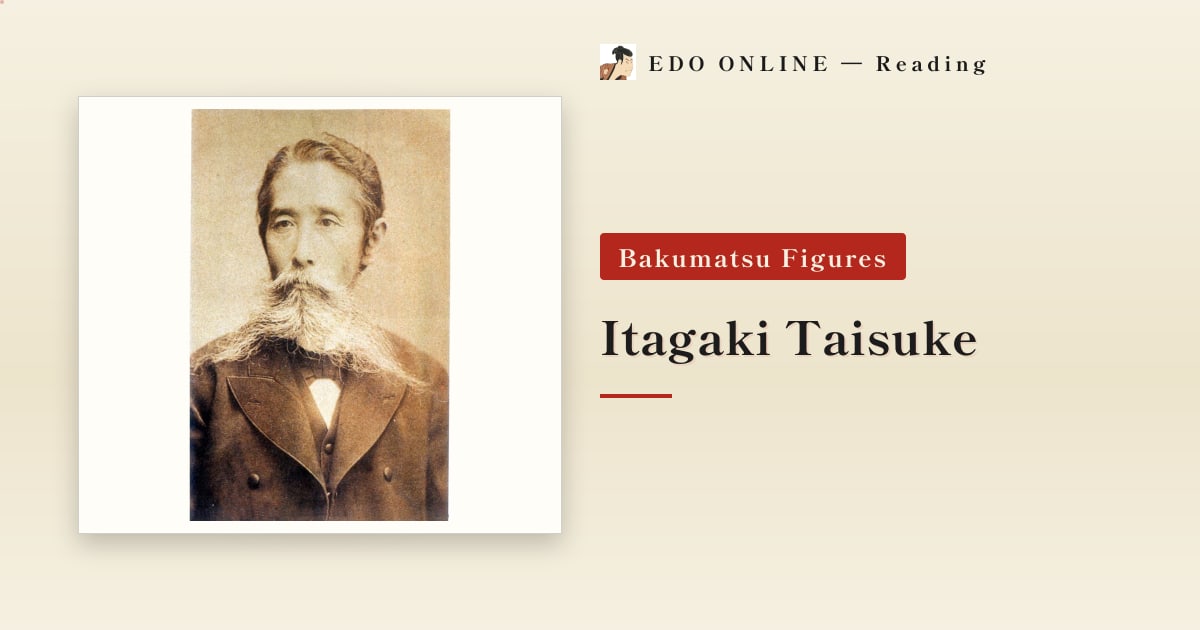
His face was once on the Japanese hundred-yen note. Itagaki Taisuke fought the last war of the samurai era with a sword, and then spent the rest of his life telling the winners to give up some of their power.
Contents
Who Was Itagaki Taisuke?
His career splits cleanly in two.
First, as a soldier. He commanded Tosa troops in the Boshin War, defeated a Shinsengumi force in Koshu, and took part in the assault on Aizu.
Then, as an agitator. After leaving the Meiji government he submitted a petition demanding an elected assembly and became the central figure of the Freedom and People's Rights Movement, leading Japan's first significant political party.
A man who helped install the new government by force then spent decades telling it to distribute power. That tension is the whole of him.
Itagaki Taisuke from Tosa to the Boshin War
Born in 1837 into an upper-rank samurai family of Tosa domain, he originally bore the surname Inui and adopted Itagaki around the time of the war.
He stood apart from the Tosa loyalist party but moved steadily toward overthrowing the shogunate, coordinating with Satsuma in preparation for war.
In 1868 he led his troops east, defeated Kondo Isami's unit at Katsunuma, and pressed on into Aizu, where he was among the commanders who broke its defense.
He was a genuinely capable field commander, and that record is what carried him into the new government.
Why Itagaki Taisuke Left the Government
Itagaki became a councillor of state under the Meiji government, but in 1873 he lost an internal struggle over policy toward Korea and resigned, leaving alongside Saigo Takamori.
Unlike Saigo, he did not turn to rebellion. The following year he submitted a petition for the establishment of an elected assembly.
His argument: government had fallen into the hands of men from two or three domains, this could not sustain a country, and a body representing the people at large was required.
Coming from a Tosa man watching Satsuma and Choshu divide the state between them, the charge landed. The Freedom and People's Rights Movement spread nationwide from there.
In 1881 the throne promised a national assembly, and Itagaki founded the Liberal Party and became its president.
"Itagaki May Die, But Liberty Never!"
In 1882, after giving a speech in Gifu, Itagaki was attacked and wounded. The words attributed to him at that moment are among the most quoted in modern Japanese history.
Whether he actually said them has been disputed since the time itself. One persistent account holds that the line came from someone else present and was later transferred to him.
What is not in doubt is that the phrase became the slogan of an entire political movement. It is a rare case where the function of a sentence mattered more than its authorship.
He survived the attack, remained at the center of party politics, and later served as home minister.
Itagaki Taisuke on the Hundred-Yen Note
More Japanese people encountered Itagaki's face through currency than through politics.
He appeared on the postwar hundred-yen note, which circulated long enough that an entire generation remembers him simply as "the man on the hundred".
The denomination later moved to coinage and the note disappeared from daily use.
That a leader of the democratic-rights movement is best remembered as a banknote portrait is an ironic route to fame, but a real one.
Itagaki Taisuke's Last Years
In old age Itagaki turned toward social causes and to criticism of the peerage system, reportedly declining to see his own title passed down.
He died in 1919, aged eighty-two — a long life for a man of the sword-carrying generation.
Itagaki Taisuke Timeline
| Year | Event |
|---|---|
| 1837 | Born into an upper samurai family of Tosa |
| 1868 | Commands troops in the Boshin War; defeats a Shinsengumi force and advances on Aizu |
| 1871 | Becomes a councillor in the Meiji government |
| 1873 | Resigns after the split over Korea policy |
| 1874 | Submits the petition for an elected assembly |
| 1881 | Founds the Liberal Party |
| 1882 | Attacked at Gifu; the famous phrase enters circulation |
| 1919 | Dies, aged 82 |
For other men of Tosa see Sakamoto Ryoma and Nakaoka Shintaro; for the government he fought, see the Meiji Restoration.
Related reading
Abe Juro — The Former Member Who Talked
He deserted the Shinsengumi and rejoined under another name, shot at Kondo Isami as one of the Goryō Eji, and then grew apples in Sapporo. His late-Meiji testimony is where the ranking of the corps' best swordsmen comes from.
Ando Hayataro — The Shinsengumi's Record-Breaking Archer
He set the standing national record in the long-range shooting at the Tōdai-ji Great Buddha Hall, sending 8,685 arrows the length of the corridor. Nearly fifty, he joined the Shinsengumi and died of wounds taken in the back garden of the Ikedaya.
Hattori Takeo — Two Swords at Aburanokoji
A two-sword master and fencing instructor of the Shinsengumi who defected with the Goryō Eji. At Aburanokōji he alone wore mail, held a wall against the whole corps, and fell with more than twenty wounds.