Eto Shinpei — The Man Who Built Japan's Courts and Died Without One
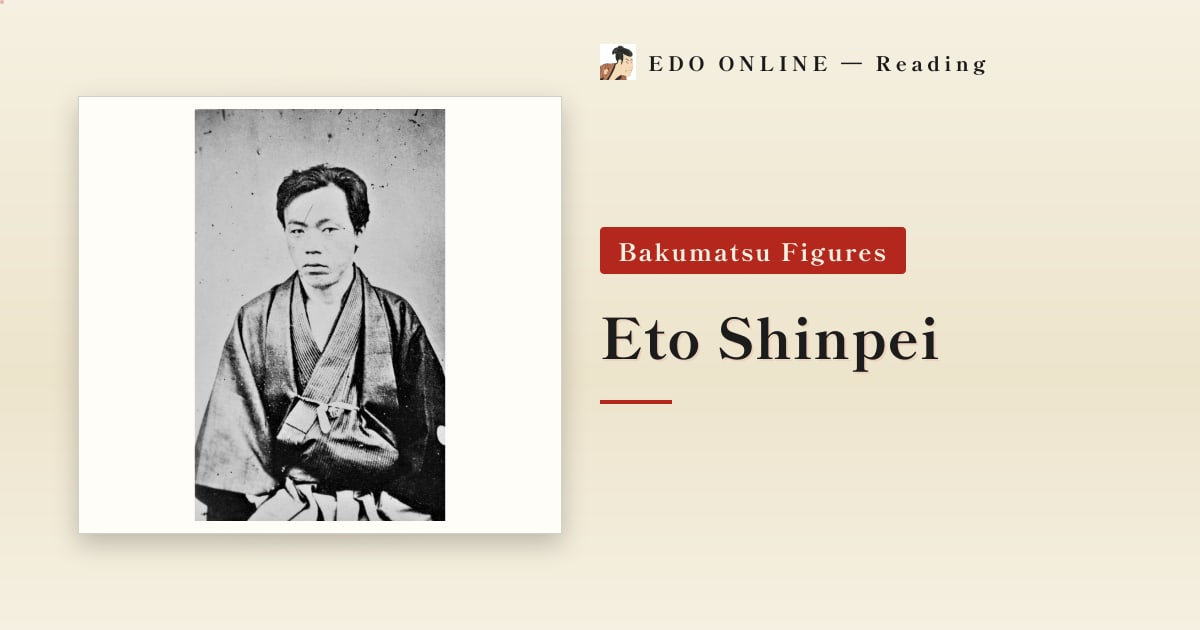
The man who built the framework of Japanese justice was killed without anything resembling a proper trial. Eto Shinpei, the country's first justice minister.
Contents
Who Was Eto Shinpei?
Eto was a low-ranking Saga samurai who rose to run the Meiji government's justice ministry.
His record comes to three things.
He built the court system. He established courts across the country, drove the compilation of legal codes, and argued that the judiciary must be independent of the executive. The shape of the modern Japanese court system dates from his tenure.
He prosecuted the government's own. He forced Yamagata Aritomo and Inoue Kaoru out of office over separate scandals — trying the heroes of the Restoration under law.
He was executed. Made the figurehead of a rebellion in his home province, he lost, and was beheaded.
He was born in Saga in 1834.
The Saga That Produced Eto Shinpei
Eto came from a poor samurai household and is said to have struggled to pay for his education.
He studied under the nativist scholar Edayoshi Shin'yo, in a school that also held Okuma Shigenobu and Soejima Taneomi. A remarkable share of Saga's contribution to the Meiji government came out of that one room.
In 1862 Eto left his domain without permission for Kyoto — a serious offence. On his return he was placed under long confinement. He spent the most eventful years of the Bakumatsu period stalled at home.
How Eto Shinpei Built Japan's Legal System
After 1868 he rose fast, and in 1872 became the first shiho-kyo, or justice minister.
What he attempted was to assemble a state that ran on law, from nothing.
He put courts across the country. Judging had been the work of administrative officials; Eto held that it belonged to a separate institution.
He forced the pace on codification. Drafting of a civil code modelled on French law was pushed forward at furious speed — he is said to have valued speed over precision, and was criticised for it.
He made officials suable. Opening a legal route for ordinary subjects to sue the government was, for the time, a radical idea.
Eto Shinpei's Corruption Investigations
Eto's ministry turned its blade inward.
Yamagata Aritomo was driven from office over army funds that had passed to a merchant house. Inoue Kaoru was pursued over a mining concession.
Both were Restoration heroes, and both were core Satsuma–Choshu men. Eto went at them anyway.
Before the law, a founder of the state is a defendant like anyone else — that was his position, and it left him isolated inside the government.
Eto Shinpei and the Saga Rebellion
In 1873 the government split over whether to send a mission to Korea — the Political Crisis of 1873.
Saigo Takamori, Itagaki Taisuke and others lost and resigned. Eto went with them.
In January 1874 he signed, with Itagaki, the memorial calling for an elected national assembly — the first formal public demand for a parliament in Japan.
Then he went home to Saga, where discontented former samurai were gathering. They made him their leader, and the Saga Rebellion broke out.
It was crushed quickly. Eto sought help from Saigo Takamori in Kagoshima and from allies in Kochi, and got none. He was captured in Tosa while on the run.
How Eto Shinpei Was Executed
He was tried by an emergency court set up in Saga. Proceedings were fast, and he had almost no opportunity to argue his case. The man who had built the guarantees did not receive them.
The sentence was beheading and public exposure of the head. It was carried out on 13 April 1874. He was forty.
The exposed head was photographed, and the photograph survives. The severity was exceptional for the new state's penal practice, and the role of Okubo Toshimichi in pressing for it is still argued over.
Exposure of the head as a punishment was abolished within a few years.
Eto Shinpei's Grave
His grave is at Hongyo-ji in Saga City. Saga honours him as a local figure of the first rank, and a statue of him stands in the city.
Eto Shinpei Timeline
| Year | Event |
|---|---|
| 1834 | Born into a low-ranking Saga samurai family |
| 1850s | Studies under Edayoshi Shin'yo alongside Okuma Shigenobu and Soejima Taneomi |
| 1862 | Leaves the domain without permission; confined on his return |
| 1872 | Becomes Japan's first justice minister |
| 1872–73 | Prosecutes Yamagata Aritomo and Inoue Kaoru |
| 1873 | Resigns in the Political Crisis of 1873 |
| Jan 1874 | Signs the memorial demanding an elected assembly |
| Feb 1874 | Made leader of the Saga Rebellion, and defeated |
| Apr 1874 | Captured and executed, aged 40 |
For his fellow Saga men see Okuma Shigenobu and Soejima Taneomi; for the man who pressed the sentence, Okubo Toshimichi.
Related reading
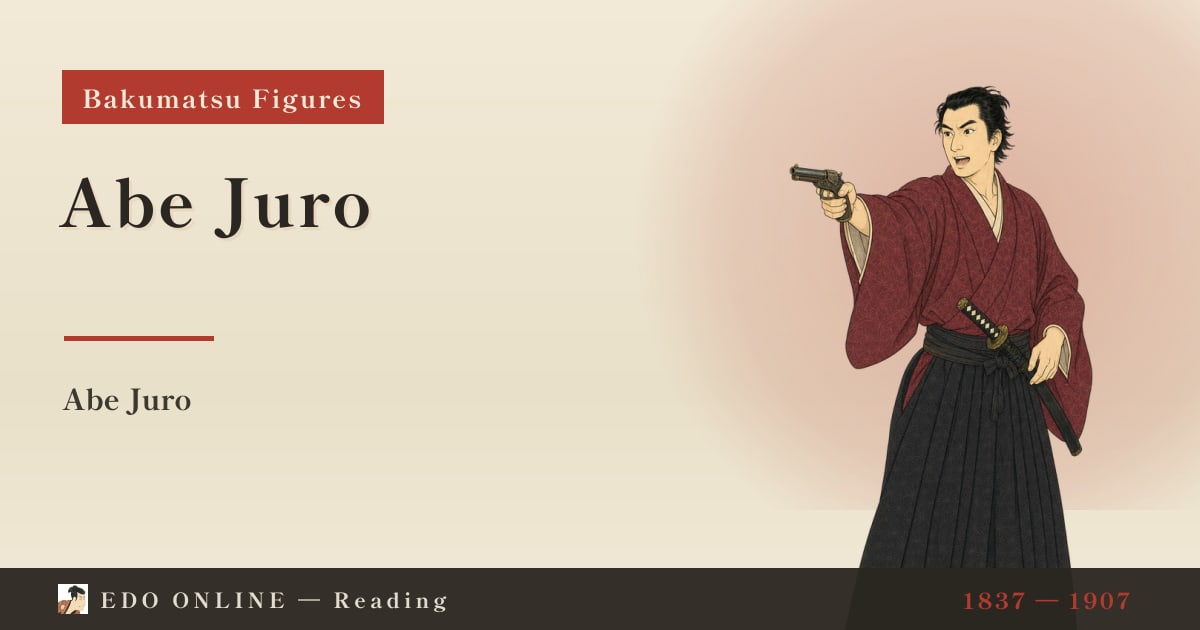
Abe Juro — The Former Member Who Talked
He deserted the Shinsengumi and rejoined under another name, shot at Kondo Isami as one of the Goryō Eji, and then grew apples in Sapporo. His late-Meiji testimony is where the ranking of the corps' best swordsmen comes from.
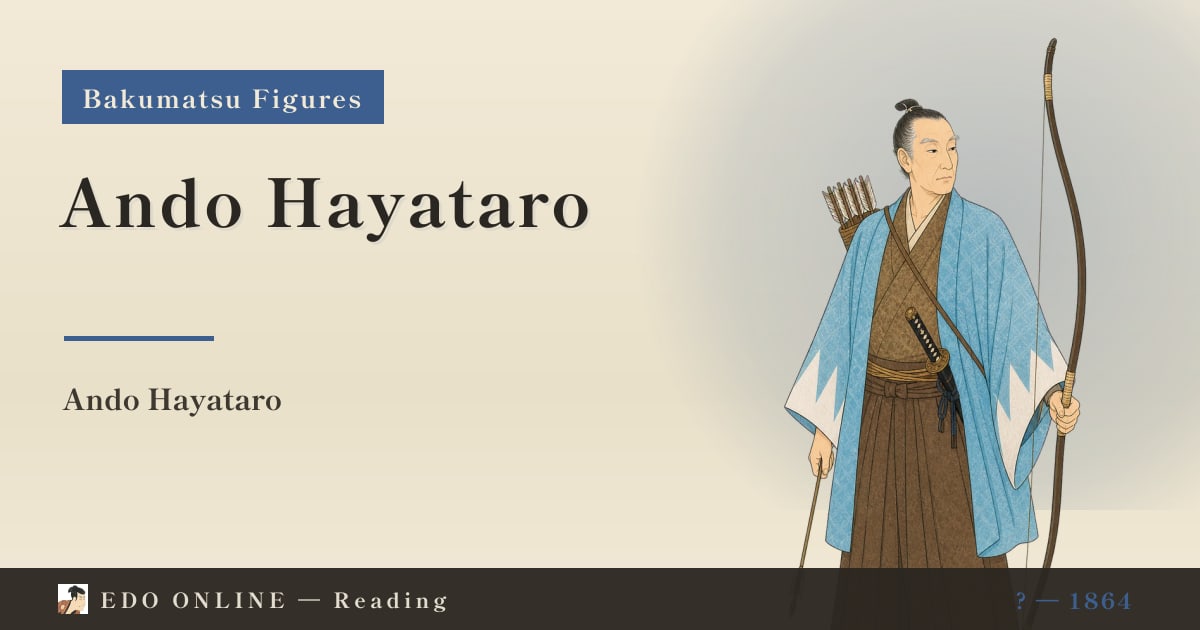
Ando Hayataro — The Shinsengumi's Record-Breaking Archer
He set the standing national record in the long-range shooting at the Tōdai-ji Great Buddha Hall, sending 8,685 arrows the length of the corridor. Nearly fifty, he joined the Shinsengumi and died of wounds taken in the back garden of the Ikedaya.
Hattori Takeo — Two Swords at Aburanokoji
A two-sword master and fencing instructor of the Shinsengumi who defected with the Goryō Eji. At Aburanokōji he alone wore mail, held a wall against the whole corps, and fell with more than twenty wounds.