
What Was the Meiji Restoration? Causes and Reforms Explained
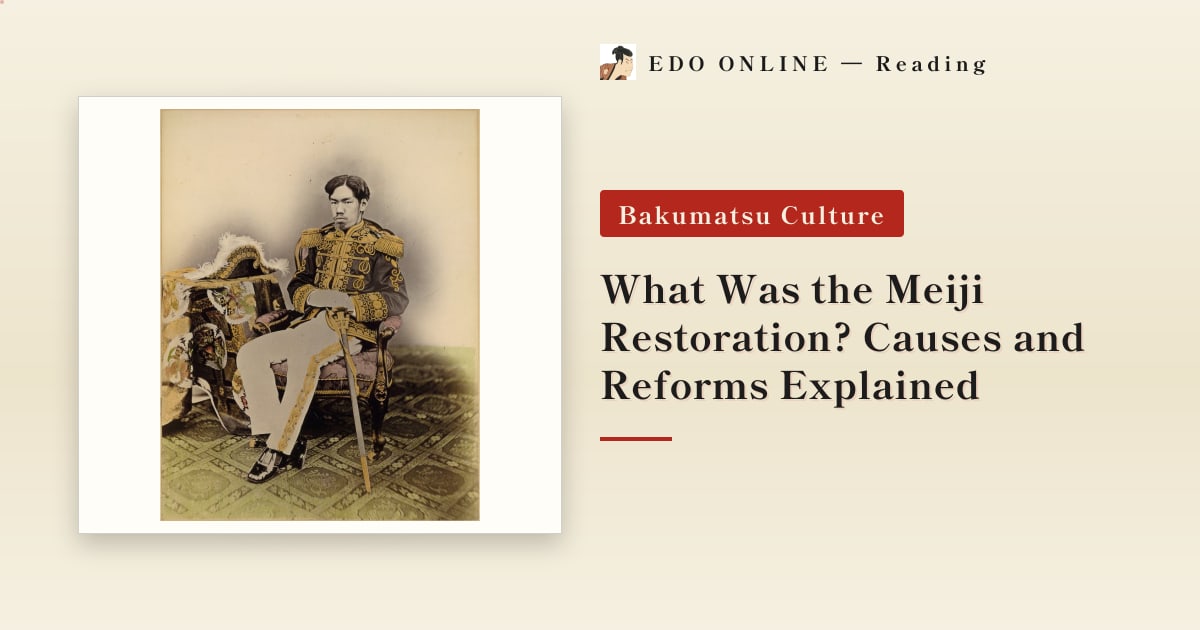
The Meiji Restoration is the hinge between early modern and modern Japan. It was not merely a change of government: status, taxation, the army, education and even the calendar were rebuilt from the ground up.
Contents
What was the Meiji Restoration?
The Meiji Restoration is the sequence of changes by which the Tokugawa shogunate fell and a modern state was constructed under the emperor.
| Item | Detail |
|---|---|
| Period | Disputed; broadly 1853 to about 1877 |
| Driving force | Lower-ranking samurai from Satsuma, Chōshū, Tosa and Hizen |
| Key figures | Saigō Takamori, Ōkubo Toshimichi, Kido Takayoshi, Iwakura Tomomi |
| Result | A centralised modern state |
When was the Meiji Restoration?
There is no agreed boundary. The span depends on what counts as part of the Restoration.
Possible starting points
- 1853 Black Ships
- 1867 Return of power
- 1868 Restoration of Imperial Rule
Possible end points
- 1868 Meiji era proclaimed
- 1871 Abolition of the domains
- 1877 End of the Satsuma Rebellion
- 1889 Promulgation of the constitution
Narrowly it means the transfer of government in 1868; broadly it covers about thirty-five years from the Black Ships to the constitution. Since the transformation plainly did not happen in a single year, the broader framing is closer to what occurred.
Why did the Meiji Restoration happen?
There is no single cause. What matters is that external pressure and internal exhaustion arrived at the same time.
Pressure from outside
The Black Ships of 1853 forced Japan to open. Western military power was overwhelming and there was no means of resisting it.
The commercial treaties the shogunate then signed were unequal: Japan lacked tariff autonomy and had to concede extraterritoriality. The sense that national sovereignty was being compromised spread widely.
Exhaustion inside
Shogunal and domain finances were already near their limits. Famine and rural revolt recurred, and the rigid status system blocked the promotion of capable men.
That the Restoration was driven by lower-ranking samurai from Satsuma and Chōshū is telling. Under the existing order they could never reach the centre of power. That gave them a direct interest in dismantling the order itself.
The collapse of shogunal authority
The decisive factor was the demonstration that the shogunate could no longer defend the country. Its attempt to suppress opposition by force in the Ansei Purge produced the assassination of its own chief minister in broad daylight.
Then in 1866 the shogunate lost a war against a single domain. After that, no one could pretend it still governed.
What did the Meiji Restoration change?
| Reform | Effect |
|---|---|
| Return of registers and abolition of the domains (1871) | Domains replaced by prefectures under direct central government |
| Equality of the four classes | The warrior-farmer-artisan-merchant order abolished; samurai privileges ended |
| Land tax reform (1873) | Tax shifted from rice in kind to cash on assessed land value, stabilising state finances |
| Conscription (1873) | Universal military service regardless of birth; the end of warfare as a samurai monopoly |
| The school system (1872) | Primary schools established nationwide |
| The solar calendar (1873) | Replacing the lunisolar calendar |
The abolition of the domains is remarkable by any international standard. More than 260 years of territorial fragmentation were eliminated at a stroke, without the civil war such a measure would normally cause. Ōkubo Toshimichi and Kido Takayoshi drove it through.
Meiji Restoration timeline
| Year | Event |
|---|---|
| 1853 | The Black Ships arrive |
| 1858 | Commercial treaty signed; the Ansei Purge |
| 1860 | The Sakuradamon incident |
| 1866 | Satsuma-Chōshū Alliance; the shogunate loses the second Chōshū campaign |
| 1867 | Return of power to the emperor |
| Jan 1868 | Restoration of Imperial Rule; the Boshin War begins |
| 1868 | The Charter Oath; the Meiji era proclaimed |
| 1869 | Boshin War ends; domain registers returned |
| 1871 | Abolition of the domains; the Iwakura Mission departs |
| 1873 | Land tax reform and conscription; the Seikanron crisis |
| 1877 | The Satsuma Rebellion ends the samurai revolts |
| 1889 | The constitution is promulgated |
The contradictions the Restoration left
Rapid reform produced deep strains.
The ruin of the samurai. Stripped of stipends and privileges, former warriors rose repeatedly, culminating in the Satsuma Rebellion of 1877. That Saigō Takamori, the Restoration's greatest single contributor, was placed at the head of that rebellion captures the contradiction exactly.
New burdens. Land tax reform and conscription fell heavily on farmers and provoked protests across the country.
Domain clique politics. Government posts were dominated by men from Satsuma and Chōshū. A regime proclaiming equality of the four classes was visibly run by people from two provinces, and criticism of this fed the later movement for popular rights.
The treatment of the defeated. Aizu and other domains that had backed the shogunate were punished severely, leaving resentments that persisted for generations.
Key Dates and Common Confusions
The sequence to hold: 1867 the return of power, 1868 the restoration decree and the opening of the Boshin War, 1869 the surrender at Hakodate.
| Common mistake | Actually |
|---|---|
| The Restoration was a single event in 1868 | It is a name for a long sequence of changes running from the Bakumatsu into the 1870s |
| The samurai disappeared at once | Domains were abolished in 1871; stipends and swords went in 1876. It was staged |
| The expulsionists won and closed the country | The winners Westernised. Expulsion was dropped as a method |
Frequently asked questions
What was the Meiji Restoration?
The process by which the Tokugawa shogunate fell and a centralised modern state was built under the emperor.
Why did the Meiji Restoration happen?
Because external pressure following the arrival of the Black Ships coincided with the financial and political exhaustion of the shogunate and the domains. The shogunate's defeat by a single domain in 1866 made its weakness undeniable.
When was the Meiji Restoration?
Centred on 1868, but often taken to span from 1853 to 1877, or as far as the 1889 constitution.
What changed after the Meiji Restoration?
The domains were abolished in favour of prefectures, the status system was dismantled, taxation was reformed, conscription and universal schooling were introduced, and the solar calendar was adopted.
For the war that preceded it see the Boshin War; for the people who made it see the Bakumatsu figures.
Related reading
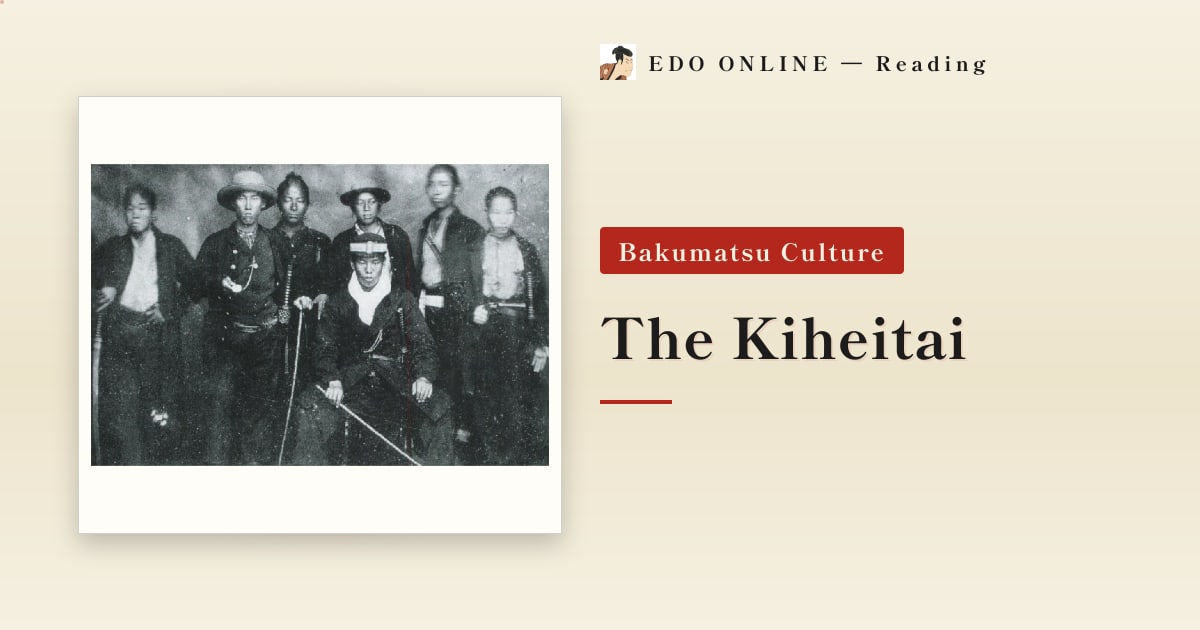
The Kiheitai — Takasugi's Army That Ignored Class
Raised in 1863 by Takasugi Shinsaku, the Kiheitai took commoners as soldiers. Why Choshu did it, how it differed from the regular army, what it won, and how the new government crushed it.
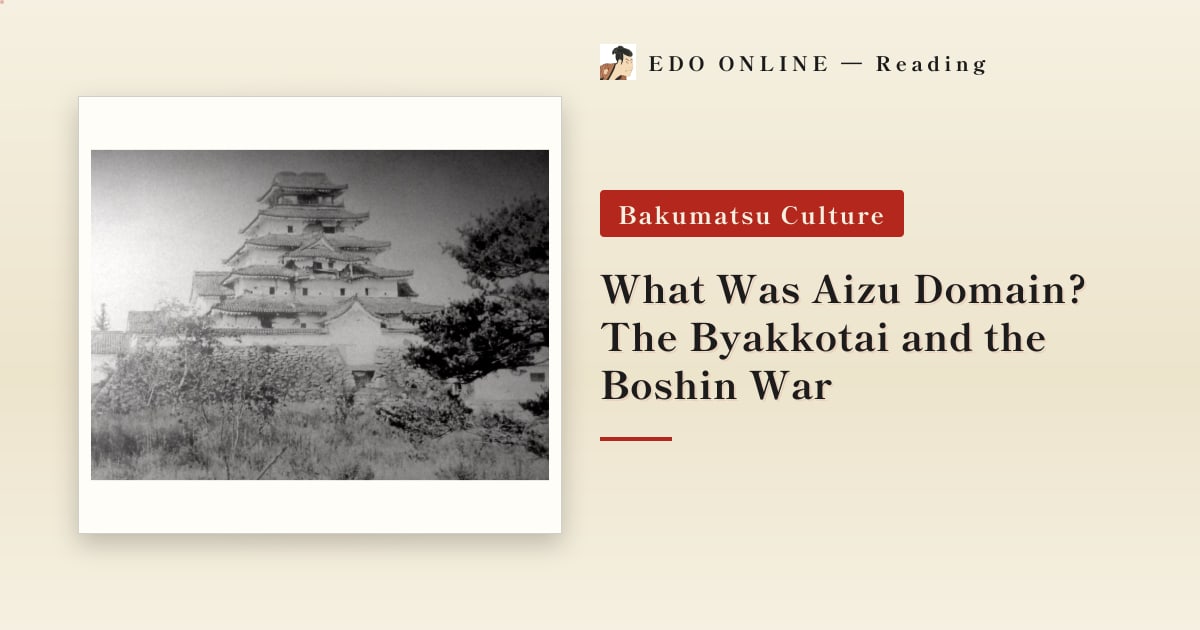
What Was Aizu Domain? The House Code, the Byakkotai, the Siege
Aizu stayed loyal to the shogunate to the end and was destroyed for it. Why Matsudaira Katamori took the Kyoto post, what happened to the Byakkotai, and how the domain was punished.
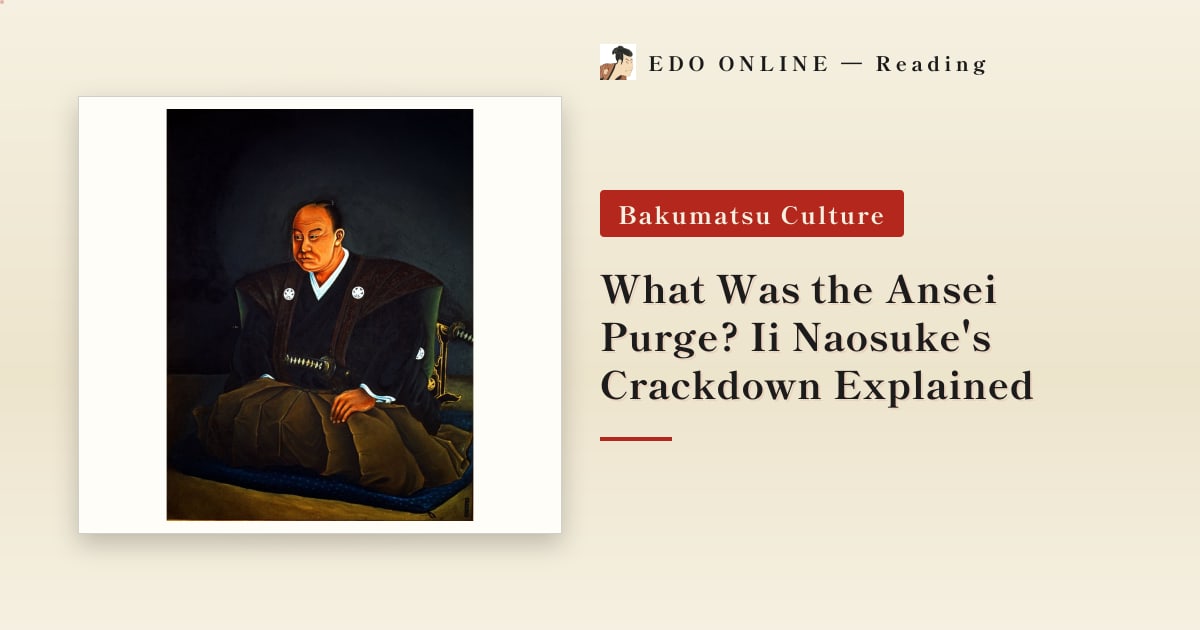
What Was the Ansei Purge? Ii Naosuke's Crackdown Explained
Between 1858 and 1859 the shogunate's chief minister Ii Naosuke purged more than a hundred opponents and executed eight, including Yoshida Shoin. Why it happened and what it destroyed.