The Black Ships — When Perry Arrived, and Why
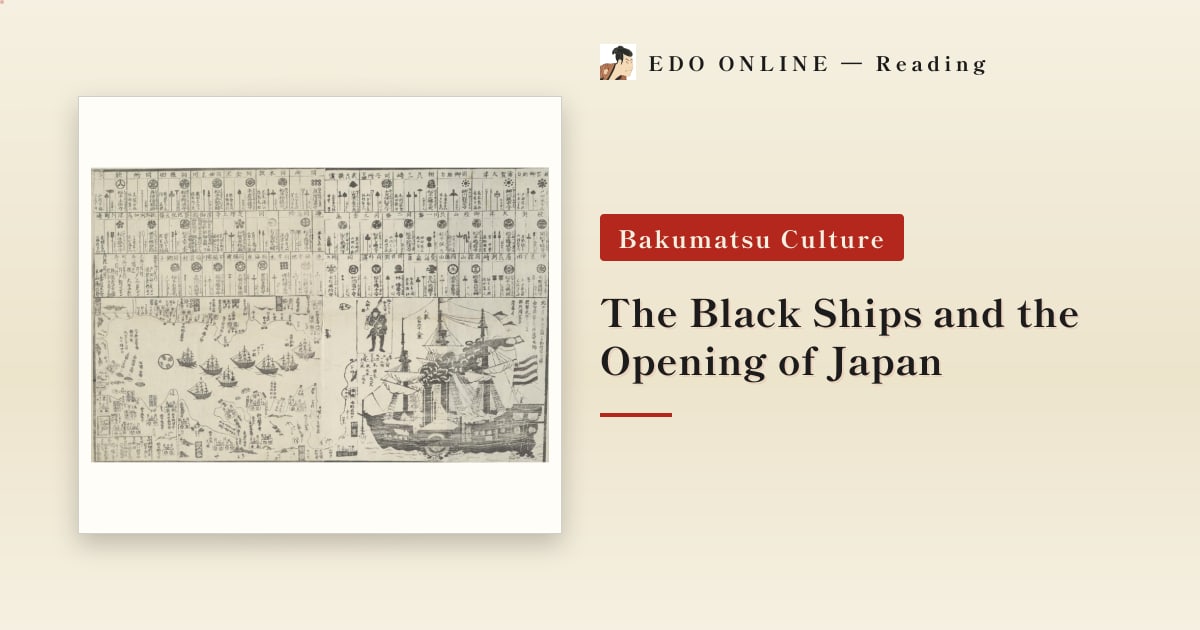
The Bakumatsu era began with four warships. The arrival of the black ships — 8 July 1853.
Contents
When and Where Did the Black Ships Arrive?
On 8 July 1853, off Uraga — the mouth of Edo Bay, in what is now Yokosuka — an American squadron appeared.
| Item | Detail |
|---|---|
| Date | 8 July 1853 |
| Place | Off Uraga, at the entrance to Edo Bay |
| Commander | Matthew Perry, commodore of the East India Squadron |
| Ships | Four |
| Composition | Two steam paddle warships (Susquehanna, Mississippi) and two sailing warships (Saratoga, Plymouth) |
| Purpose | To deliver the president's letter and demand that Japan open |
They were called black ships because their hulls were black — tarred against rot.
What shocked people was the steam: ships that moved without wind, against the current, trailing smoke. Most Japanese had never seen one.
A famous comic verse of the period turns on a pun — joukisen is both a brand of strong green tea and a steamship — and says that four cups will keep you awake all night. So will four black ships.
Why Did Perry Come?
The American aim was supply, not conquest. Three reasons.
Whaling. The American whaling fleet worked the Pacific in force, including the seas off Japan, and needed ports where it could take on water and fuel.
The China trade. Steamships burn coal in quantity. A crossing to China required a coaling station on the way.
Shipwrecked sailors. Americans wrecked on Japanese shores had been detained, and Washington wanted the treatment of castaways settled.
In other words, the black ships were a consequence of steam turning the Pacific into a thoroughfare. John Manjiro, rescued by an American whaler and taken to Massachusetts, belongs to the same story.
How Did the Shogunate Respond?
Perry refused to be sent round to Nagasaki and pushed his ships up the bay under the pretext of surveying.
The shogunate agreed to receive the letter at Kurihama, and on 14 July 1853 took delivery of President Fillmore's letter. Perry announced he would return the following year for an answer, and left.
Then the shogun Tokugawa Ieyoshi died, nineteen days after the fleet arrived, leaving the chief councillor Abe Masahiro holding the problem.
What Abe did had no precedent: he circulated the American letter to the daimyo and the imperial court and asked for their opinions.
That broke the shogunate's own two-century-old rule that foreign policy was its exclusive business. From then on, daimyo and court debated national policy as a matter of course. The political conflict of the Bakumatsu starts here.
From the Black Ships to the Treaty
Perry returned in February 1854, with a larger squadron.
On 31 March 1854 the Convention of Kanagawa was signed at Yokohama village. It provided for:
- opening Shimoda and Hakodate
- supplying American ships with wood, water, coal and provisions
- protection for castaways
- residence of an American consul
Note what it is not: a trade treaty. The ports were opened for supply; commerce had not begun.
Trade came four years later with the Treaty of Amity and Commerce of 29 July 1858, negotiated by the first consul general Townsend Harris and signed by the regent Ii Naosuke without the emperor's sanction — the decision that led straight to the Ansei Purge and the Sakuradamon Incident.
Yokohama opened in 1859, and the silk trade began.
What the Black Ships Changed
Coastal defence. Gun batteries were thrown up in Edo Bay at Odaiba, the ban on building large ships was lifted, and the Nagasaki naval school opened, where Katsu Kaishu and others learned Western naval practice.
Politics. Because Abe had consulted them, powerful lords such as Shimazu Nariakira and Tokugawa Nariaki now had a route into national policy.
Ideology. Sonno joi — revere the emperor, expel the barbarians — became a political movement.
Economics. After the ports opened, the gap between Japanese and world gold-silver ratios drained gold abroad, forcing the Man'en recoinage and driving prices up.
The black ships were not a single incident. Fourteen years to the return of power, fifteen to the Meiji Restoration. This is where the Bakumatsu begins.
Timeline
| Date | Event |
|---|---|
| 8 Jul 1853 | Perry's four ships arrive off Uraga |
| 14 Jul 1853 | The president's letter is received at Kurihama |
| 27 Jul 1853 | The shogun Tokugawa Ieyoshi dies |
| autumn 1853 | Abe Masahiro consults the daimyo and the court; batteries begun off Shinagawa |
| Feb 1854 | Perry returns |
| 31 Mar 1854 | The Convention of Kanagawa opens Shimoda and Hakodate |
| 21 Aug 1856 | Townsend Harris arrives at Shimoda as consul general |
| 29 Jul 1858 | The Treaty of Amity and Commerce begins trade |
| 1859 | Yokohama, Nagasaki and Hakodate open to trade |
Places to Visit
Perry Park, Kurihama, Yokosuka — where the letter was received; a landing monument stands there.
Uraga, Yokosuka — the anchorage, with the site of the Uraga magistrate's office.
Odaiba, Tokyo — the batteries built to defend the bay; the third survives as a park.
Shimoda, Shizuoka — one of the two ports opened in 1854, with Gyokusen-ji, Harris's consulate.
Key Dates and Common Confusions
Three dates in sequence: 1853 the fleet arrives, 1854 the Convention of Kanagawa, 1858 the commercial treaty. Keeping them in that order prevents most of the usual mistakes.
| Common mistake | Actually |
|---|---|
| Japan opened in 1853 | The ports opened under the 1854 convention. No treaty was signed in the year of the arrival |
| The 1854 convention started trade | It opened ports for supply. Trade began with the 1858 treaty |
| Perry's was the first foreign ship | Russian and British ships had come before. What was new was a squadron pushing into Edo Bay |
| Perry landed at Shimoda | He first arrived at Uraga. Shimoda was opened by the 1854 convention |
Frequently Asked Questions
When did the black ships arrive?
8 July 1853, with a second visit in February 1854.
How many ships were there?
Four in 1853 — two steamers and two sailing warships. The 1854 squadron was larger.
Why "black ships"?
Their hulls were tarred black against rot.
Why did Perry come?
For supply ports for whalers and steamers, and to settle the treatment of shipwrecked sailors.
Did Japan open to trade in 1854?
No. The 1854 convention opened two ports for supply. Trade began with the 1858 commercial treaty.
For the man himself see Perry; for the negotiations that followed, Townsend Harris; for the ideological fallout, sonno joi.
Related reading
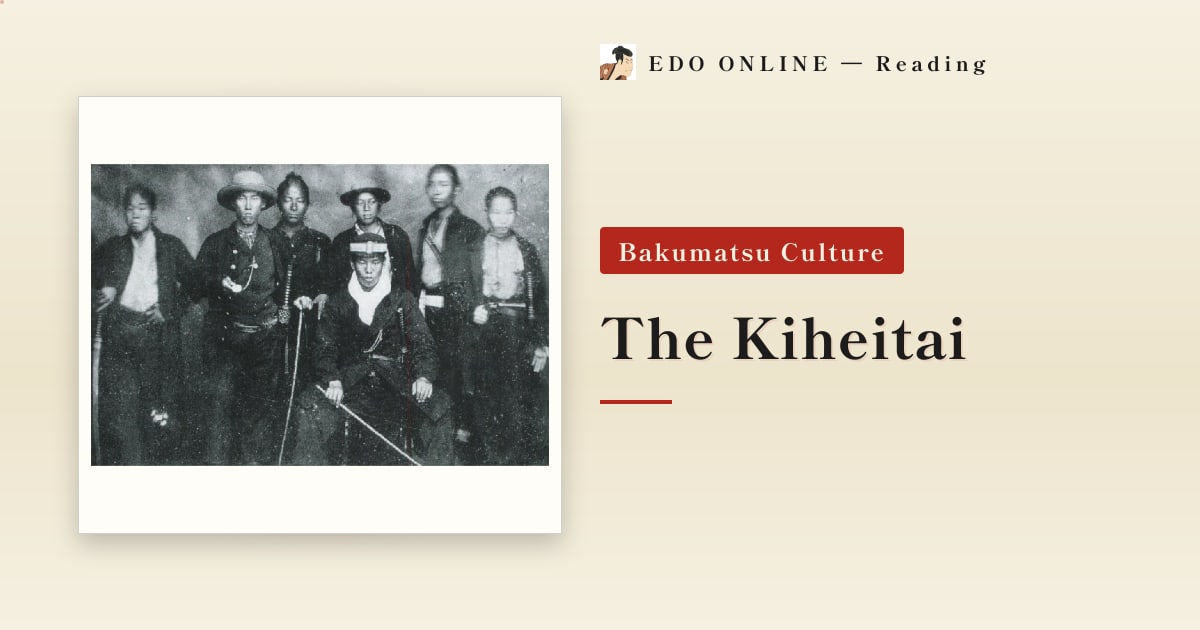
The Kiheitai — Takasugi's Army That Ignored Class
Raised in 1863 by Takasugi Shinsaku, the Kiheitai took commoners as soldiers. Why Choshu did it, how it differed from the regular army, what it won, and how the new government crushed it.
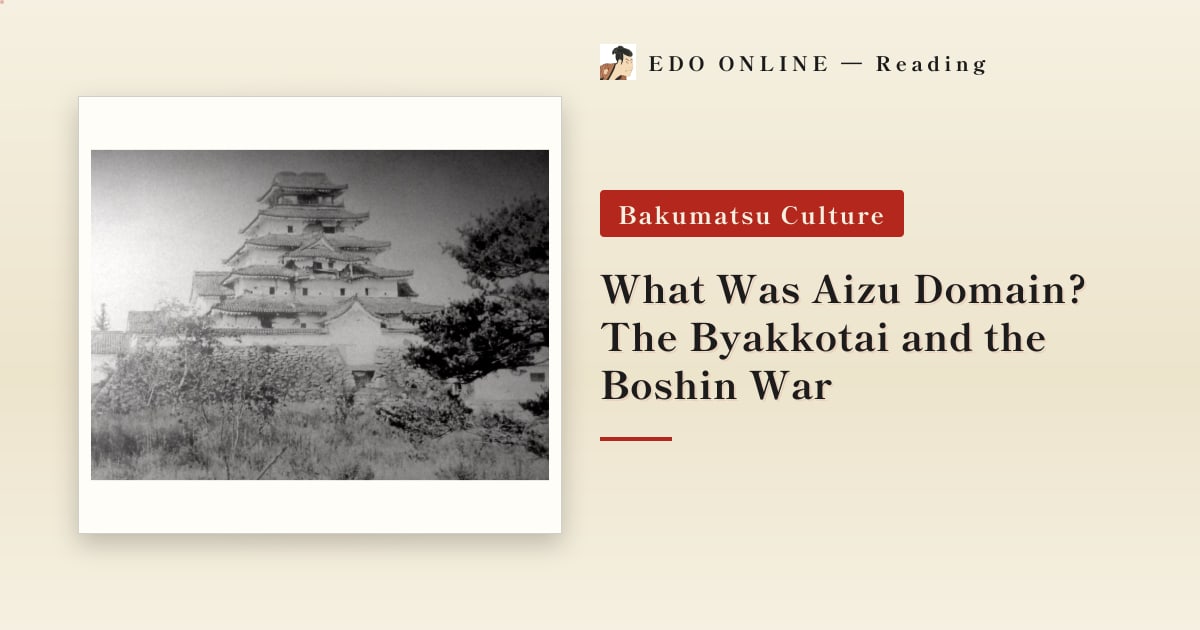
What Was Aizu Domain? The House Code, the Byakkotai, the Siege
Aizu stayed loyal to the shogunate to the end and was destroyed for it. Why Matsudaira Katamori took the Kyoto post, what happened to the Byakkotai, and how the domain was punished.
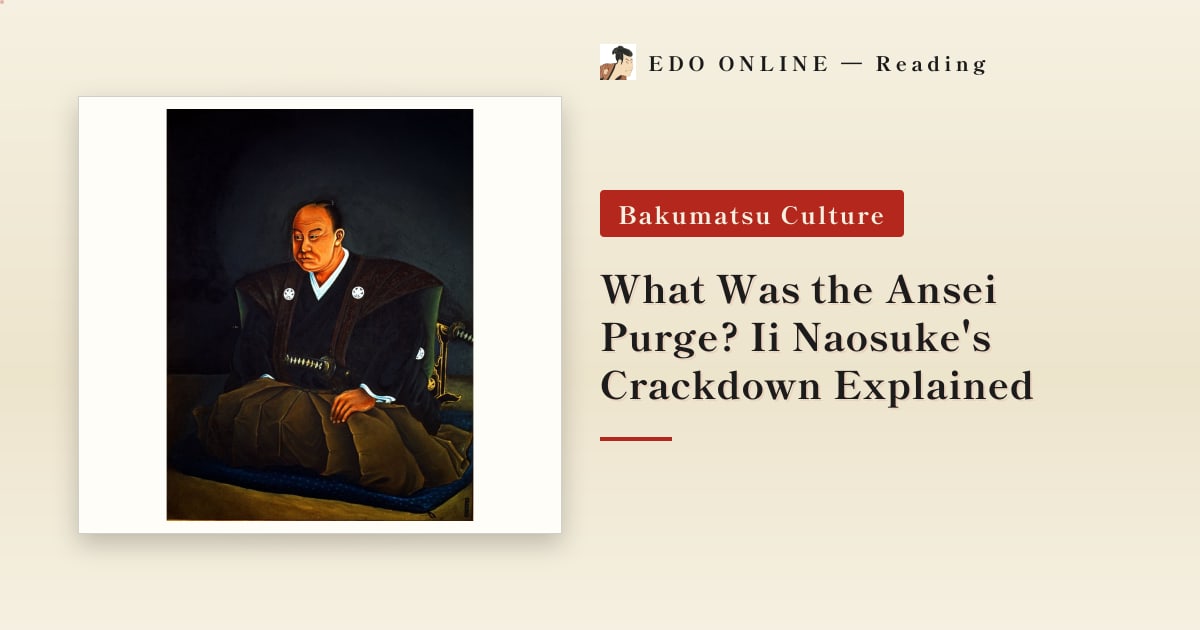
What Was the Ansei Purge? Ii Naosuke's Crackdown Explained
Between 1858 and 1859 the shogunate's chief minister Ii Naosuke purged more than a hundred opponents and executed eight, including Yoshida Shoin. Why it happened and what it destroyed.