Komatsu Tatewaki — The Satsuma Councillor Above Saigo and Okubo
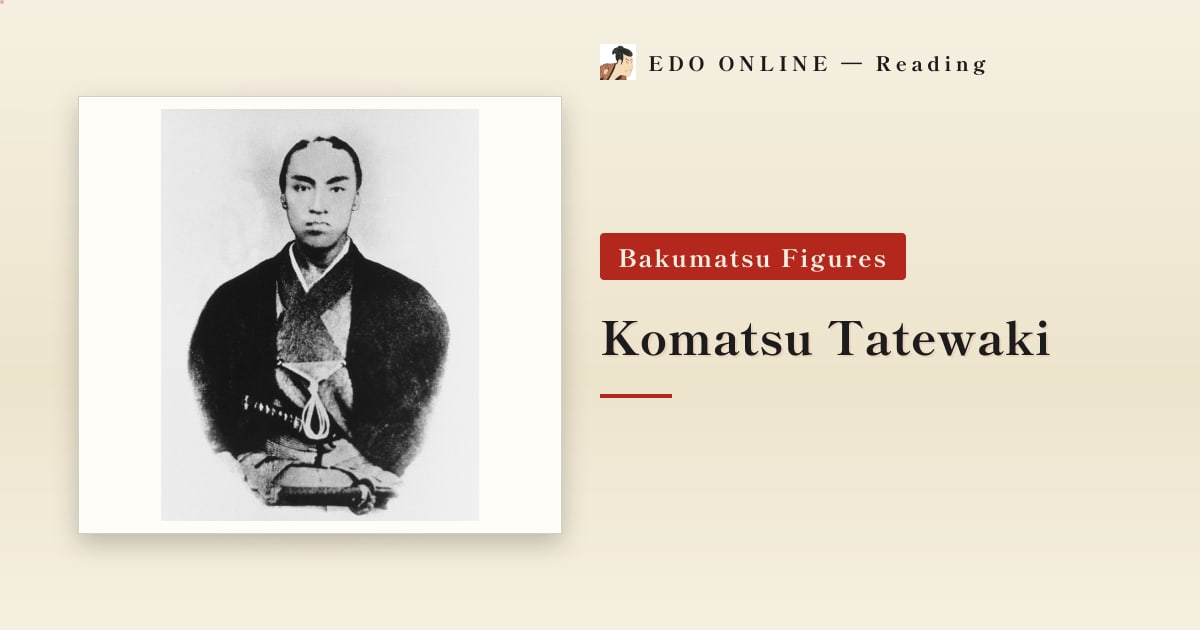
There was a man above Saigo Takamori and Okubo Toshimichi. Komatsu Tatewaki, chief retainer of Satsuma. He died at thirty-four.
Contents
Who Was Komatsu Tatewaki?
Komatsu was a karo, or chief retainer, of Satsuma domain. His formal name was Komatsu Kiyokado.
Three things define him.
He ran Satsuma's government. A chief retainer in his twenties, he directed the domain's administration under Shimazu Hisamitsu.
He made the Satsuma–Choshu Alliance happen. His own Kyoto residence was where the two domains met.
He pushed the return of power to the court, working for it from the Satsuma side.
He was born in 1835 and died in 1870.
Komatsu Tatewaki's Rank, and Saigo's
Accounts of Satsuma in the Restoration name Saigo Takamori and Okubo Toshimichi.
Both were low-ranking samurai inside their own domain — men whose birth did not, in principle, admit them to its decisions.
Komatsu was different. Born into the Kimotsuki, lords of Kiire, he was adopted into the Komatsu, a house of chief-retainer rank — the top of Satsuma's hierarchy.
He took the post of chief retainer in his twenties and held the domain's administration in his hands.
The structure was therefore this: Komatsu stood above Saigo and Okubo as chief retainer and coordinated the domain's policy and diplomacy in concert with them. Shimazu Hisamitsu and the lord Tadayoshi sat above them all; Komatsu was not deciding alone.
His early death is one reason his presence faded in later accounts of the Restoration.
What Was Decided at Komatsu Tatewaki's Kyoto Residence
The Satsuma–Choshu Alliance was concluded in 1866.
Satsuma and Choshu had been enemies. It was Satsuma and Aizu that had driven Choshu out of Kyoto. The alliance meant those two shaking hands.
The venue was Komatsu Tatewaki's residence in Kyoto, where Kido Takayoshi and Saigo Takamori met face to face.
That the house of a chief retainer was used means the meeting was Satsuma's official act, not a private compact among activists. A man who represented the domain provided the room.
The brokering of Sakamoto Ryoma and Nakaoka Shintaro is the part usually told — but the man who moved Satsuma was Komatsu.
Komatsu Tatewaki on Politics and Money
In 1867 Komatsu worked toward the return of power to the court.
Destroy the shogunate by force, or make it resign? Satsuma itself was split. Komatsu came down on the side of supporting the proposal put by Yamauchi Yodo of Tosa.
He also worked on the economy.
The Hyogo Trading Company — something close to a joint-stock firm, developed with Godai Tomoatsu and others. He was also involved in Satsuma's programme of sending students abroad and in procuring arms and ships through Thomas Glover.
He was working military, diplomatic and economic questions at the same time.
How Komatsu Tatewaki Died at Thirty-Four
Under the new government Komatsu held the post of councillor and served in the foreign affairs bureau.
It did not last long.
He died of illness in 1870, aged thirty-four.
Accounts mention a growth on the leg or beriberi, but the cause is not firmly established.
His death changed the shape of Satsuma's Restoration.
While he lived, the domain's coordination ran through him as chief retainer. With him gone, the faces representing Satsuma narrowed to Saigo and Okubo.
And a few years later those two faced each other as enemies in the Satsuma Rebellion.
"If Komatsu Tatewaki had lived, would Saigo and Okubo have broken?" is asked repeatedly, but it is an untestable counterfactual. Both men were already central to Satsuma well before 1870, so his absence cannot on its own explain the split.
Komatsu Tatewaki's Grave
His grave is in Hioki, Kagoshima Prefecture, where he is honoured locally with a statue.
He is nowhere near as well known as Saigo or Okubo. But on the single fact that the alliance was negotiated in his house, he stood at a hinge of the period.
Komatsu Tatewaki Timeline
| Year | Event |
|---|---|
| 1835 | Born into the Kimotsuki, lords of Kiire; later adopted into the Komatsu |
| early 1860s | Becomes a chief retainer of Satsuma in his twenties under Shimazu Hisamitsu |
| 1866 | His Kyoto residence hosts the Satsuma–Choshu talks |
| 1867 | Works for the return of power to the court and the Hyogo Trading Company |
| 1868 | Serves the new government as councillor and in foreign affairs |
| 1870 | Dies of illness, aged 34 |
For his Satsuma contemporaries see Saigo Takamori, Okubo Toshimichi and Shimazu Hisamitsu; for the alliance, Satsuma–Choshu.
Related reading
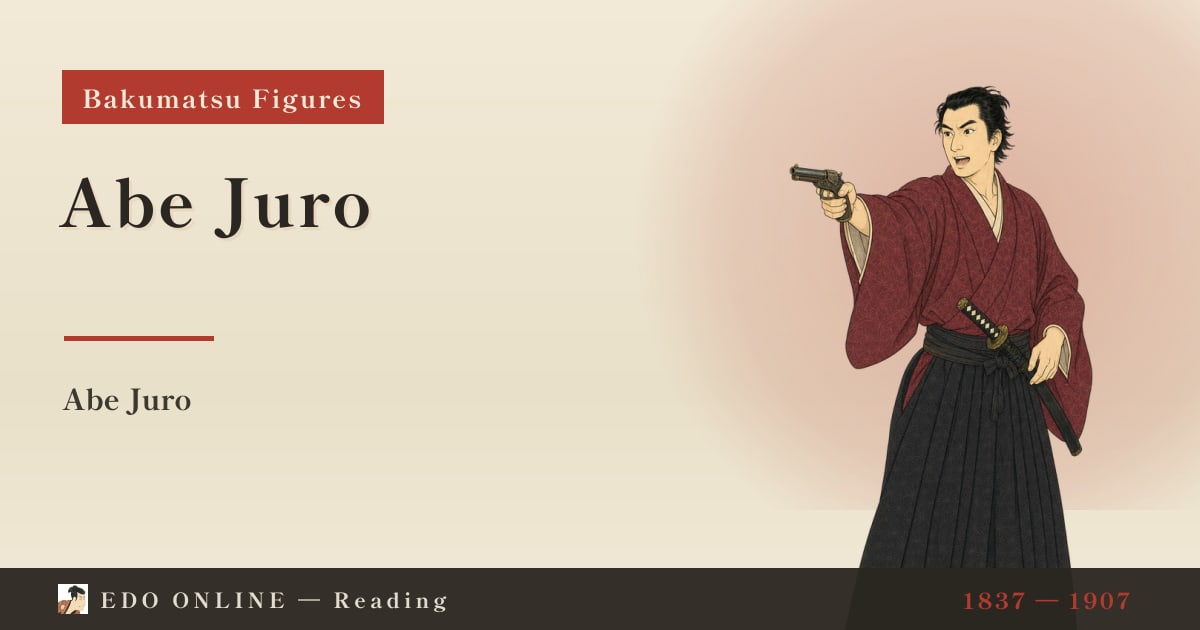
Abe Juro — The Former Member Who Talked
He deserted the Shinsengumi and rejoined under another name, shot at Kondo Isami as one of the Goryō Eji, and then grew apples in Sapporo. His late-Meiji testimony is where the ranking of the corps' best swordsmen comes from.
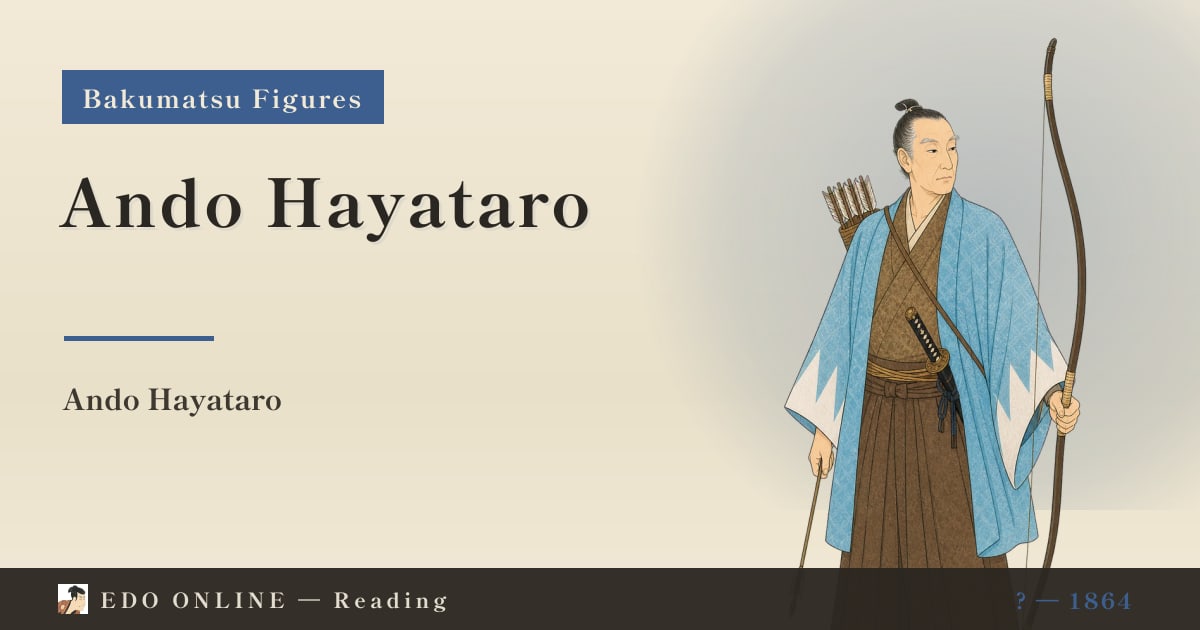
Ando Hayataro — The Shinsengumi's Record-Breaking Archer
He set the standing national record in the long-range shooting at the Tōdai-ji Great Buddha Hall, sending 8,685 arrows the length of the corridor. Nearly fifty, he joined the Shinsengumi and died of wounds taken in the back garden of the Ikedaya.
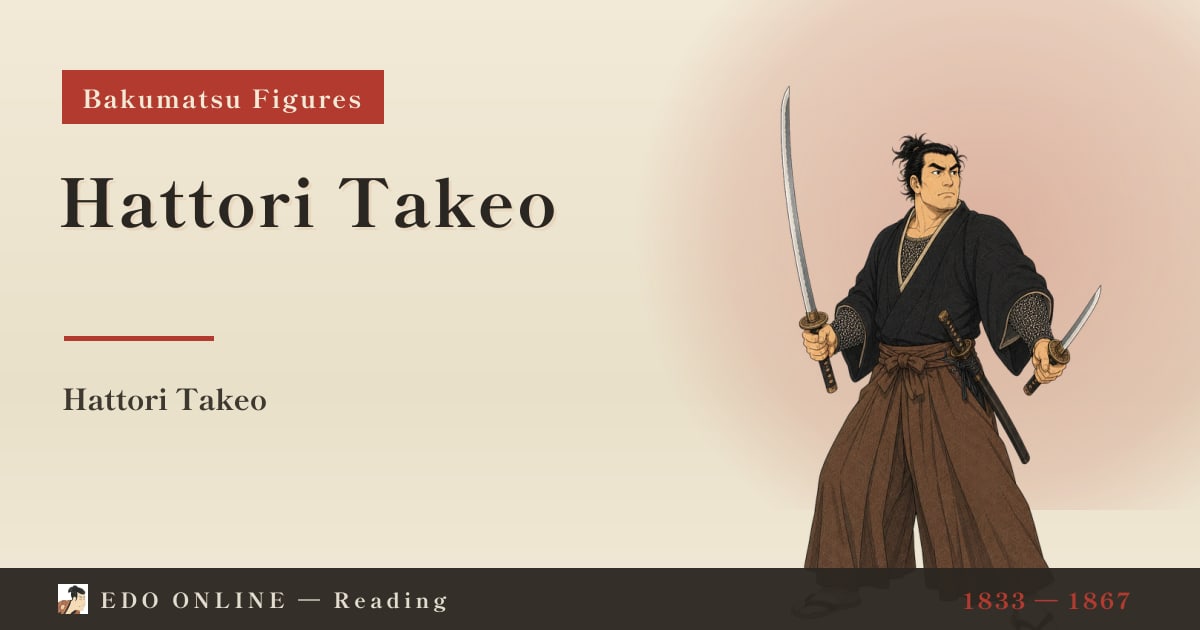
Hattori Takeo — Two Swords at Aburanokoji
A two-sword master and fencing instructor of the Shinsengumi who defected with the Goryō Eji. At Aburanokōji he alone wore mail, held a wall against the whole corps, and fell with more than twenty wounds.