Thomas Glover — The Scottish Merchant Who Armed the Restoration
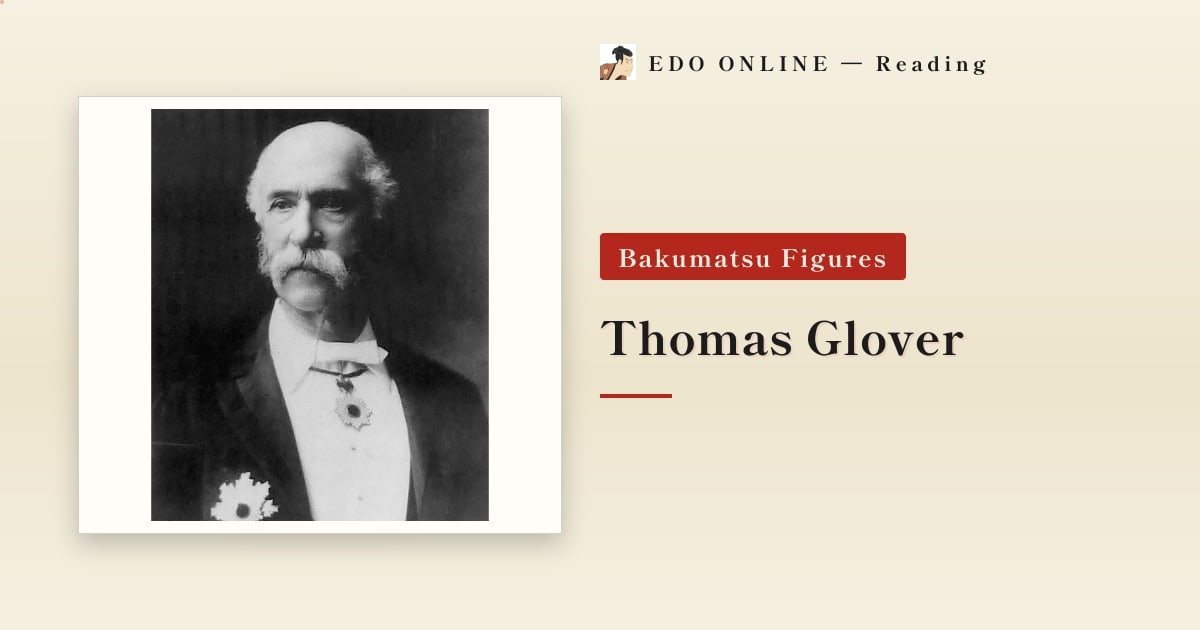
A Scotsman who took part in Japan's revolution by selling weapons. Thomas Blake Glover, the merchant remembered through Glover Garden in Nagasaki.
Contents
Who Was Thomas Glover?
Glover was a Scottish merchant who operated in Bakumatsu Nagasaki.
His work divides into two periods.
The Bakumatsu — selling arms. He sold ships and guns to the anti-shogunal domains, Satsuma and Choshu among them. He supported the overthrow of the shogunate as a business.
The Meiji era — building industry. Shipbuilding, coal mining, beer, railways. His hand is present across the industries of modern Japan.
Born in Scotland in 1838, he came to Japan in his early twenties and set up a firm in Nagasaki.
Thomas Glover as an Arms Dealer
Glover arrived not long after Japan opened.
His largest commodity was weapons: rifles, cannon, and ships. Bakumatsu Japan was a time when domains raced to modernize their arms, and there was enormous demand for Western weapons.
Glover met it — above all for Satsuma and Choshu, the domains that would lead the overthrow of the shogunate.
Here lies the delicacy of his position. Choshu was then a domain treated as an enemy by the shogunate, and selling it arms ran against shogunal policy. Glover did not shrink from such risky trade.
Glover did not deal only with the anti-shogunal side; he traded with the shogunate too. What drove him was first of all commerce, and no source establishes that he was betting on a particular political outcome. What is certain is that his weapons ended up strengthening the side that overthrew the shogunate.
Thomas Glover's Link to Sakamoto Ryoma
Glover is said to have had dealings with Sakamoto Ryoma.
The Kameyama Shachu (later the Kaientai), which Ryoma was involved in, was an organization for trade and shipping across domain lines. In dealing in arms and ships, Glover's firm is thought to have had contact with it.
The famous case is Choshu buying weapons under Satsuma's name — arms the enemy domain could not purchase directly, obtained through Satsuma. Ryoma and others were involved in brokering this, and behind it stood Glover.
That said, primary records of a concrete relationship between Ryoma and Glover are scarce, and how directly the two were connected should be treated with caution.
Thomas Glover in Meiji Industry
With the shogunate overthrown and the Meiji era begun, Glover's business reached a turning point.
Demand for arms fell with the end of the fighting, and Glover's firm ran into difficulty and failed.
But Glover himself did not leave Japan. He found a new place inside the industry of Meiji Japan.
He worked in shipbuilding and supported what became Mitsubishi's enterprises. He was involved in running the Takashima coal mine, and in one of the earliest beer ventures, a company that fed into what became Kirin. The man who had armed a revolution supported the country afterward through industry, and was decorated late in life for it.
Thomas Glover's House and Glover Garden
The house Glover built in Nagasaki is known as among the oldest surviving Western-style wooden buildings in Japan.
Around this former residence in the Minamiyamate district, gathering other Western houses nearby, Glover Garden was laid out — a leading Nagasaki attraction that preserves the trace of Westerners living in the city in the Bakumatsu.
He kept a household with a Japanese woman, Tsuru. Glover's son, Kuraba Tomisaburo (accounts of his birth mother differ), grew up in Japan and lived involved in Nagasaki's fisheries and society. Glover's line continued as Japanese.
Thomas Glover Timeline
| Year | Event |
|---|---|
| 1838 | Born in Scotland |
| 1859 | Comes to the newly opened Nagasaki |
| 1860s | Sells ships and guns to Satsuma, Choshu, and others as an arms dealer |
| c. 1865 | Said to be involved in Choshu's arms purchases |
| early Meiji | His firm fails; he turns to shipbuilding and coal |
| 1911 | Dies in Tokyo, aged 73 |
For the Japanese side of the period see Sakamoto Ryoma; for the opening of Japan, the Black Ships.
Related reading
Abe Juro — The Former Member Who Talked
He deserted the Shinsengumi and rejoined under another name, shot at Kondo Isami as one of the Goryō Eji, and then grew apples in Sapporo. His late-Meiji testimony is where the ranking of the corps' best swordsmen comes from.
Ando Hayataro — The Shinsengumi's Record-Breaking Archer
He set the standing national record in the long-range shooting at the Tōdai-ji Great Buddha Hall, sending 8,685 arrows the length of the corridor. Nearly fifty, he joined the Shinsengumi and died of wounds taken in the back garden of the Ikedaya.
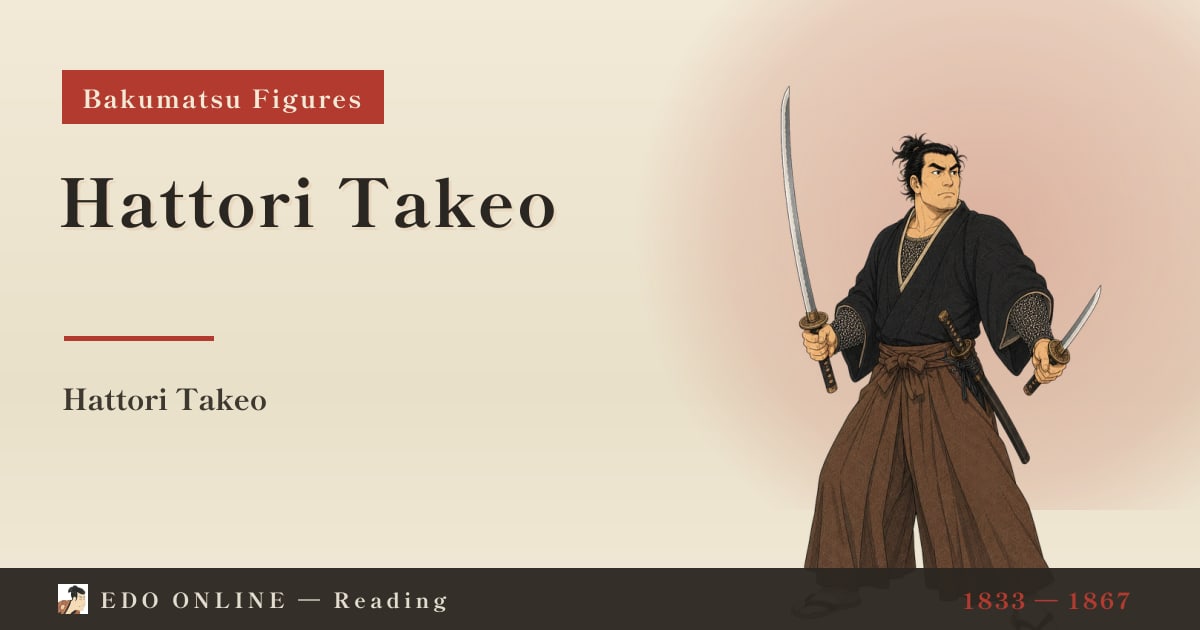
Hattori Takeo — Two Swords at Aburanokoji
A two-sword master and fencing instructor of the Shinsengumi who defected with the Goryō Eji. At Aburanokōji he alone wore mail, held a wall against the whole corps, and fell with more than twenty wounds.