
How Tall Were People in Edo Japan? Average Height Explained
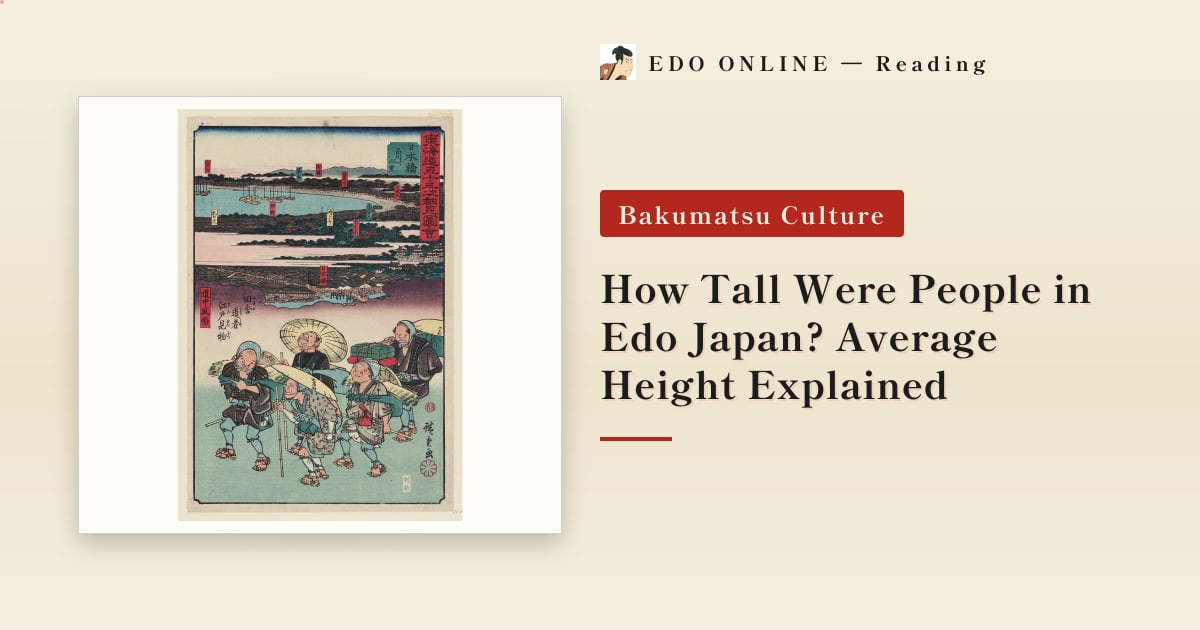
Japanese men today average about 171cm. How tall were people in the Edo period? The answer is considerably shorter than most people expect.
Contents
What was the average height in Edo Japan?
Measurements of excavated skeletal remains give the following.
| Group | Men | Women |
|---|---|---|
| Edo period | about 155-158cm | about 143-146cm |
| Present day | about 171cm | about 158cm |
| Difference | 13-16cm shorter | 12-15cm shorter |
About 155cm for men — roughly the average of a modern Japanese fourteen-year-old.
Edo Japan had the shortest people in two thousand years
The striking finding is that the Edo period is the low point of recorded Japanese history, not simply an earlier and therefore shorter era.
| Period | Approximate male average |
|---|---|
| Jōmon | about 158cm |
| Kofun | about 163cm |
| Kamakura and Muromachi | about 159cm |
| Edo | about 155cm |
| Meiji | about 157cm |
| Present day | about 171cm |
People shrank by roughly 8cm between the Kofun period and the Edo period. This is not a simple story of "people used to be smaller."
Why were people so short in Edo Japan?
The leading explanation is a shortage of animal protein.
Meat was effectively off the menu
Buddhist influence and shogunal policy meant that meat from four-legged animals was almost absent from the Japanese diet. Beef and pork were rare; dairy essentially unknown. Protein and calcium needed for bone growth were chronically short.
That people in the Kofun period were taller is generally attributed to a greater surviving element of hunting and meat consumption.
A diet built on rice
The ordinary Edo meal was white rice, miso soup and pickles. Calories were adequate; nutrition was not.
In the city, heavy consumption of polished white rice produced widespread beriberi from thiamine deficiency. It was called the "Edo affliction" because sufferers often recovered on returning to the countryside — contemporaries had noticed the connection with urban diet even without understanding the cause.
Density and sanitation
Edo held over a million people. Concentration favoured infectious disease, and repeated childhood illness impairs growth.
How tall were famous Bakumatsu figures?
Estimates drawn from records and surviving possessions give a sense of the period.
| Person | Estimated height | Note |
|---|---|---|
| Sakamoto Ryōma | about 174cm | Exceptionally tall for the time |
| Saigō Takamori | about 178cm | Also said to have weighed close to 100kg |
| Kondō Isami | about 168cm | Above average |
| Hijikata Toshizō | about 167cm | Above average |
| Katsu Kaishū | about 156cm | Almost exactly average |
| Takasugi Shinsaku | about 160cm | Slightly above |
In a world averaging 155cm, Ryōma at 174cm would have stood out immediately. Saigō would have appeared enormous to contemporaries.
These figures should be treated with care. Most are inferred from clothing dimensions or from written recollection rather than measured directly.
Why did heights rise after the Edo period?
The increase from the Meiji era onward reverses each of the causes above.
- Meat became acceptable. The government actively promoted Western food, and beef hotpot spread
- Dairy entered the diet. Milk and butter appeared on Japanese tables
- Nutrition became a science. Research into beriberi and other deficiency diseases changed how diet was understood
The decisive change came after 1945, when school meal programmes were introduced. Male average height rose more than 10cm between the 1950s and the 1990s.
Frequently asked questions
What was the average height in Edo Japan?
About 155-158cm for men and 143-146cm for women.
Why were people in Edo Japan so short?
Principally because meat was almost absent from the diet, leaving animal protein and calcium in short supply. A rice-heavy diet and urban living conditions contributed.
Was the Edo period really the shortest in Japanese history?
Yes. Skeletal evidence shows it below the Jōmon, Kofun and medieval periods.
How tall was Sakamoto Ryoma?
Estimated at about 174cm — nearly 20cm above the average of his time.
For the diet behind these figures see food in Edo Japan; for the economy that shaped it see how much one ryō was worth.
Related reading
The Kiheitai — Takasugi's Army That Ignored Class
Raised in 1863 by Takasugi Shinsaku, the Kiheitai took commoners as soldiers. Why Choshu did it, how it differed from the regular army, what it won, and how the new government crushed it.
What Was Aizu Domain? The House Code, the Byakkotai, the Siege
Aizu stayed loyal to the shogunate to the end and was destroyed for it. Why Matsudaira Katamori took the Kyoto post, what happened to the Byakkotai, and how the domain was punished.
What Was the Ansei Purge? Ii Naosuke's Crackdown Explained
Between 1858 and 1859 the shogunate's chief minister Ii Naosuke purged more than a hundred opponents and executed eight, including Yoshida Shoin. Why it happened and what it destroyed.