Who Was Takasugi Shinsaku? A Life of Twenty-Seven Years
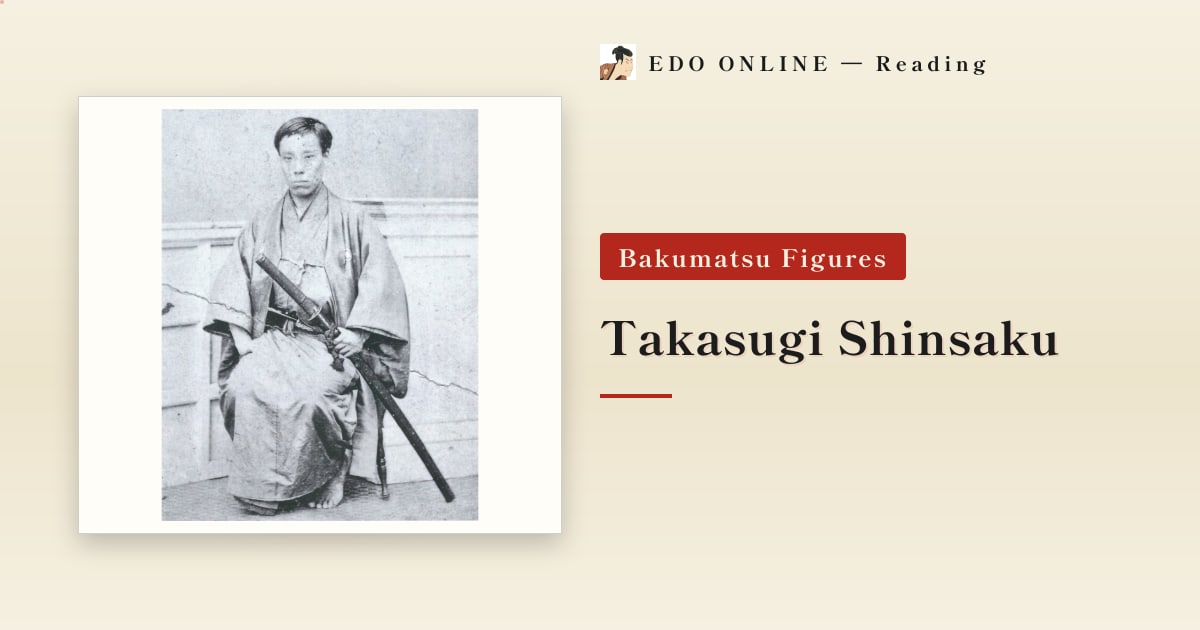
Takasugi Shinsaku pushed Chōshū decisively toward overthrowing the shogunate. He lived twenty-seven years, and spent them breaking whatever structure stood in front of him.
Contents
What did Takasugi Shinsaku do?
Two acts define him.
He created the Kiheitai, a militia that accepted farmers and townsmen alongside samurai. In a society organised entirely around inherited status, recruiting fighters by ability was close to heresy.
He seized back his own domain. When Chōshū's conservatives regained control and moved to submit to the shogunate, Takasugi raised a rebellion with roughly eighty men and reversed the domain's policy by force.
Neither the Satsuma-Chōshū Alliance nor Chōshū's defeat of the shogunal army in 1866 would have been possible without that reversal.
Takasugi Shinsaku's early life and the Shoka Sonjuku
Born in 1839 to an upper-ranking samurai family in Hagi, Chōshū, Takasugi entered Yoshida Shōin's Shōka Sonjuku academy in 1857.
There he was paired with Kusaka Genzui as the two outstanding students of the school. Shōin recognised his ability while worrying openly about his unruliness.
What was the Kiheitai?
After foreign warships had shown how hollow Chōshū's "expel the barbarians" policy was in practice, the domain needed a working army rather than a symbolic one.
Takasugi's answer was the Kiheitai, formed in 1863. Its distinguishing feature was that it did not require samurai birth. Farmers and merchants served alongside warriors, and command was based on competence.
Takasugi himself came from the upper ranks. The proposal undercut his own inherited privilege, which is precisely what made it radical rather than merely practical.
Takasugi Shinsaku's death and age
Takasugi died on 17 May 1867 at Shimonoseki, of a lung disease generally identified as tuberculosis. He was twenty-seven.
| Item | Detail |
|---|---|
| Born | 27 September 1839 |
| Died | 17 May 1867 |
| Age | 27 |
| From | Hagi, Chōshū (present-day Yamaguchi Prefecture) |
The timing is worth noting. The shogun returned power to the emperor five months later, and the Restoration followed after that. Takasugi saw none of the outcome he had done so much to bring about.
Where is Takasugi Shinsaku's grave?
His grave is at Tōgyō-an in Shimonoseki, Yamaguchi Prefecture. "Tōgyō", meaning "going east", was his own sobriquet — a deliberate inversion of the poet-monk Saigyō, who went west.
Ouno, the woman said to have nursed him at the end, took holy orders after his death and spent the rest of her life tending his memory at this site. The hermitage takes its name from hers.
Other sites connected with him:
- Tōgyō-an (Shimonoseki) — the grave, with a museum holding his effects
- Takasugi Shinsaku's birthplace (Hagi) — the family house survives
- Shōka Sonjuku (Hagi) — the academy building still stands
- Kōzan-ji (Shimonoseki) — the temple where he launched his rising
Takasugi Shinsaku and Kusaka Genzui
At the Shōka Sonjuku, Takasugi and Kusaka Genzui were spoken of together as the school's two finest students.
They were opposites in method. Kusaka was the theorist who drove the loyalist movement head-on; Takasugi worked by breaking existing structures and forcing new situations. Shōin rated both highly and is said to have placed Kusaka slightly ahead.
Kusaka killed himself after the failed attack on the imperial palace in 1864, aged twenty-five. Another classmate, Yoshida Toshimaro, died at the Ikedaya. With Takasugi's early death as well, the men who actually governed Japan from Shōin's school were Itō Hirobumi and Yamagata Aritomo — not, at the time, considered the leading students.
What was Takasugi Shinsaku like?
He went to Shanghai. In 1862 he sailed with a shogunal mission and saw a Chinese city effectively under Western control. The experience destroyed any belief that slogans about expelling foreigners could protect a country.
He raised the Kiheitai. Discussed above — an attack on the status system he personally benefited from.
He rose at Kōzan-ji. With the domain turning conservative, he decided with about eighty men. There was no realistic prospect of success; it worked anyway, and it changed the direction of the country.
The verse traditionally given as his death poem reads:
A world with nothing amusing in it, made amusing
The closing line, "it is the heart that makes it so", is said to have been added by Nomura Bōtō, who attended him. Whether the verse is Takasugi's at all is not certain, but it fits a man who spent his life finding it entertaining to dismantle things.
Timeline of Takasugi Shinsaku's life
| Year | Event |
|---|---|
| 27 Sep 1839 | Born in Hagi, Chōshū |
| 1857 | Enters the Shōka Sonjuku under Yoshida Shōin |
| 1862 | Sails to Shanghai with a shogunal mission |
| 1863 | Founds the Kiheitai |
| 1864 | Four-nation fleet bombards Shimonoseki; he negotiates terms |
| Dec 1864 | Rises at Kōzan-ji and reverses domain policy |
| 1866 | Chōshū defeats the second shogunal expedition |
| 17 May 1867 | Dies of illness at Shimonoseki, aged 27 |
Frequently asked questions
Who was Takasugi Shinsaku?
A Chōshū samurai who founded the Kiheitai militia and forced his domain onto the path of overthrowing the shogunate.
What was the Kiheitai?
A military unit founded in 1863 that recruited farmers and townsmen alongside samurai, breaking with the principle that fighting was the preserve of the warrior class.
How did Takasugi Shinsaku die?
Of a lung disease, generally identified as tuberculosis, in May 1867 at the age of twenty-seven.
Where is Takasugi Shinsaku buried?
At Tōgyō-an in Shimonoseki, Yamaguchi Prefecture.
For his teacher see Yoshida Shōin; for the alliance his domain entered see the Satsuma-Chōshū Alliance.
Related reading
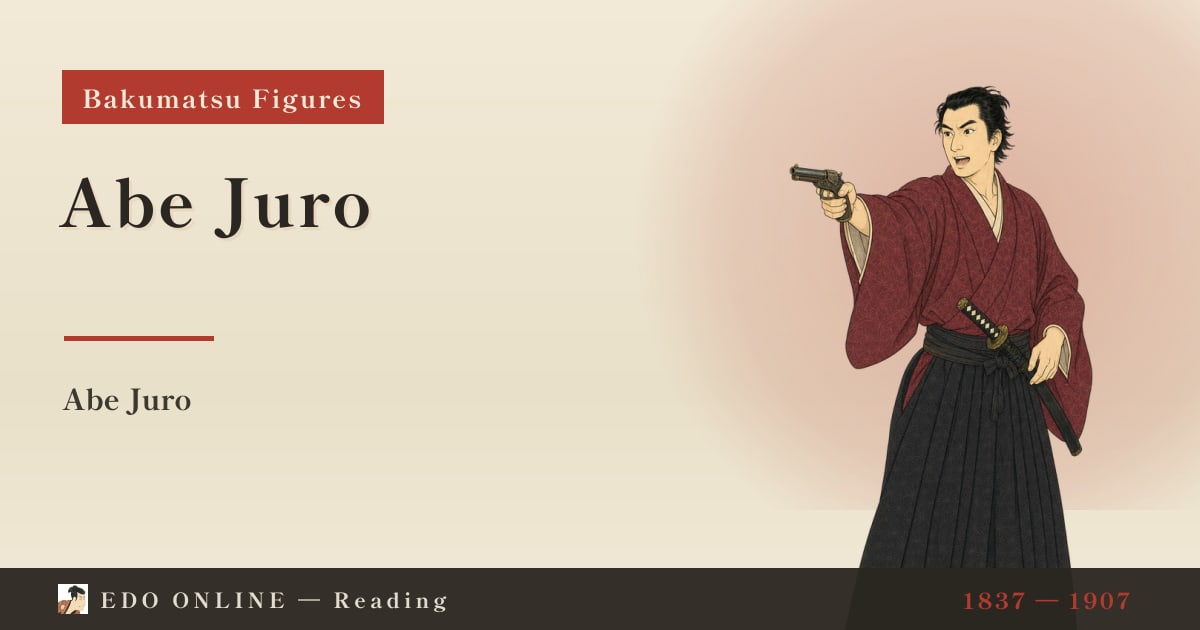
Abe Juro — The Former Member Who Talked
He deserted the Shinsengumi and rejoined under another name, shot at Kondo Isami as one of the Goryō Eji, and then grew apples in Sapporo. His late-Meiji testimony is where the ranking of the corps' best swordsmen comes from.
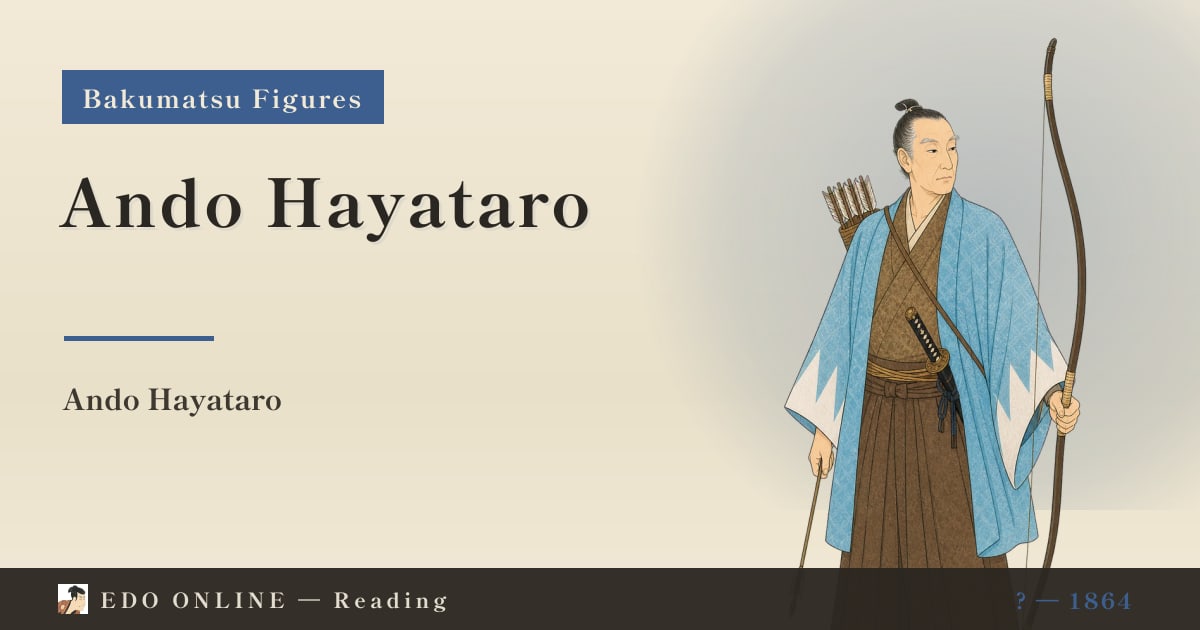
Ando Hayataro — The Shinsengumi's Record-Breaking Archer
He set the standing national record in the long-range shooting at the Tōdai-ji Great Buddha Hall, sending 8,685 arrows the length of the corridor. Nearly fifty, he joined the Shinsengumi and died of wounds taken in the back garden of the Ikedaya.
Hattori Takeo — Two Swords at Aburanokoji
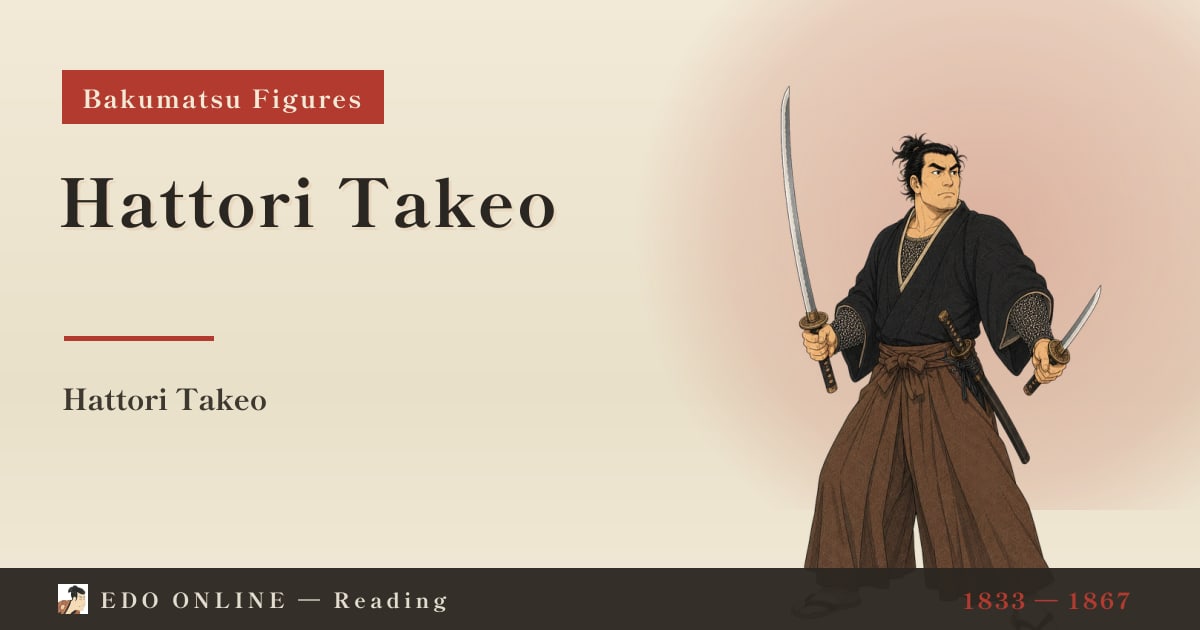
A two-sword master and fencing instructor of the Shinsengumi who defected with the Goryō Eji. At Aburanokōji he alone wore mail, held a wall against the whole corps, and fell with more than twenty wounds.