How Much Was One Ryo Worth? Edo Money Explained
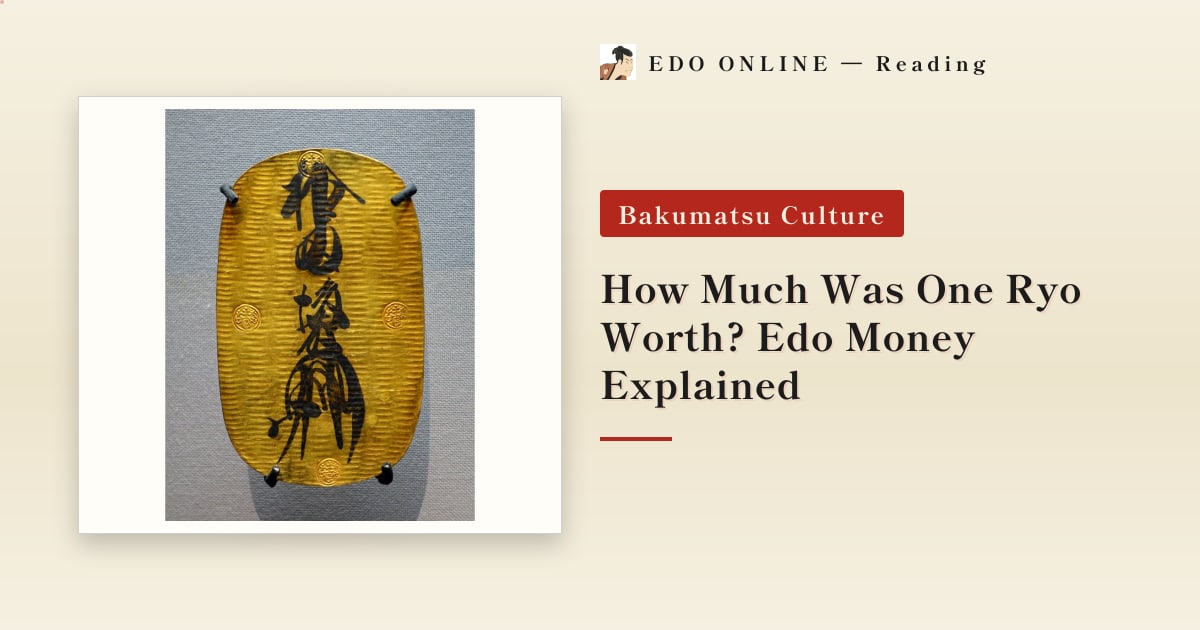
Hearing that something cost "a hundred ryō" tells a modern reader almost nothing. So what was one ryō actually worth?
The short answer is that there is no single correct figure — but once you understand why the answers disagree, you can form a reliable sense of it.
Contents
How much is one ryo in modern money?
Common conversions place one ryō somewhere between 50,000 and 300,000 yen (roughly £250 to £1,500, or $350 to $2,000). The spread is enormous because the answer depends entirely on what you compare it against.
| Basis of comparison | Approximate value of 1 ryō |
|---|---|
| Price of rice | 70,000-80,000 yen |
| Wages of a skilled craftsman | 200,000-300,000 yen |
| Price of a bowl of soba | 120,000-130,000 yen |
The same ryō is worth 70,000 yen measured in rice and 300,000 measured in labour. None of these is wrong. That is the heart of the problem.
Why do the answers differ so much?
Because the relative prices of goods and labour have swapped places between Edo Japan and the present.
In modern Japan rice is cheap and labour is expensive. In the Edo period the reverse held: rice was the central and costly commodity, while human labour was comparatively cheap.
Measure in rice and one ryō buys less than intuition suggests. Measure in wages and it commands far more work than it would today. A conversion that shifts by a factor of four when you change the yardstick is exactly what you should expect.
The same effect appears within living memory. Valuing a banknote from thirty years ago in bowls of ramen gives a different answer from valuing it against a graduate starting salary. Edo Japan simply sits further away, so the gap widens.
Converting by the price of rice
The classical method.
From the mid-Edo period onward, one koku of rice — about 150 kilogrammes — was reckoned at roughly one ryō. One koku was considered a year's rice for one adult.
At a modern price of about 2,500 yen for five kilogrammes, 150 kilogrammes comes to about 75,000 yen. Hence 1 ryō ≒ 70,000-80,000 yen.
The advantage of this method is that it matches how contemporaries actually thought. Samurai stipends and domain assessments were all expressed in rice.
Converting by wages
The alternative.
A carpenter's daily wage varied by period but ran to around five monme of silver. Converted into gold, one ryō represents roughly 30 to 40 days of a craftsman's labour.
At a modern daily rate of about 20,000 yen, thirty days would be 600,000 yen. Because craftsmen did not work continuously through the year, the figure usually quoted is adjusted downward to 1 ryō ≒ 200,000-300,000 yen.
This is more than three times the rice-based answer, and the gap is a direct measure of how cheap human labour was in Edo Japan.
Edo period currency units
Understanding the conversions requires the underlying system, which used three metals — gold, silver and copper — with floating exchange rates between them.
| Unit | Equivalent | Use |
|---|---|---|
| 1 ryō | = 4 bu = 16 shu | Gold. Large transactions |
| 1 bu | = 4 shu | Gold |
| 1 kan | = 1,000 mon | Copper coin |
| 1 mon | smallest unit | Everyday purchases |
The official rate was 1 ryō = 4,000 mon, but the market rate moved. By the late Tokugawa period it could exceed 6,000 mon.
There was also a regional split: Edo transacted in gold, Osaka in silver. The prominence of money-changers in the period follows directly from this complexity.
What could one ryo buy?
Concrete prices make the figure tangible. Approximate late-Edo values:
| Item | Price | Quantity for 1 ryō (≒4,000 mon) |
|---|---|---|
| A bowl of soba | 16 mon | about 250 bowls |
| A visit to the bathhouse | 8-10 mon | 400-500 visits |
| 1 koku of rice (150kg) | about 1 ryō | 1 koku |
| Monthly rent on a tenement room | 300-500 mon | 8-13 months |
Two hundred and fifty bowls of soba is the most useful anchor. At 500 yen a bowl that is 125,000 yen, matching the soba-based figure in the table above.
What was a samurai's salary?
Samurai income was expressed not in money but in rice, as an assessed yield.
- Lower-ranking samurai — a typical stipend equates to roughly 1-2 million yen a year in modern terms
- Middle-ranking bannermen — several hundred koku, sometimes equivalent to around 10 million yen
- Daimyo — 10,000 koku and above, though retainers' salaries and the cost of alternate attendance came out of it
An important caution: the assessed yield was not take-home pay. Tax rates and retainers' stipends had to be deducted, and lower-ranking samurai in particular lived modestly. Records of samurai households taking in piecework to make ends meet are common.
Why one ryo collapsed in value at the end of the Edo period
Everything above describes the period broadly. The final years were different.
The opening of Japan drained gold overseas, and the shogunate responded with the Man'en recoinage, reducing the gold content of the koban. Debasing the currency reduced its value.
Combined with the inflation that followed the expansion of foreign trade, prices rose several times over within a decade. A ryō in the 1860s was worth a fraction of a ryō a century earlier.
So when a novel or a film mentions a hundred ryō, which decade it belongs to changes its meaning entirely.
Frequently asked questions
How much was one ryo in today's money?
Between about 50,000 and 300,000 yen, depending on the basis of comparison. Rice gives 70,000-80,000; craftsmen's wages give 200,000-300,000.
Why isn't there a single answer?
Because the relative prices of goods and labour differ between Edo Japan and the present, so changing the yardstick changes the answer by several times.
How many mon were in one ryo?
Officially 4,000, though the market rate fluctuated and could exceed 6,000 by the late Tokugawa period.
Was one koban one ryo?
Yes. A koban in general circulation was worth one ryō, though the gold content varied between issues.
What did samurai earn?
Income was measured in rice rather than money. Lower-ranking samurai received the equivalent of roughly 1-2 million yen a year, and many supplemented it with piecework.
For the currency crisis of the 1860s see the Man'en koban; for what people spent it on see food in Edo Japan.
Related reading
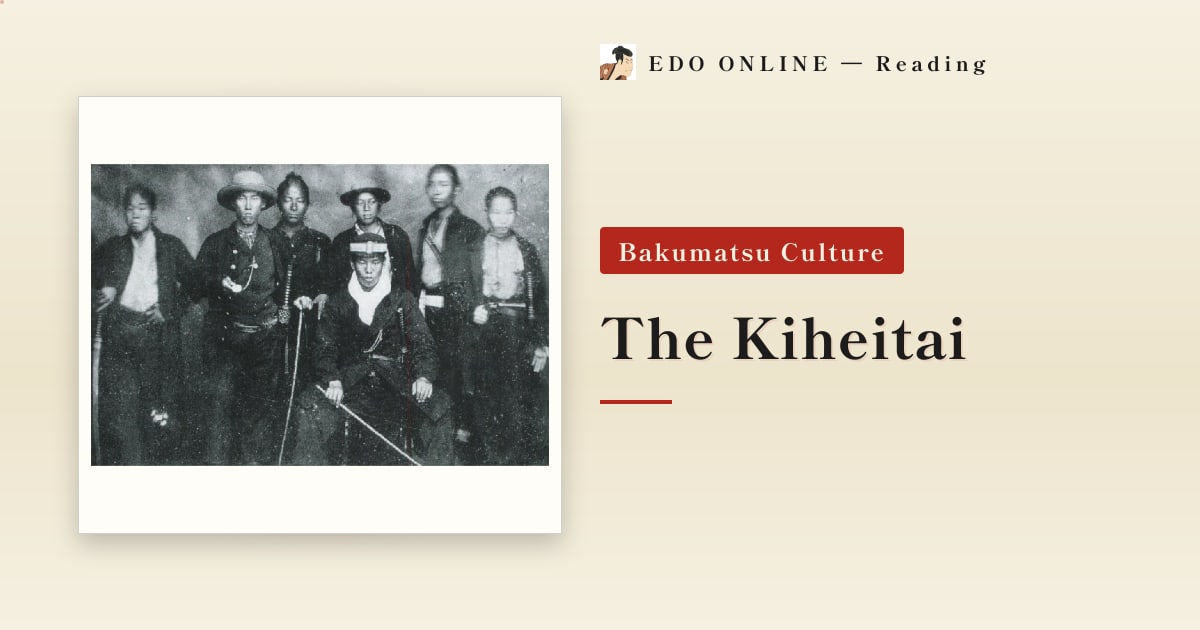
The Kiheitai — Takasugi's Army That Ignored Class
Raised in 1863 by Takasugi Shinsaku, the Kiheitai took commoners as soldiers. Why Choshu did it, how it differed from the regular army, what it won, and how the new government crushed it.
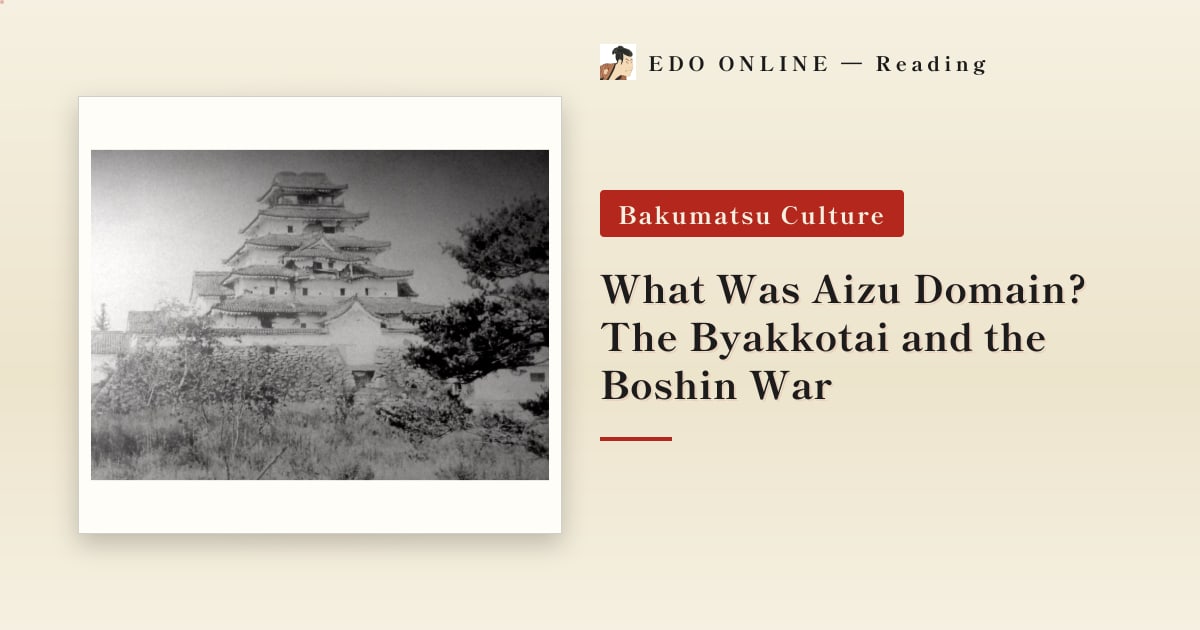
What Was Aizu Domain? The House Code, the Byakkotai, the Siege
Aizu stayed loyal to the shogunate to the end and was destroyed for it. Why Matsudaira Katamori took the Kyoto post, what happened to the Byakkotai, and how the domain was punished.
What Was the Ansei Purge? Ii Naosuke's Crackdown Explained
Between 1858 and 1859 the shogunate's chief minister Ii Naosuke purged more than a hundred opponents and executed eight, including Yoshida Shoin. Why it happened and what it destroyed.