
Niimi Nishiki — The Early Shinsengumi Officer Nobody Remembers
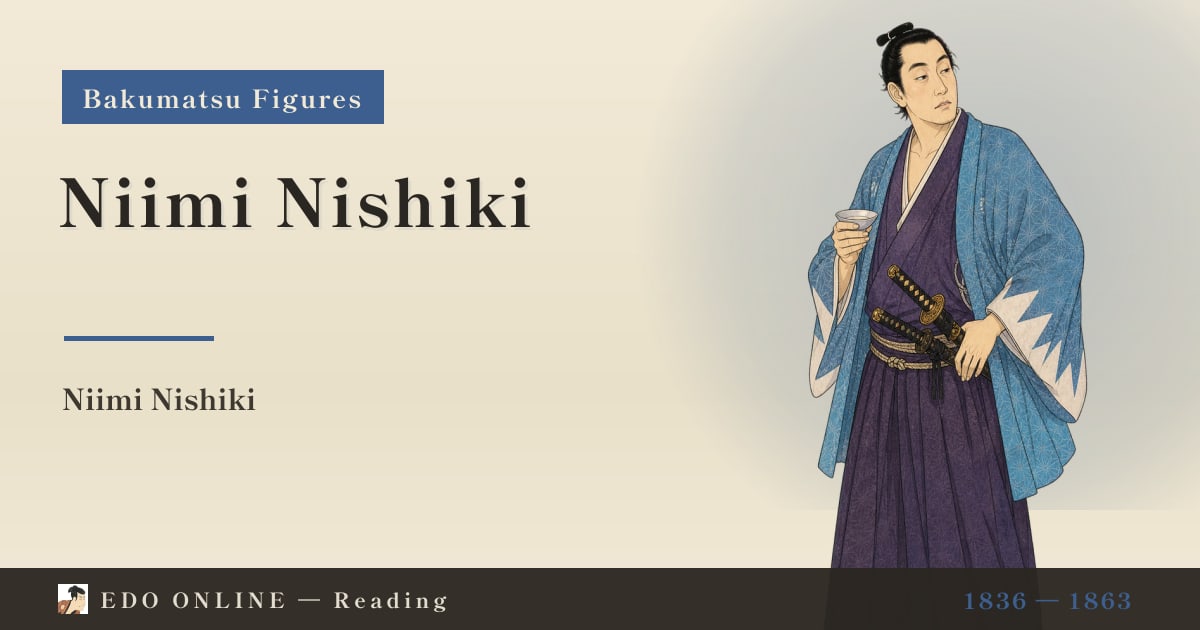
The Shinsengumi is said to have had three men of commander rank at its founding. Kondo Isami, Serizawa Kamo, and Niimi Nishiki. Of the three, one is barely a person on the record at all.
Contents
Who Was Niimi Nishiki?
Niimi was a masterless samurai of the Mito domain and a member of the Mibu Rōshi. The surname is also read "Shinmi."
In March 1863, in the founding organisation of the Mibu Rōshi, some sources make him a commander alongside Serizawa Kamo and Kondo Isami. Later records call him vice-commander instead. Where exactly he sat in the founding structure differs from source to source.
On paper, either way, he was one of the men at the top of what became the Shinsengumi.
And almost nothing he did is recoverable.
What Is Actually Known About Niimi Nishiki
The firm ground amounts to this.
His birth year is back-calculated. A reference to his being twenty-eight in the Abe Family Documents puts his birth at 1836.
Most sources make him a man of the Mito domain. At some point he studied under Okada Sukeemon and received full certification in Shintō Munen-ryū. A contemporary rumour rates him "of the quality of a master."
In February 1863 he joined the Rōshigumi, organised through the efforts of Kiyokawa Hachiro, as sub-leader of the third company. Holding an officer's post implies a name already known. Five Tama-district students of Tennen Rishin-ryū were assigned under him, including Inoue Genzaburo and Okita Rintarō.
When Kiyokawa announced the return to Edo on 27 February, Niimi broke away with Serizawa and Kondo, declaring he would stay in Kyoto.
Then, in April, his name appears with theirs on the covering note for 100 ryō extorted from an Osaka merchant.
That is very nearly the only record of him acting as a member of the corps.
Why There Is No Record of Niimi Nishiki
The record is not so much thin as almost entirely absent.
His name is absent from the roster submitted to Matsudaira Katamori on 25 May. It is also absent from the Eimeiroku compiled by Shimada Kai, who joined that same month.
Yagi Tamesaburō, of the family that housed the corps and who remembered Serizawa and Kondo well, said of Niimi: "I have absolutely no recollection of him," and "he was gone before anyone noticed."
The son of the household that quartered the corps could not remember a man of commander rank. That is not normal.
What does survive is abuse. Nagakura Shinpachi's Rōshi Bunkyū Hōkoku Kiji has him violent to excess, breaking the regulations and deaf to both Serizawa and Kondo. Shimozawa Kan's Shinsengumi Shimatsuki has him neglecting his duties for dissipation and repeatedly shaking down local households in the name of corps expenses.
Yet there is no record of Niimi taking part in Serizawa Kamo's own outrages — the Osaka sumo brawl, the Yamatoya arson. Described as Serizawa's right hand, he leaves no trace at the scenes of Serizawa's misconduct.
When Was Niimi Nishiki Forced to Die?
On his end, the same Nagakura Shinpachi wrote it two different ways.
In Shinsengumi Tenmatsuki: Kondo's faction descended on the Gion restaurant where Niimi was carousing, laid out his offences, told him that if he did not cut his belly he would be beheaded under the regulations, and had him do it.
In Rōshi Bunkyū Hōkoku Kiji: the group agreed on seppuku, but before it happened Niimi assaulted another Mito rōnin, and he was made to die on 14 or 15 August with one Umezu as second.
Which is right is not known.
The conventional date of death is 27 October 1863, and that is not settled either.
Either way, Serizawa Kamo and Hirayama Gorō were assassinated by the Shieikan faction soon after, and the corps' Mito faction was destroyed.
Was Niimi Nishiki Somebody Else?
Recent scholarship favours the view that the name was an alias.
The candidate is Niinomi Kumetarō, another Mito rōnin and a comrade of Shimomura Tsuguji — the earlier name attributed to Serizawa Kamo — in the Tamatsukuri faction. On this reading, Niinomi was arrested with Shimomura, released, and thereafter called himself "Niimi Nishiki."
Several things line up. Niinomi was a student of the Shintō Munen-ryū swordsman Kaneko Kenshirō. He is documented in Kyoto in May 1863. He is said to have committed seppuku on 15 September that year, and the age recorded is twenty-eight — the same as Niimi's. One passage even writes him as "Niimi Kumejirō."
It also explains the disappearance of Niimi's name after May. Yoshinari Yūtarō recorded that "the Mibu Rōshi had had enough of Kumetarō, so we took him in," which suggests Kondo and Serizawa conferred, lifted his confinement and let him leave.
Separately, Nishimura Kanefumi's Shinsengumi Shimatsuki does not name Niimi at all. In his place it lists a Tanaka Iori among the founders of the Mibu Rōshi, and says of his end that he was "killed in the dark for having gone against Kondō's wishes." Some read that as another alias for Niimi.
Why Niimi Nishiki Was Made to Die
Misconduct and factional conflict are the usual answers. There is another.
After the Restoration, the Ryōzen shrine was built to enshrine the spirits of Chōshū-aligned activists — and Niimi, who ought to have been their enemy, is enshrined there. His name also appears in a register of Restoration loyalists compiled by Kureji Yoshinobu, formerly of the Shinchōgumi.
The new government, in other words, counted Niimi as one of theirs.
Hence the suggestion that he was made to die not merely for dissipation or faction, but because his closeness to the imperial-loyalist men of Mito, Chōshū and Tosa was held against him. Inferring collusion from an enshrinement and a register is reasoning, not proof.
Frequently asked questions
Who was Niimi Nishiki?
One of the commanders of the Mibu Rōshi, the body that became the Shinsengumi. He ranked with Kondo Isami and Serizawa Kamo, but almost no record of his activity survives.
When did Niimi Nishiki die?
Conventionally by seppuku on 27 October 1863. Nagakura Shinpachi, however, also dates it to 14 or 15 August, and the matter is unsettled.
Did Niimi Nishiki really exist?
Yes, but "Niimi Nishiki" may not have been his real name. Recent scholarship favours identifying him with the Mito rōnin Niinomi Kumetarō.
Why is there so little record of Niimi Nishiki?
His name vanishes from the May roster, and the son of the family that quartered the corps said he had "absolutely no recollection" of him. He appears to have dropped out very early.
Niimi Nishiki Timeline
| Year | Event |
|---|---|
| 1836 | Born (back-calculated from a reference to his age); said to be of the Mito domain |
| Date unknown | Studies under Okada Sukeemon; receives full certification in Shintō Munen-ryū |
| Feb 1863 | Joins Kiyokawa Hachiro's Rōshigumi as sub-leader of the third company |
| 27 Feb 1863 | Declares he will remain in Kyoto with Serizawa and Kondo |
| Mar 1863 | Ranked among the Mibu Rōshi's senior officers (commander in some sources, vice-commander in others) |
| Apr 1863 | Named on the note for 100 ryō extorted in Osaka — nearly his only record of activity |
| May 1863 | His name disappears from the roster given to Matsudaira Katamori |
| 1863 | Forced to commit seppuku; the date is given as 14–15 August or 15 September |
For the other purged commander see Serizawa Kamo; for the man who created the Rōshigumi, Kiyokawa Hachiro; for the roster, the Shinsengumi members; for the corps, the Shinsengumi.
Related reading
Abe Juro — The Former Member Who Talked
He deserted the Shinsengumi and rejoined under another name, shot at Kondo Isami as one of the Goryō Eji, and then grew apples in Sapporo. His late-Meiji testimony is where the ranking of the corps' best swordsmen comes from.
Ando Hayataro — The Shinsengumi's Record-Breaking Archer
He set the standing national record in the long-range shooting at the Tōdai-ji Great Buddha Hall, sending 8,685 arrows the length of the corridor. Nearly fifty, he joined the Shinsengumi and died of wounds taken in the back garden of the Ikedaya.
Hattori Takeo — Two Swords at Aburanokoji
A two-sword master and fencing instructor of the Shinsengumi who defected with the Goryō Eji. At Aburanokōji he alone wore mail, held a wall against the whole corps, and fell with more than twenty wounds.