
Matsudaira Katamori — The Lord Whose Loyalty Destroyed His Domain
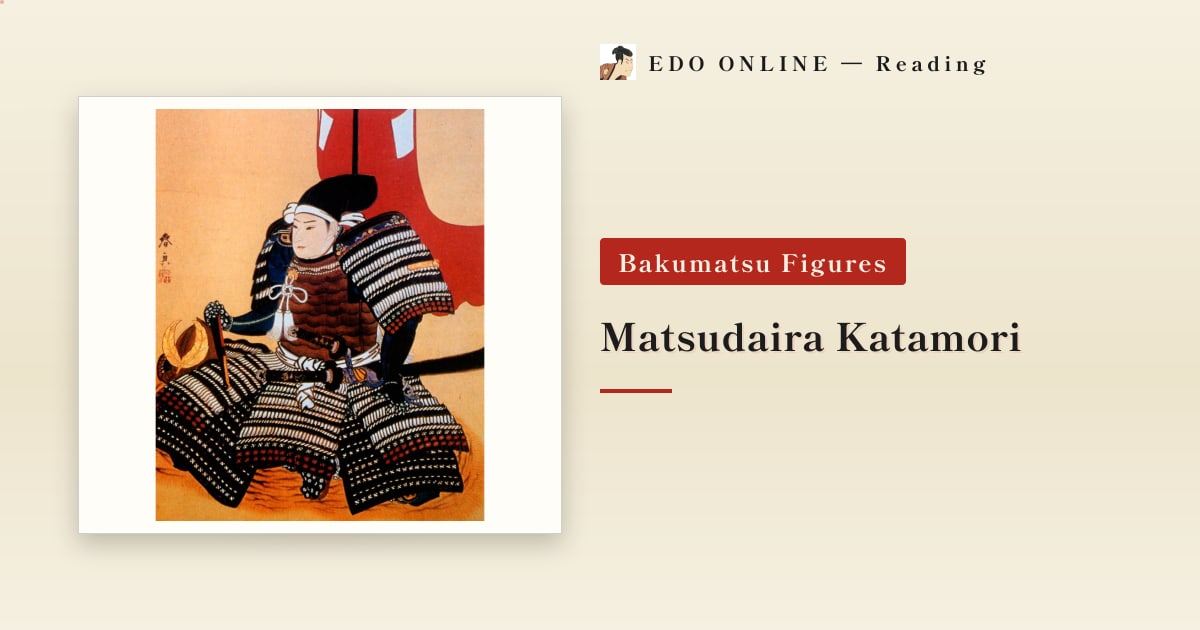
There was one appointment that ruined a domain by being accepted. The office of Protector of Kyoto. The man who took it was Matsudaira Katamori, lord of Aizu.
Contents
Who Was Matsudaira Katamori?
His life turns on that one office, Protector of Kyoto.
The shogunate charged him with keeping order in a disintegrating Kyoto. To do it he policed the imperial-loyalist activists and took the Shinsengumi under his command.
As a result he drew the concentrated hatred of the loyalists. And in the Boshin War, Aizu was branded an enemy of the court and destroyed.
Loyalty faithfully performed brought his domain to ruin. That is Katamori's tragedy.
He was born in 1836 into the Takasu house of Mino and succeeded, by adoption, as lord of Aizu.
The House Code That Bound Matsudaira Katamori
To understand Katamori you have to know the house code of Aizu.
Aizu's founder, Hoshina Masayuki, was of Tokugawa shogunal blood. The first article of the code he laid down held, in substance, that Aizu was to serve the Tokugawa shogunal house with singular loyalty, and was not to measure itself by the conduct of other domains.
Aizu had kept that code for more than two centuries. Loyalty to the shogunate was the domain's very reason for existing.
That is what determined Katamori's choice.
Why Matsudaira Katamori Accepted the Kyoto Post
In 1862 the shogunate asked Katamori to become Protector of Kyoto.
Kyoto had collapsed into disorder, filled with loyalist activists, with assassinations in the name of "heaven's punishment" running beyond the shogunate's control.
The request was to suppress it with Aizu troops.
Katamori and his retainers opposed it at first. Pouring the domain's strength into Kyoto would ruin its finances and earn the hatred of every faction. His chief retainer Saigo Tanomo objected repeatedly.
But the house code did not permit refusal. A domain that placed loyalty to the Tokugawa first could not decline. Katamori accepted.
And exactly what Tanomo had feared then happened.
Matsudaira Katamori and the Trust of Emperor Komei
Katamori did gain one thing in Kyoto: the deep trust of Emperor Komei.
Komei was hostile to radical expulsionism and to overthrowing the shogunate, and wanted cooperation with it. He came to trust Katamori, who was keeping order in the capital. In 1863 the emperor granted Katamori a letter in his own hand and poems of his own composition, and Katamori kept them all his life.
The conviction that he was serving the emperor stayed with Katamori — and it is what later tormented him.
Why Matsudaira Katamori Became an Enemy of the Court
Emperor Komei died suddenly at the end of 1866 (January 1867 by the Western calendar), and Katamori lost his greatest support.
The following year the shogunal forces were defeated at Toba-Fushimi. The new government's troops raised the brocade banner of imperial authority, and Aizu was declared an "enemy of the court."
The man who believed he had served the emperor was now attacked as his enemy — having lost his support at court with Komei's death, and then been branded an enemy of it.
Matsudaira Katamori and the Battle of Aizu
In 1868 the imperial army invaded Aizu — the Battle of Aizu.
Aizu offered its submission, was refused, and fought. The siege of Tsuruga Castle, the tragedy of the Byakkotai, the fighting of women like Nakano Takeko, the mass suicide of Saigo Tanomo's family — the disasters piled up.
After about a month the domain surrendered. It was dissolved, and its former retainers were removed to Tonami in the far north.
The whole domain carried the consequences of its lord's loyalty.
Matsudaira Katamori's Later Life and Death
After the surrender Katamori was confined but escaped execution.
In the Meiji era he served as head priest of the Nikko Tosho-gu, the shrine that enshrines Tokugawa Ieyasu. A man who had given his loyalty to the Tokugawa ended as a priest serving Tokugawa Ieyasu.
He died in 1893, aged fifty-seven.
The imperial letter he had received from Komei he kept in a bamboo tube, close to his body, and preserved for the rest of his life. A man branded an enemy of the court never let go of the proof of the emperor's trust — the whole of Katamori is in that.
Matsudaira Katamori Timeline
| Year | Event |
|---|---|
| 1836 | Born into the Takasu house of Mino; later succeeds as lord of Aizu |
| 1862 | Becomes Protector of Kyoto |
| 1863–64 | Takes the Shinsengumi under command; polices Kyoto |
| Jan 1867 | Emperor Komei dies suddenly |
| 1868 | Branded enemy of the court after Toba-Fushimi; surrenders in the Battle of Aizu |
| Meiji era | Serves as head priest of the Nikko Tosho-gu |
| 1893 | Dies, aged 57 |
For the war see Aizu domain; for the retainer who opposed the Kyoto post, Saigo Tanomo.
Related reading
Abe Juro — The Former Member Who Talked
He deserted the Shinsengumi and rejoined under another name, shot at Kondo Isami as one of the Goryō Eji, and then grew apples in Sapporo. His late-Meiji testimony is where the ranking of the corps' best swordsmen comes from.
Ando Hayataro — The Shinsengumi's Record-Breaking Archer
He set the standing national record in the long-range shooting at the Tōdai-ji Great Buddha Hall, sending 8,685 arrows the length of the corridor. Nearly fifty, he joined the Shinsengumi and died of wounds taken in the back garden of the Ikedaya.
Hattori Takeo — Two Swords at Aburanokoji
A two-sword master and fencing instructor of the Shinsengumi who defected with the Goryō Eji. At Aburanokōji he alone wore mail, held a wall against the whole corps, and fell with more than twenty wounds.