Nakajima Nobori — The Corporal Who Drew His Comrades' Faces
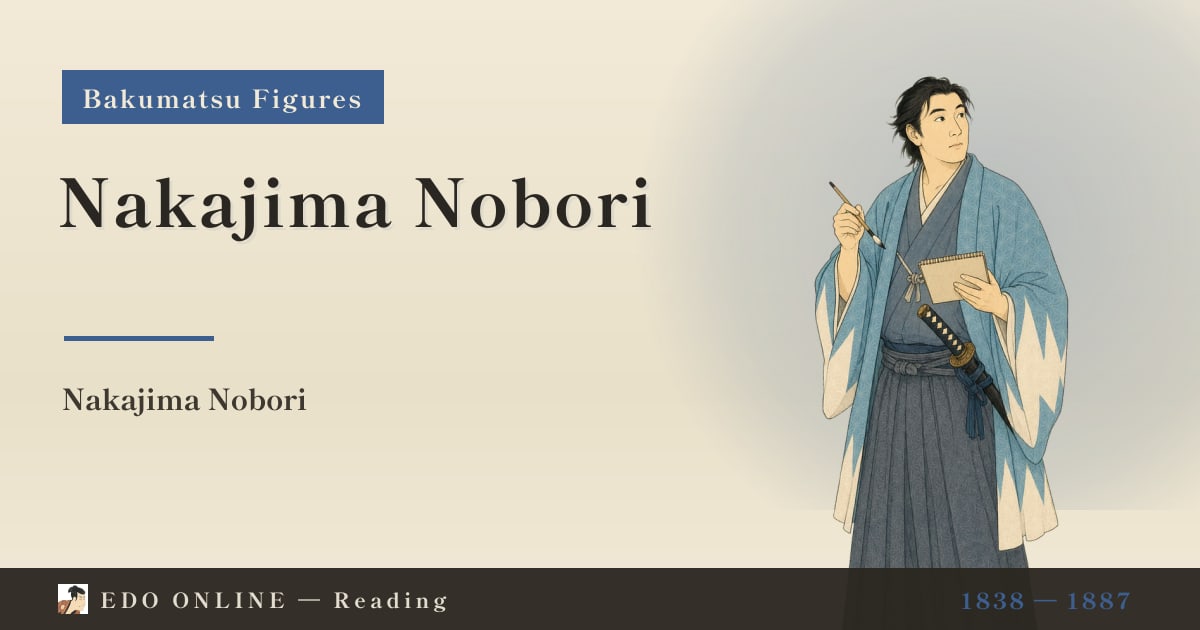
We know what some Shinsengumi members looked like because this man drew them. Nakajima Nobori. He left a scroll of his comrades' portraits.
Contents
Who Was Nakajima Nobori?
Nakajima was a corporal of the Shinsengumi.
He was born on 25 February 1838 at Odano in the Tama district of Musashi province — now part of Hachiōji in Tokyo — eldest son of a farming family.
He died at Hamamatsu on 2 April 1887, aged forty-nine.
How Nakajima Nobori Reached the Shinsengumi
Around September 1856, at nineteen, he entered the Tennen Rishin-ryū school of Yamamoto Manjirō. The next year he married a woman from his own district, and a son was born.
He then joined the Hachiōji Sen'nin Dōshin, the local militia of shogunal retainers.
And then he clashed with one of his fellows, cut him down, and fled to a relative's house.
A man who had killed and run joined the Shinsengumi — in 1864.
He is said to have carried out secret surveys of the terrain of Musashi, Kai and Sagami on Kondo Isami's orders. He became a corporal in 1867.
Tama-born and Tennen Rishin-ryū-trained puts him on the same road as Kondo, Hijikata and Inoue Genzaburo.
Nakajima Nobori in the Boshin War
On 25 April 1868, when Kondo Isami surrendered at Nagareyama, Nakajima followed the Satsuma escort officer Arima Tōta. The guard was too tight and he came away with nothing.
He tried to save Kondo and could not reach him.
He then joined Ōtori Keisuke's former shogunal forces with Hijikata Toshizo and Shimada Kai, fighting at Utsunomiya, at the Nikkō approaches and in the Aizu campaign. At Sendai he joined Enomoto Takeaki's naval force and crossed to Ezo.
At Hakodate he served as guide officer to the second detachment at the Benten battery.
He surrendered on 24 June 1869, was confined at the battery, sent under guard to Aomori, and after more than eight months of confinement in Hirosaki and Aomori was placed in the Shizuoka domain's custody in May 1870 and pardoned mid-month, returning to Tama.
Nakajima Nobori's Picture-Scroll
His most important legacy is the scroll of his comrades.
It depicts Shinsengumi members; he also left a book of recollections.
This matters a great deal. Reliable photographs survive for only a few members, Hijikata Toshizo among them; for men like Okita Soji no dependable likeness exists at all.
Against that, pictures of his comrades drawn by a man who was actually in the corps have no substitute.
Shimada Kai left a diary and objects, Nagakura Shinpachi left recollections, and Nakajima drew. What the survivors left, each in his own medium, is what the modern picture of the Shinsengumi is built from.
Nakajima Nobori's Businesses and House Rules
After the Restoration he worked on the Shizuoka domain's land reclamation and gave away his own fields to others.
He settled at Hamamatsu, brought his eldest son there in 1879, and remarried in 1882.
He started business after business and failed at them.
First a pawnshop with other former shogunal retainers, which failed. In 1881 a new variety appeared by chance among the aspidistra he grew as a hobby; named at a show, it sold explosively — until a horse ate the parent plant and that was the end of the business.
In 1884 he obtained a licence as a dealer in guns and gunpowder and opened the Nakajima gun and powder shop.
And he left house rules.
One: never say a word about liking or disliking your food. Two: have nothing to do with go, shōgi or any game of winning and losing. Three: no pawnbroking or moneylending, down to your grandchildren's generation.
A man who failed at pawnbroking forbade it to his grandchildren. These are rules written out of experience.
He left a death poem too, on crossing the pass of fifty years lightly into a peaceful age.
Frequently asked questions
Who was Nakajima Nobori?
A corporal of the Shinsengumi. Born to a Tama farming family and trained in Tennen Rishin-ryū, he fought all the way to Hakodate and left a picture-scroll of his fellow members.
What is Nakajima Nobori's picture-scroll?
A set of drawings of Shinsengumi members in his own hand. Since reliable likenesses of most members do not exist, images drawn by someone who served alongside them are important source material.
What did Nakajima Nobori do after the Restoration?
He worked on land reclamation for the Shizuoka domain and settled at Hamamatsu, trying pawnbroking and horticulture before opening a gun and powder shop in 1884. He died at Hamamatsu in 1887.
What were Nakajima Nobori's house rules?
Never complain about food; avoid all games of winning and losing; and never take up pawnbroking or moneylending, down to his grandchildren's generation.
Nakajima Nobori Timeline
| Year | Event |
|---|---|
| 1838 | Born to a farming family at Odano in the Tama district |
| 1856 | Enters Yamamoto Manjirō's Tennen Rishin-ryū school at nineteen |
| Thereafter | Joins the Hachiōji militia; kills a fellow member and flees |
| 1864 | Joins the Shinsengumi; reportedly surveys terrain in secret |
| 1867 | Becomes a corporal |
| Apr 1868 | Follows Kondo Isami's escort from Nagareyama without success |
| 1868 | Fights at Utsunomiya, Nikkō and Aizu; crosses to Ezo from Sendai |
| 1869 | Guide officer at the Benten battery; surrenders on 24 June |
| May 1870 | Placed in Shizuoka domain custody, then pardoned; returns to Tama |
| 1884 | Opens a gun and powder shop at Hamamatsu |
| 2 Apr 1887 | Dies at Hamamatsu, aged forty-nine |
For fellow Tama men see Kondo Isami, Hijikata Toshizo and Inoue Genzaburo; for the other record-keeper, Shimada Kai; for the roster, the Shinsengumi members.
Related reading
Abe Juro — The Former Member Who Talked
He deserted the Shinsengumi and rejoined under another name, shot at Kondo Isami as one of the Goryō Eji, and then grew apples in Sapporo. His late-Meiji testimony is where the ranking of the corps' best swordsmen comes from.
Ando Hayataro — The Shinsengumi's Record-Breaking Archer
He set the standing national record in the long-range shooting at the Tōdai-ji Great Buddha Hall, sending 8,685 arrows the length of the corridor. Nearly fifty, he joined the Shinsengumi and died of wounds taken in the back garden of the Ikedaya.
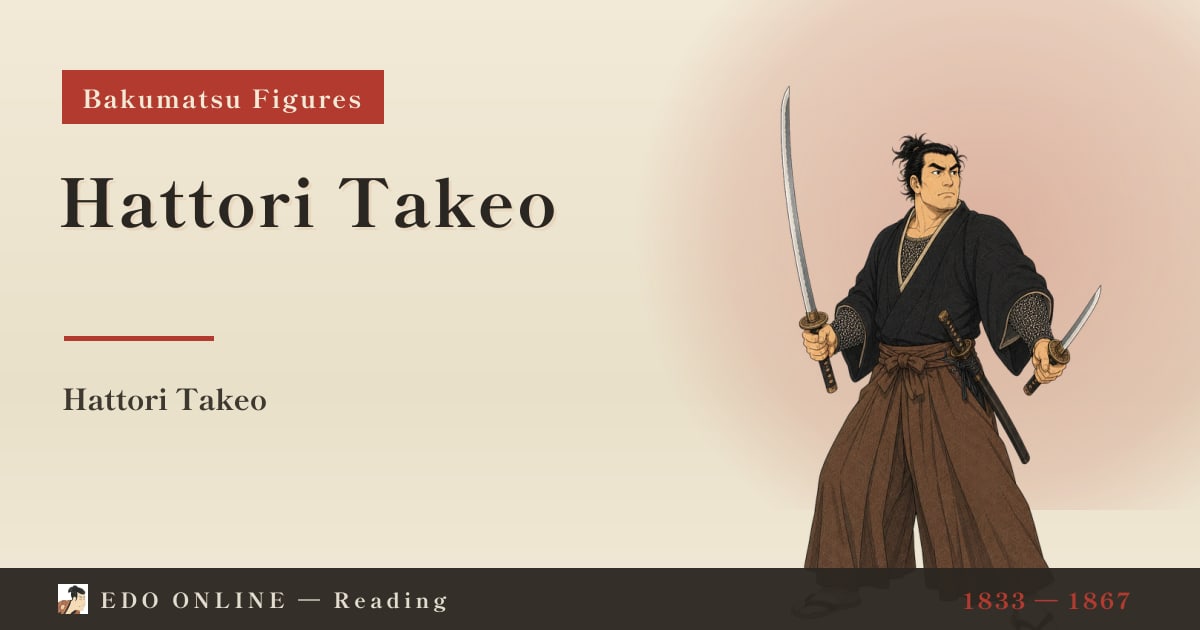
Hattori Takeo — Two Swords at Aburanokoji
A two-sword master and fencing instructor of the Shinsengumi who defected with the Goryō Eji. At Aburanokōji he alone wore mail, held a wall against the whole corps, and fell with more than twenty wounds.