Yamada Akiyoshi — From Battlefield Command to Drafting Japan's Codes
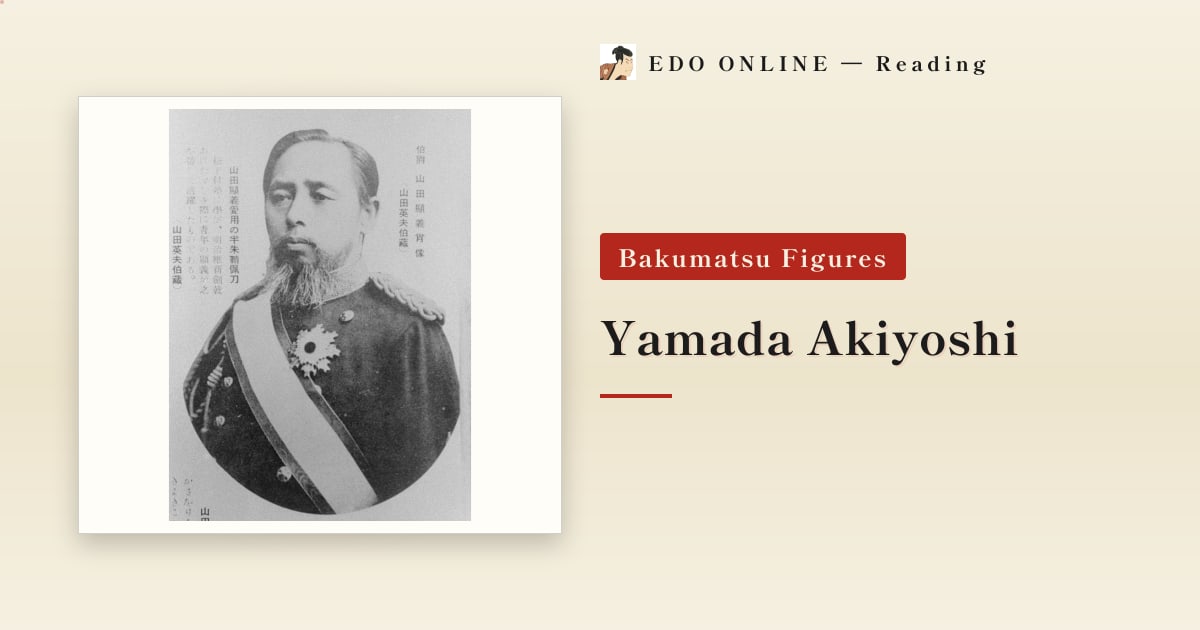
A man who commanded an army in his twenties drafted a civil code in his forties. Yamada Akiyoshi — who also left two universities behind him.
Contents
Who Was Yamada Akiyoshi?
Yamada was a Choshu samurai who became justice minister of the Meiji government.
His life breaks in three.
A commander in the Boshin War. In his early twenties he fought across Echigo, Aizu and Hakodate, and made his name for handling troops.
The man who built the codes. As head of the justice ministry for more than seven years — shiho-kyo from 1883, then Japan's first justice minister from 1885 — he drove the compilation of its civil, commercial and criminal law.
The man who built schools. Both Nihon University and Kokugakuin University trace back to him.
He was born in 1844 and died in 1892.
Yamada Akiyoshi, the Youngest in Shoin's Classroom
Yamada was born to a Choshu samurai family in Hagi and studied at the Shoka Sonjuku under Yoshida Shoin.
He entered in his mid-teens — among the very youngest of the students. While Takasugi Shinsaku and Kusaka Genzui were moving domain policy, Yamada was still a boy.
That age gap decided his life. Where the two star students died in their twenties, Yamada lived a quarter-century into the Meiji era and got to be one of the people who built institutions.
Yamada Akiyoshi as a Commander in His Twenties
The Boshin War began in 1868. Yamada was twenty-three.
He fought in one theatre after another: in Echigo against Kawai Tsugunosuke of Nagaoka, on into Aizu, and finally in the reduction of Goryokaku at Hakodate.
In that short span he established a reputation as a commander.
The line usually quoted about him is Omura Masujiro's judgment that his handling of troops was uncanny. The remark is recorded later, and its source and exact wording are disputed.
He was also called "the little Napoleon", for a small frame and a facility with troops out of proportion to his age.
Why Yamada Akiyoshi Moved From War to Law
In 1871 Yamada joined the Iwakura Mission to Europe and the United States.
The mission's purpose was to sound out treaty revision and study institutions. What Yamada concentrated on was law. He went back to studying the French and German codes in earnest.
The reasoning was plain. Revising the unequal treaties required a legal system the West would accept. To try foreigners in Japanese courts, Japan needed the courts and the codes first.
A soldier becoming a jurist was not an ideological conversion but a means chosen from the end.
What Yamada Akiyoshi Did as Justice Minister
Yamada took the justice portfolio in 1883 as shiho-kyo, chief of the ministry under the old council system, and became Japan's first Minister of Justice when the cabinet system began in 1885. Across the two offices his tenure ran over seven years, among the longest of anyone in the post.
What he did in that time was substantial.
Codification. He worked with the French jurist Gustave Boissonade, whom the Japanese government had recruited in 1873, on the criminal, procedural and civil law, and chaired the criminal-code compilation committee from 1875 — Japan's first modern body of codes.
Court structure. He put through the law organising the judiciary.
Training lawyers. And he saw the gap: there were not enough schools teaching law. A code is inert without people able to operate it.
The Two Universities Yamada Akiyoshi Founded
In 1889 Yamada helped found the Japan Law School — now Nihon University — and became the first head of the Koten Kokyusho, an institute for classical studies.
In July 1890 Kokugakuin was established on that institute's foundation. It is now Kokugakuin University, a school for the study of Japanese classics and history.
The man who imported Western codes also built a school for Japanese antiquity.
His reasoning: transplanted law does not take root on its own. People who knew Japanese custom and history had to be the ones adapting it to Japanese conditions.
How Yamada Akiyoshi Died
Yamada died suddenly while travelling in November 1892, aged forty-seven.
The old civil code he had driven forward was promulgated in 1890, while he was still alive. But Boissonade's draft was attacked as incompatible with the Japanese family system, and after the civil-code controversy its entry into force was postponed and it was never enforced.
A revised code was promulgated in 1896 and 1898 and came into force in 1898, after his death. He never saw a code of his in use. But the court structure, and the schools that trained the lawyers, remained.
Yamada Akiyoshi Timeline
| Year | Event |
|---|---|
| 1844 | Born to a Choshu samurai family in Hagi |
| late 1850s | Studies under Yoshida Shoin, among the youngest students |
| 1868 | Fights in Echigo and Aizu in the Boshin War, aged 23 |
| 1869 | Takes part in the reduction of Goryokaku |
| 1871 | Joins the Iwakura Mission; studies Western legal systems |
| 1875 | Chairs the criminal-code compilation committee (Boissonade recruited by the government in 1873) |
| 1883 | Becomes shiho-kyo, chief of the justice ministry |
| 1885 | Becomes Japan's first Minister of Justice; over seven years across the two offices |
| 1889 | Helps found the Japan Law School (now Nihon University); heads the Koten Kokyusho |
| 1890 | Kokugakuin founded on that institute; the old civil code is promulgated |
| 1892 | Dies suddenly, aged 47 |
For fellow students of Shoin see Takasugi Shinsaku, Kusaka Genzui and Shinagawa Yajiro; for his opponent at Nagaoka, Kawai Tsugunosuke.
Related reading
Abe Juro — The Former Member Who Talked
He deserted the Shinsengumi and rejoined under another name, shot at Kondo Isami as one of the Goryō Eji, and then grew apples in Sapporo. His late-Meiji testimony is where the ranking of the corps' best swordsmen comes from.
Ando Hayataro — The Shinsengumi's Record-Breaking Archer
He set the standing national record in the long-range shooting at the Tōdai-ji Great Buddha Hall, sending 8,685 arrows the length of the corridor. Nearly fifty, he joined the Shinsengumi and died of wounds taken in the back garden of the Ikedaya.
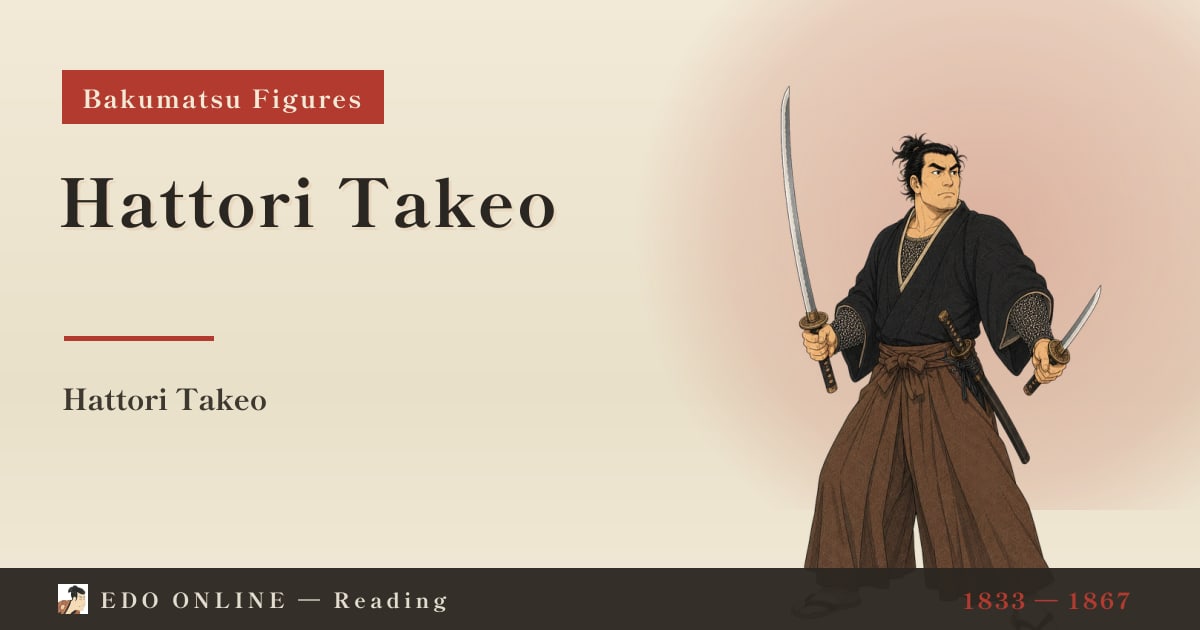
Hattori Takeo — Two Swords at Aburanokoji
A two-sword master and fencing instructor of the Shinsengumi who defected with the Goryō Eji. At Aburanokōji he alone wore mail, held a wall against the whole corps, and fell with more than twenty wounds.