Kawai Tsugunosuke — The Small-Domain Elder Who Fought with a Gatling Gun
A man who armed a small domain with the newest weapons and fought a great power with it. Kawai Tsugunosuke was a chief retainer of Nagaoka in Echigo.
Contents
Who Was Kawai Tsugunosuke?
His work comes down to trying to remake tiny Nagaoka into an independent, strong domain.
He reformed its administration, restored its finances, and poured the proceeds into modern weapons. He is known for buying a Gatling gun — a rapid-firing weapon of which only a handful existed in Japan.
And in the Boshin War, he sought armed neutrality, siding with neither the new government nor the old shogunate. When that proved impossible, he fought the imperial army.
Refusing to be carried along by the tide, he tried to hold his own domain's course. That is the whole of Kawai.
Kawai Tsugunosuke's Financial Reforms
Born in 1827 into a Nagaoka samurai family.
As a young man Kawai studied in Edo and elsewhere. The strongest influence was the financial reformer Yamada Hokoku of Bitchu Matsuyama domain, who had rescued a bankrupt domain's finances; Kawai learned his methods.
Back in Nagaoka, Kawai set about reform. He cut waste, promoted industry, and restored the finances, then directed the surplus into military modernization.
Enrich the domain, and use the wealth to arm it. His plan was consistent.
Kawai Tsugunosuke's Gamble on Armed Neutrality
In 1868 the Boshin War reached the north.
Domain after domain was forced to choose between the new government and the old shogunate. What Kawai wanted was neither: armed neutrality.
Nagaoka would keep its independence and join no side, holding strong forces and standing between the two to mediate the war. That was the road he envisaged.
For a small domain to propose this was either reckless or idealistic. Kawai meant it.
Kawai Tsugunosuke at the Ojiya Negotiation
In the summer of 1868 Kawai went to the imperial camp to negotiate in person — the Ojiya negotiation.
He asked that Nagaoka's neutrality be recognized. The young imperial staff officer dismissed it out of hand, and the talk collapsed in a very short time.
Kawai's ideal was not even entertained. With neutrality dead, Nagaoka had no choice but to fight.
The failure of that meeting is variously judged. Did he misread his man, or was the proposal never going to pass? The argument continues.
Kawai Tsugunosuke and the Hokuetsu War
So began the Hokuetsu War.
Kawai's Nagaoka troops, with modern weapons and skilful handling, gave the imperial army real trouble. Having lost Nagaoka Castle once, they retook it by surprise attack — a small domain's army holding its own against a far larger force.
Kawai is said to have worked a Gatling gun himself. A chief retainer firing a machine gun at the front made his legend.
But the disparity in numbers and material could not be overcome. Nagaoka Castle fell again, and the domain's troops were routed.
How Kawai Tsugunosuke Died
In the fighting Kawai took a bullet in the leg and was badly wounded.
The defeated Nagaoka troops crossed the mountains toward Aizu. Kawai, wounded, was carried on a litter over the steep Hachijuri-goe pass.
He is credited with a self-mocking poem composed on the way, playing the pass's name against his own broken body — a defeated commander leaving words in pain and bitterness.
Just after crossing into Aizu territory, at Shiozawa, the wound worsened and Kawai died — on 1 October 1868, aged forty-one.
He tried to make his domain strong, led it into war, and fell himself. Opinions of him still divide because of the weight of that ending.
How Kawai Tsugunosuke Is Judged
Kawai has been received in complicated ways in his own Nagaoka.
There are voices that honour him as an able leader, and there is a long, persistent criticism that he dragged the domain into a needless war and burned its town — for Nagaoka suffered heavily in the Hokuetsu War.
Shiba Ryotaro's novel Toge ("The Pass") made his name nationally known. The image of a man martyred to his ideal owes a great deal to that book.
The Kawai Tsugunosuke Memorial Museum in Nagaoka, Niigata, presents his life and the Hokuetsu War.
Kawai Tsugunosuke Timeline
| Year | Event |
|---|---|
| 1827 | Born into a Nagaoka samurai family |
| 1850s | Studies widely; influenced by the reformer Yamada Hokoku |
| 1860s | Leads Nagaoka's administrative reform; modernizes its arms |
| Jun 1868 | Seeks armed neutrality at the Ojiya negotiation; it collapses |
| 1868 | The Hokuetsu War; retakes Nagaoka Castle before losing it again |
| Oct 1868 | Dies at Shiozawa in Aizu territory, aged 41 |
For the war see the Boshin War; for Aizu, Aizu domain.
Related reading
Abe Juro — The Former Member Who Talked
He deserted the Shinsengumi and rejoined under another name, shot at Kondo Isami as one of the Goryō Eji, and then grew apples in Sapporo. His late-Meiji testimony is where the ranking of the corps' best swordsmen comes from.
Ando Hayataro — The Shinsengumi's Record-Breaking Archer
He set the standing national record in the long-range shooting at the Tōdai-ji Great Buddha Hall, sending 8,685 arrows the length of the corridor. Nearly fifty, he joined the Shinsengumi and died of wounds taken in the back garden of the Ikedaya.
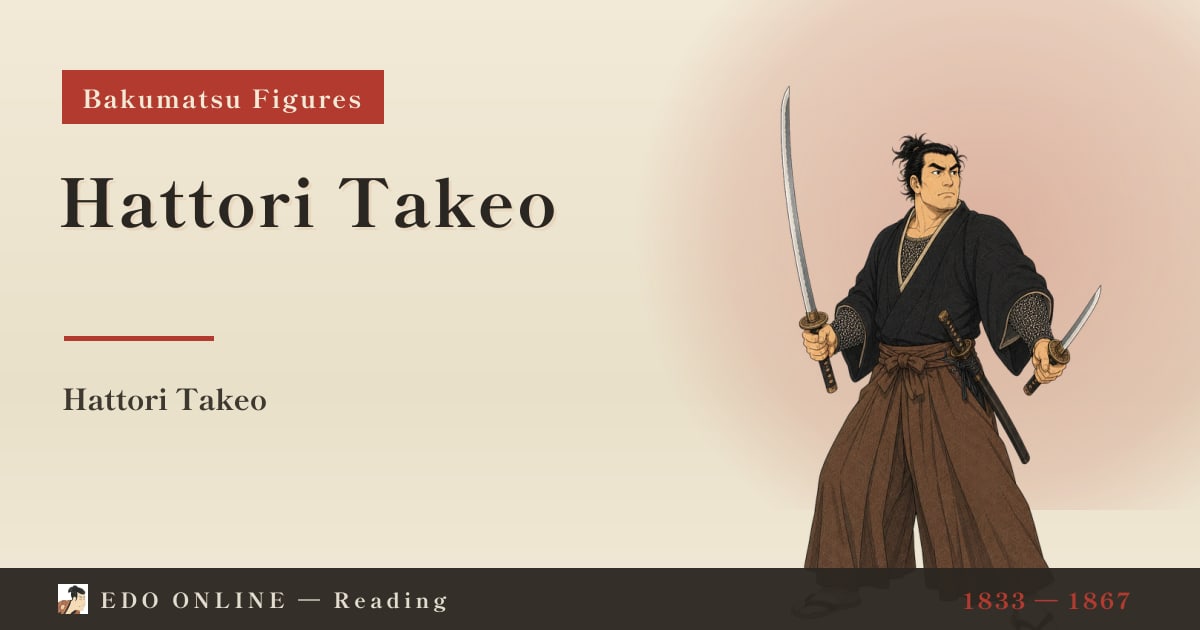
Hattori Takeo — Two Swords at Aburanokoji
A two-sword master and fencing instructor of the Shinsengumi who defected with the Goryō Eji. At Aburanokōji he alone wore mail, held a wall against the whole corps, and fell with more than twenty wounds.