Inoue Kaoru — Smuggled to London, Sewn Up With a Tatami Needle
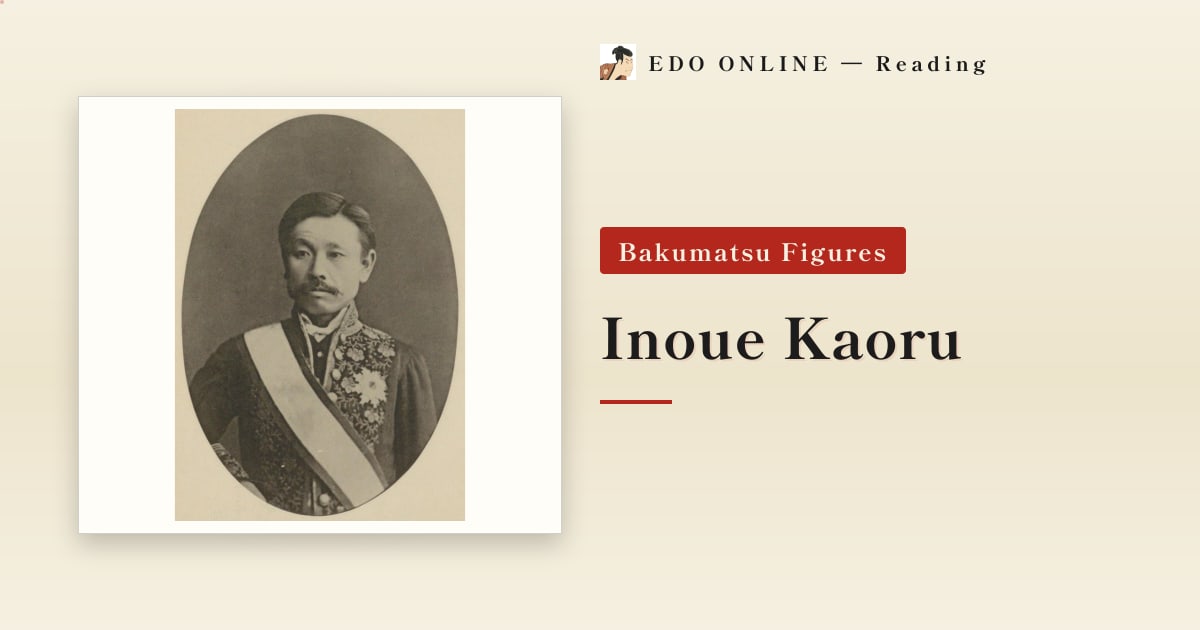
A man is said to have been stitched back together with more than fifty passes of a tatami-maker's needle — and to have survived it. His name was Inoue Kaoru, and he became Japan's first foreign minister.
Contents
Who Was Inoue Kaoru?
Inoue was a Choshu samurai who rose to the centre of the Meiji government. In his younger years he went by Inoue Monta.
His career divides three ways.
A student smuggled abroad. A young man shouting for the expulsion of foreigners went secretly to Britain, saw what the West actually was, and changed his mind on the spot.
A financier. He ran the practical side of Meiji state finance, and later moved deep into business.
Japan's first foreign minister. He took on revision of the unequal treaties and built the era of the Rokumeikan — and resigned when his method was attacked.
He was born in January 1836 and died in 1915.
Inoue Kaoru and the Choshu Five
In 1862 Monta joined Takasugi Shinsaku, Ito Hirobumi and others in burning down the British legation under construction at Shinagawa. He was an expulsionist of the hardest kind.
The following year, some of those same men smuggled themselves to Britain: Inoue Monta, Ito Hirobumi, Inoue Masaru, Endo Kinsuke and Yamao Yozo — later known as the Choshu Five.
Leaving Japan was a capital offence at the time. They went anyway, on domain money, with a trading house arranging the passage. The stated purpose was to know the enemy.
In London they understood, completely, that expelling the foreigners was not possible. The number of warships, the scale of the factories, the railways and docks — the entire premise collapsed.
Inoue Kaoru's Race Home
In 1864 word reached them: Choshu was about to fight a Western fleet.
Inoue and Ito abandoned their studies and sailed home to argue that the war was unwinnable and the only route was to open up and build strength.
The domain would not listen. A four-nation fleet bombarded Shimonoseki and Choshu was crushed.
And immediately afterwards, Inoue was cut down.
In October 1864 conservatives inside his own domain ambushed him and left him with deep wounds across his body. The man who saved him was a physician named Tokoro Ikutaro, who — according to later accounts — washed the wounds with distilled spirit and closed them with more than fifty stitches using a tatami needle. The ambush and Tokoro's intervention are documented; the stitch count and similar details come down as anecdote.
Inoue recovered from that, joined Takasugi Shinsaku's uprising, and helped turn the domain's policy over.
Inoue Kaoru in the Meiji Government
After the Restoration Inoue took charge of finance in practice, controlling the budget as the ministry's number two.
In 1873 he resigned in protest at expanding expenditure. Around the same time he was suspected of self-dealing in a mining concession — the Osarizawa copper mine affair — and pursued by Eto Shinpei's justice ministry.
Out of government, he turned to business and founded a trading company. That firm became the nucleus of what is now Mitsui & Co. His association with Mitsui began there and lasted the rest of his life, which is why he was called "the Mitsui head clerk."
Inoue Kaoru, the Rokumeikan and Treaty Revision
When Ito Hirobumi formed Japan's first cabinet in 1885, Inoue became the first foreign minister.
The task was revising the unequal treaties signed at the end of the shogunate, which denied Japan control of its own tariffs and put foreign residents beyond Japanese courts.
Inoue's method was to make the West concede that Japan was a civilised nation on Western terms: Western buildings, Western dress, and balls for the diplomatic corps. This is the age of the Rokumeikan.
The substance of the negotiations undid him. The draft revision included appointing foreign judges to Japanese courts. When that leaked, the attacks came from inside and outside the government at once.
He resigned in 1887. The glitter of the Rokumeikan has been criticised ever since as westernisation that never went below the surface.
What Inoue Kaoru Was Like
Inoue was famous for his temper — shouting, banging tables, tearing strips off subordinates. He was known as "the thunder old man."
His friendship with Ito Hirobumi, on the other hand, never broke. From the smuggling ship to the first cabinet to their years as elder statesmen behind the government, the two worked as a pair. Inoue is said to have been badly shaken by Ito's assassination.
Money and appointments, rather than the front of the stage, were where Inoue was strongest. Long after leaving high office he continued to shape cabinets from behind as one of the genro.
How Inoue Kaoru Died
He died in September 1915 at his villa in Okitsu, Shizuoka, aged seventy-nine.
The young man who burned a legation ended as the minister who negotiated with the West, and lived into the twentieth century.
Inoue Kaoru Timeline
| Year | Event |
|---|---|
| Jan 1836 | Born into a Choshu samurai family |
| 1862 | Burns the British legation with Takasugi Shinsaku and others |
| 1863 | Smuggled to Britain as one of the Choshu Five |
| 1864 | Returns with Ito Hirobumi to stop the war, and fails |
| Oct 1864 | Nearly killed by domain conservatives; survives after being stitched with a tatami needle |
| early 1870s | Runs Meiji state finance, then resigns for business |
| 1885 | Becomes Japan's first foreign minister |
| 1887 | Resigns over the treaty revision draft |
| 1890s–1900s | Home minister, finance minister, and elder statesman |
| 1915 | Dies, aged 79 |
For his lifelong ally see Ito Hirobumi; for the justice minister who investigated him, Eto Shinpei.
Related reading
Abe Juro — The Former Member Who Talked
He deserted the Shinsengumi and rejoined under another name, shot at Kondo Isami as one of the Goryō Eji, and then grew apples in Sapporo. His late-Meiji testimony is where the ranking of the corps' best swordsmen comes from.
Ando Hayataro — The Shinsengumi's Record-Breaking Archer
He set the standing national record in the long-range shooting at the Tōdai-ji Great Buddha Hall, sending 8,685 arrows the length of the corridor. Nearly fifty, he joined the Shinsengumi and died of wounds taken in the back garden of the Ikedaya.
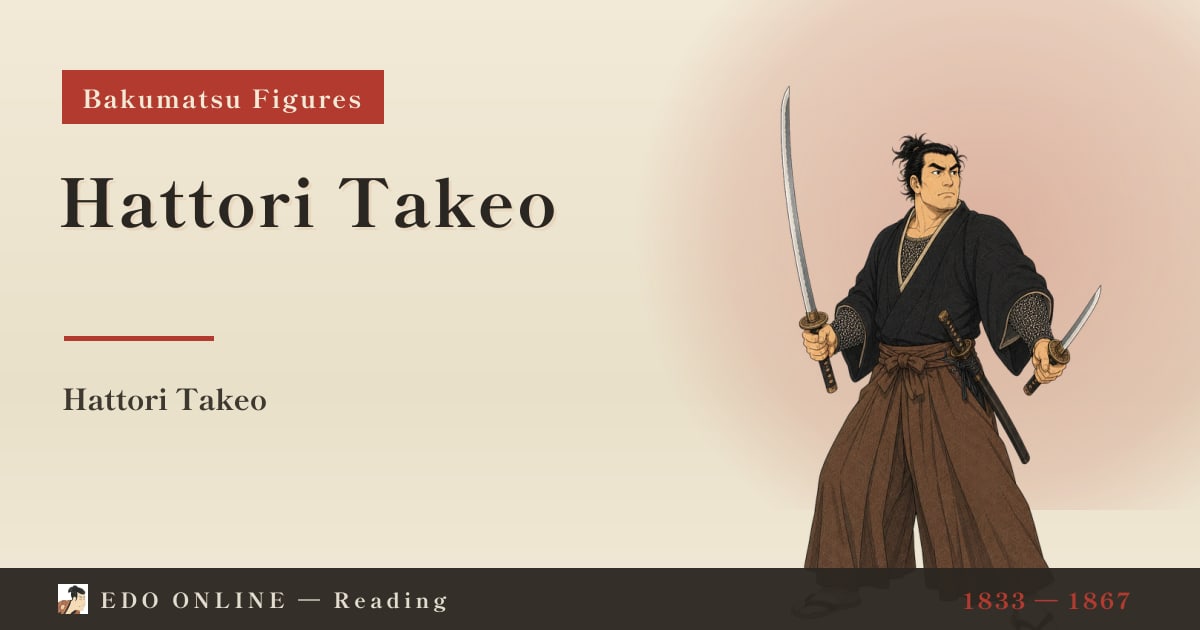
Hattori Takeo — Two Swords at Aburanokoji
A two-sword master and fencing instructor of the Shinsengumi who defected with the Goryō Eji. At Aburanokōji he alone wore mail, held a wall against the whole corps, and fell with more than twenty wounds.