
Saeki Matasaburo — Said to Be from Choshu, and Killed at Shimabara
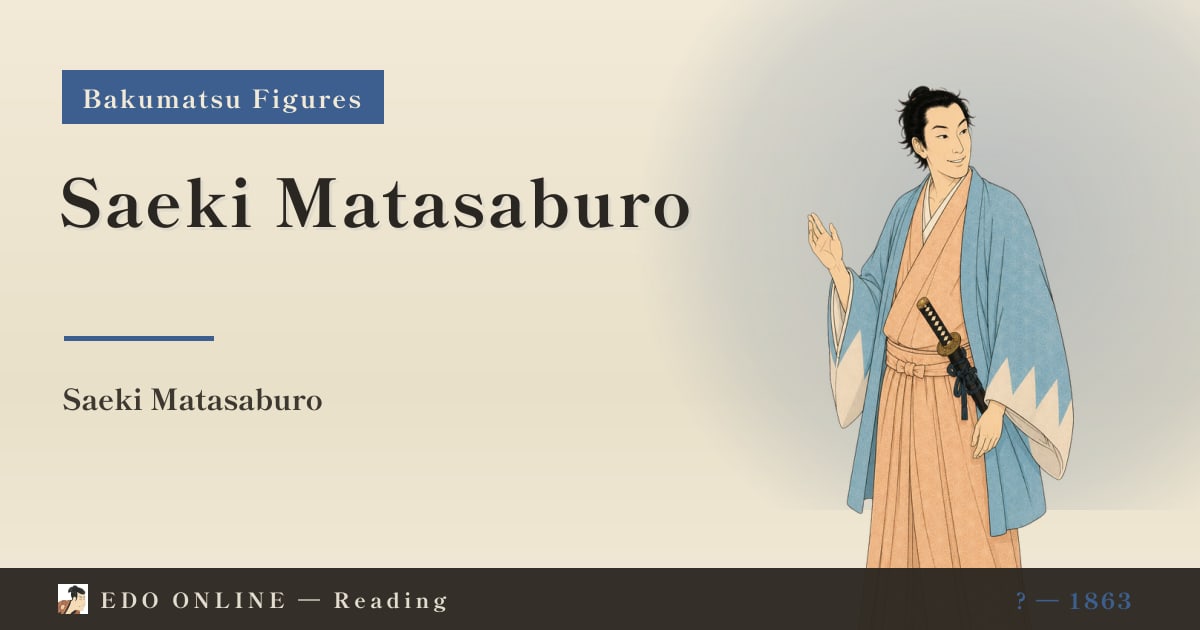
A man said to be from Chōshū served as an assistant vice-commander of the Mibu Rōshi. Saeki Matasaburō. He was killed at Shimabara.
Contents
Who Was Saeki Matasaburo?
Saeki was an assistant vice-commander in the Mibu Rōshi period.
His birth year is unknown. On 22 September 1863 he was killed at Shimabara in Kyoto by persons unknown.
He is said to have come from the Chōshū domain, and was a student of the bannerman Tamon Sōjirō Masafumi, who had himself studied the Tamiya school under Kubota Sugane. The Aizu retainer Honda Shirō's notes, however, list him as "of Edo" — residence and origin need keeping apart here.
One record is worth noting. Saeki's name appears, dated 6 April 1859, in the pledge roll of Yoshida Shoin's students of military science. Whether that man and the Mibu Rōshi's Saeki are the same person is not established.
Saeki Matasaburo's Position
He is said to have joined the Mibu Rōshi together with Saito Hajime.
That places him with neither the Shieikan men who came from Edo nor the Serizawa men who came from Mito, but with those recruited in Kyoto.
He demonstrated fencing against Hirayama Goro before Matsudaira Katamori — evidence that he held the senior post of assistant vice-commander.
And he moved with Serizawa Kamo's faction.
The Accounts of Saeki Matasaburo's Death
They fall into two families.
One holds that Serizawa Kamo killed him. The reasons offered: that his spying was discovered; that he stole Serizawa's belongings; that he had killed Sasaki Aijirō. One version adds that he raped Aijirō's mistress, and that Serizawa, who wanted her, killed him for it.
The other holds that Chōshū men killed him. Either set upon by several Chōshū samurai at Shimabara and beaten to death, or executed for a lapse in his work as an informer, or for being exposed as a double agent.
There is also an account that he was originally an agent of Kusaka Genzui planted in the Mibu Rōshi, stopped passing information out of negligence, settled into the corps in earnest, and was killed by Kusaka for it.
None of this is settled.
How to Read the Informer Theory
That Saeki is described as coming from Chōshū is documented, as is the appearance of the name among Yoshida Shoin's students.
But the identification of those two men is itself unsettled, so getting from there to "he was an informer" is inference on inference.
Informers did exist, however. Chōshū planted men such as Kusunoki Kojūrō in the Shinsengumi, who were found and killed; conversely Saito Hajime was sent into the Goryō Eji as one. People were burrowing in both directions.
Within that, an assistant vice-commander reported as Chōshū-born, attached to the Serizawa faction and killed at Shimabara, is a set of ingredients later writers were bound to build a story from.
What can be said with confidence is that he was a senior officer, that he is described as coming from Chōshū, and that somebody killed him.
Frequently asked questions
Who was Saeki Matasaburo?
An assistant vice-commander in the Mibu Rōshi period of what became the Shinsengumi. Said to be from Chōshū, he is reported to have joined in Kyoto alongside Saito Hajime.
Was Saeki Matasaburo a Choshu informer?
Unestablished. He is described as Chōshū-born and the name appears among Yoshida Shoin's students, but even that identification is unsettled, and the informer reading is inference.
Who killed Saeki Matasaburo?
Unknown. One family of accounts blames Serizawa Kamo, the other Chōshū samurai at Shimabara.
When did Saeki Matasaburo die?
On 22 September 1863, at Shimabara in Kyoto. His birth year is unknown, so his age at death cannot be given.
Saeki Matasaburo Timeline
| Year | Event |
|---|---|
| Birth unknown | Said to have been born in the Chōshū domain |
| Apr 1859 | His name appears in Yoshida Shoin's pledge roll for military science |
| Edo years | Becomes a student of the bannerman Tamon Sōjirō Masafumi |
| 1863 | Joins the Mibu Rōshi with Saito Hajime; becomes assistant vice-commander |
| May 1863 | Demonstrates fencing against Hirayama Goro before Matsudaira Katamori |
| 22 Sep 1863 | Killed at Shimabara in Kyoto |
For the man he joined with see Saito Hajime; for his faction, Serizawa Kamo and Hirayama Goro; for the roster, the Shinsengumi members; for the corps, the Shinsengumi.
Related reading
Abe Juro — The Former Member Who Talked
He deserted the Shinsengumi and rejoined under another name, shot at Kondo Isami as one of the Goryō Eji, and then grew apples in Sapporo. His late-Meiji testimony is where the ranking of the corps' best swordsmen comes from.
Ando Hayataro — The Shinsengumi's Record-Breaking Archer
He set the standing national record in the long-range shooting at the Tōdai-ji Great Buddha Hall, sending 8,685 arrows the length of the corridor. Nearly fifty, he joined the Shinsengumi and died of wounds taken in the back garden of the Ikedaya.
Hattori Takeo — Two Swords at Aburanokoji
A two-sword master and fencing instructor of the Shinsengumi who defected with the Goryō Eji. At Aburanokōji he alone wore mail, held a wall against the whole corps, and fell with more than twenty wounds.