Kondo Chojiro — The Confectioner's Son Behind the Satsuma–Choshu Alliance
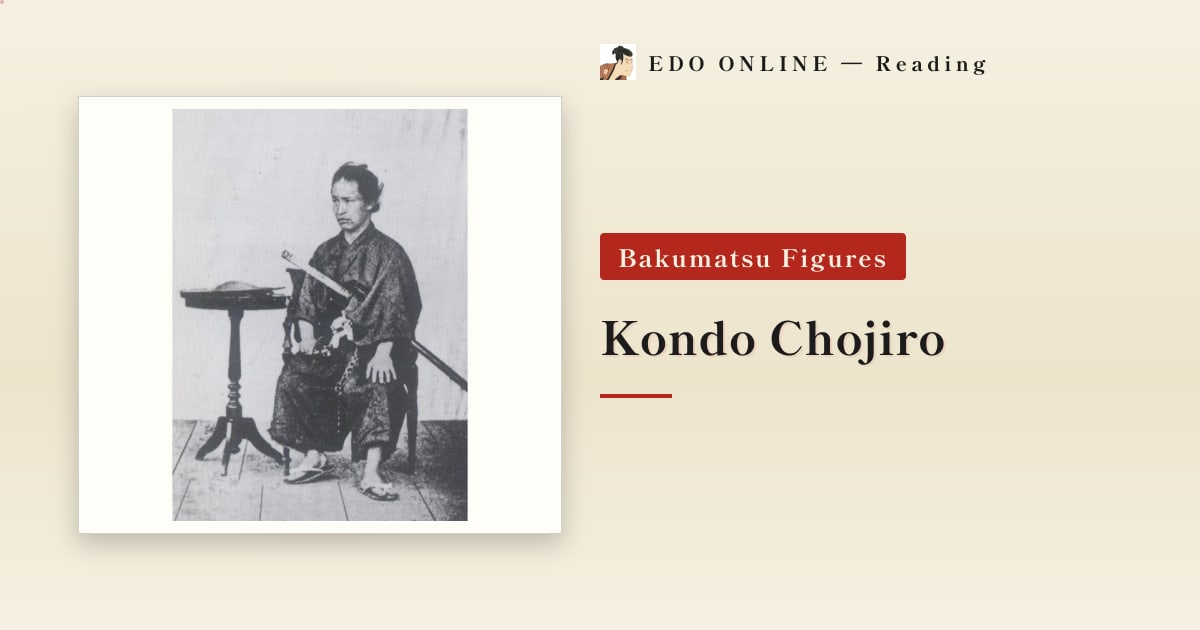
One man built the trust between Satsuma and Choshu by closing a deal for a ship and several thousand rifles. His name was Kondo Chojiro, and he was a Tosa confectioner's son. Seven days before the alliance was signed, his own comrades required him to disembowel himself.
Contents
Who Was Kondo Chojiro?
Chojiro was a Tosa commoner and a comrade of Sakamoto Ryoma. He was known as "Chojiro the sweet-shop man."
He did two things.
He ran the operations of the Kameyama Shachu, the Nagasaki venture Ryoma's men founded — sometimes called Japan's first trading company — where Chojiro handled the negotiating and the practical work.
He bought ships and weapons for Choshu. Choshu, branded an enemy of the court, could buy nothing; Chojiro acquired a steamship and rifles under Satsuma's name and passed them on. That transaction built a record of delivered promises between the two domains, and carried them toward alliance.
He was born in 1838 and died in 1866, aged twenty-seven.
Kondo Chojiro's Origins as a Commoner's Son
Chojiro was born in the castle town of Kochi into a family of rice-cake confectioners. Not samurai.
For a commoner's son, making a career out of learning was close to impossible. He studied anyway, and got himself into the circle of Kawada Shoryo, a Tosa intellectual — the man who had taken down John Manjiro's account of America directly from him.
Eventually the domain granted him samurai status and permission to go to Edo. He entered Katsu Kaishu's school and studied navigation at the naval academy at Kobe.
A sweet-maker's son had become a student of the shogunate's naval commissioner.
Kondo Chojiro and the Kameyama Shachu
In 1864 the shogunate closed the Kobe academy. Satsuma took in Ryoma's now-homeless group.
In 1865 they founded the Kameyama Shachu at Nagasaki, a shipping and trading concern that would later become the Kaientai. Masterless men, belonging to no domain, trying to support themselves by commerce — a strange proposition for the time.
Chojiro sat at the operational centre of it.
Kondo Chojiro and the Union
Then came the job that mattered.
Choshu had been declared an enemy of the court and could not buy weapons from foreign merchants. Satsuma was under no such restriction.
So Satsuma would buy, and Choshu would receive.
Chojiro handled the Nagasaki end, and closed on the steamship Union and several thousand rifles, dealing with the foreign traders in Nagasaki including Thomas Glover.
Guns and a ship physically arriving in Choshu is what dissolved the distrust between the two domains. The six-article Satsuma–Choshu agreement was concluded on 7 March 1866.
The alliance was not the product of that transaction alone — it also needed the brokering of Sakamoto Ryoma and Nakaoka Shintaro, and the political and military position of each domain. But the goods moved before the promises did, and Chojiro moved them.
Why Kondo Chojiro Was Made to Kill Himself
Chojiro never saw the alliance concluded.
He committed seppuku in Nagasaki on 28 February 1866 — seven days before the agreement.
The stated reason was an attempt to go to Britain to study, alone. The company's rules forbade acting on one's own account. Using credit and access earned in the company's name for a private passage was judged a breach of them.
He was twenty-seven.
Sakamoto Ryoma was not in Nagasaki. He is said to have grieved bitterly on returning — though that account was recorded later, and the wording varies between versions.
There is a reading that his origins were a factor in the severity of the outcome. Whether a commoner's son was ever fully the equal of his samurai-born comrades is not a question the sources can settle.
Kondo Chojiro's Grave
He is buried at Kotai-ji in Nagasaki. Ryoma is said to have written the inscription.
Kochi also has a memorial to him — his name kept in the town where the sweet shop was.
Kondo Chojiro Timeline
| Year | Event |
|---|---|
| 1838 | Born to a confectioner's family in Kochi |
| 1850s | Studies under Kawada Shoryo; granted samurai status by the domain |
| early 1860s | Joins Katsu Kaishu's school and the Kobe naval academy |
| 1865 | Helps found the Kameyama Shachu in Nagasaki |
| 1865 | Buys the steamship Union and rifles under Satsuma's name for Choshu |
| 28 Feb 1866 | Commits seppuku in Nagasaki, aged 27 |
| 7 Mar 1866 | Seven days later, the six-article Satsuma–Choshu agreement is concluded |
For his comrade see Sakamoto Ryoma; for the merchant on the other side of the deal, Thomas Glover.
Related reading
Abe Juro — The Former Member Who Talked
He deserted the Shinsengumi and rejoined under another name, shot at Kondo Isami as one of the Goryō Eji, and then grew apples in Sapporo. His late-Meiji testimony is where the ranking of the corps' best swordsmen comes from.
Ando Hayataro — The Shinsengumi's Record-Breaking Archer
He set the standing national record in the long-range shooting at the Tōdai-ji Great Buddha Hall, sending 8,685 arrows the length of the corridor. Nearly fifty, he joined the Shinsengumi and died of wounds taken in the back garden of the Ikedaya.
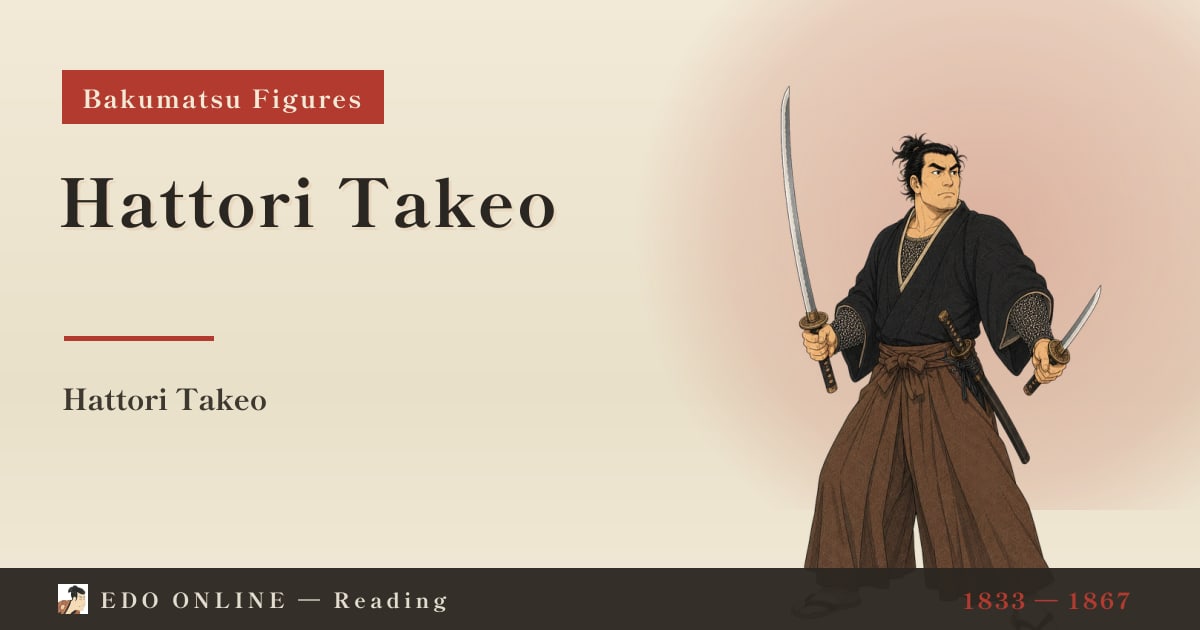
Hattori Takeo — Two Swords at Aburanokoji
A two-sword master and fencing instructor of the Shinsengumi who defected with the Goryō Eji. At Aburanokōji he alone wore mail, held a wall against the whole corps, and fell with more than twenty wounds.