John Manjiro — The Shipwrecked Fisherman Who Learned America
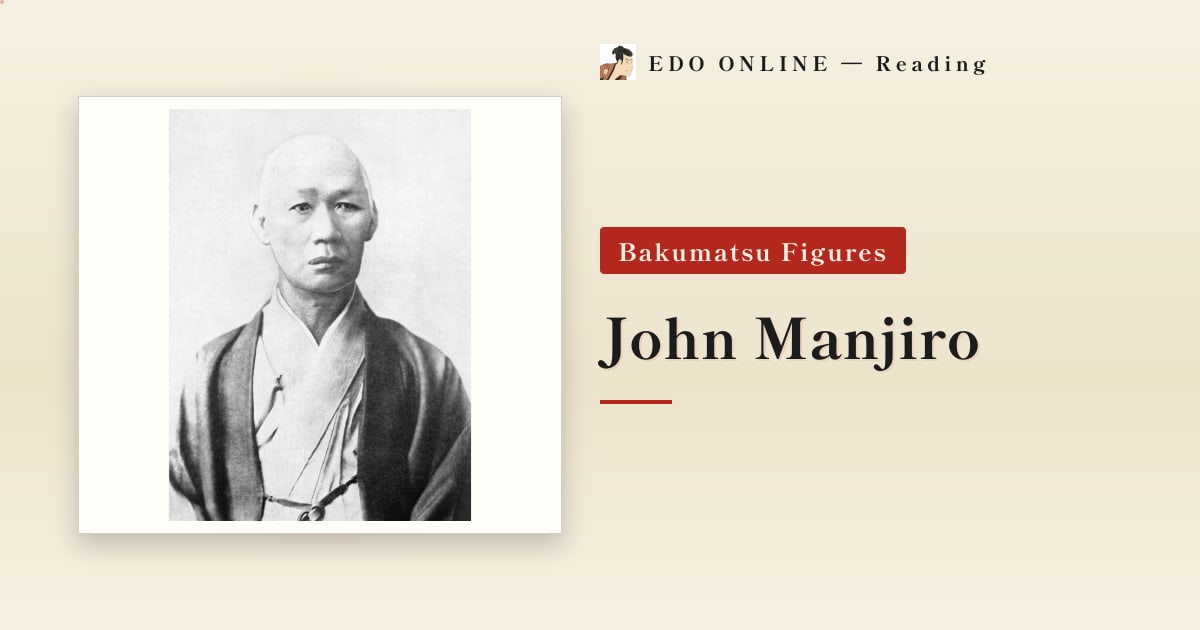
Twelve years before the Black Ships arrived, a Japanese teenager was already sitting in an American classroom. He was the son of a fisherman from Tosa, and the world would come to know him as John Manjiro.
Contents
Who Was John Manjiro?
He was one of the very few Japanese of his generation educated on the American mainland who could describe that society from the inside. Hamada Hikozo, later known as Joseph Heco, followed a comparable path; the category is small either way.
Manjiro reached the United States by shipwreck, not by choice. He studied English, mathematics, surveying, navigation, and shipbuilding there. When he finally returned home, that knowledge made him valuable enough to be raised from castaway to samurai, and then to direct retainer of the shogunate. When Perry's arrival forced Japan to decide what to do about the outside world, Manjiro was among the very few who could describe that world firsthand.
In a society organized around inherited rank, this trajectory was close to unthinkable.
John Manjiro's Shipwreck and 143 Days on Torishima
In 1841, fourteen-year-old Manjiro went out fishing with four companions. A storm carried them far off course, and they came ashore on Torishima, an uninhabited volcanic island south of the Izu chain.
There was almost no fresh water and almost no food. The five survived for 143 days, catching albatross and collecting what rain they could.
Then the American whaler John Howland passed within sight. Her captain, William Whitfield, took all five aboard. The name "John Manjiro" comes from that ship.
John Manjiro's Ten Years in America
The others left the ship in Hawaii. Manjiro alone continued with Whitfield to the American mainland, to Fairhaven, Massachusetts — a town built on whaling.
Whitfield took the boy into his own household and sent him to school. At the Bartlett Academy Manjiro studied navigation, surveying, and shipbuilding, and by all accounts did well. He was among the first Japanese to receive a formal American education.
Afterward he shipped out on whalers and saw much of the world. According to later biographical accounts, he earned enough respect from his crewmates to be chosen by their vote as a senior officer of the vessel.
To fund his passage home, he went to work in the California goldfields during the rush.
John Manjiro's Return to a Closed Country
In 1851 Manjiro landed in the Ryukyus. Japan was still closed, and a returning castaway with ten years abroad was an object of suspicion. He was questioned at length, passed through Satsuma and Nagasaki, and reached Tosa only the following year.
But the interrogations themselves produced something valuable: a detailed account of the outside world. Tosa domain granted him samurai status and made him an instructor at the domain school. The painter Kawada Shoryo recorded his testimony in a work titled Hyoson Kiryaku, which circulated among Tosa men as a window onto the West.
Some accounts connect this stream of knowledge to Sakamoto Ryoma, who would later stake his career on ships and the sea. It should be said plainly, though, that no reliable record shows Manjiro and Ryoma speaking together directly.
The year after Perry's arrival, the shogunate summoned Manjiro to Edo and enrolled him among its own retainers. He was given the surname Nakahama, after his home village. A fisherman's son had become a servant of the shogun.
Manjiro's English
Manjiro learned English on deck and in a New England household, not from a grammar book. The result was blunt, spoken, and accurate to the ear.
His Eibei Taiwa Shokei is regarded as one of the first English conversation manuals written by a Japanese author. Its distinguishing feature is phonetic: he transcribed English sounds as he actually heard them in katakana, rather than deriving them from spelling.
It was not scholar's English. It was English that worked — exactly what Japan needed in the years immediately after opening.
John Manjiro, the Kanrin Maru and His Later Life
In 1860 a shogunal embassy sailed for the United States. Manjiro joined the escort vessel Kanrin Maru as interpreter and technical advisor. Also aboard were Katsu Kaishu and Fukuzawa Yukichi.
The crossing was rough, and only a portion of the crew was able to work the ship. Manjiro's practical knowledge of Pacific navigation was one of the things that carried the voyage through.
In the Meiji years he taught at the Kaisei School, a forerunner of the University of Tokyo. Traveling to Europe to observe the Franco-Prussian War, he made a point of stopping in America to see Captain Whitfield again.
Illness slowed his final years, and he died in Tokyo in 1898 at the age of seventy-one. He is buried in Zoshigaya Cemetery.
John Manjiro's Descendants
Manjiro's line continued. His eldest son, Nakahama Toichiro, became a physician, and later generations of the family have worked to preserve and publish his record.
The remarkable part is that the friendship between the Whitfield and Nakahama families has been kept up across generations. The descendants of the captain who pulled a boy off a barren island and the descendants of that boy have gone on visiting one another for more than a century and a half.
The connection is civic as well as personal: Tosashimizu in Kochi Prefecture, where Manjiro was born, and Fairhaven, Massachusetts, where he went to school, are sister cities.
John Manjiro Timeline
| Year | Event |
|---|---|
| 1827 | Born to a fishing family in Nakanohama, Tosa Province (now Tosashimizu, Kochi) |
| 1841 | Shipwrecked; stranded on Torishima and rescued after 143 days |
| c. 1843 | Attends school in Fairhaven, Massachusetts |
| c. 1846 | Sails aboard whaling vessels |
| 1849 | Works the California goldfields to earn passage home |
| 1851 | Lands in the Ryukyus; reaches Tosa the following year after questioning |
| 1853 | Perry arrives; Manjiro is made a shogunal retainer the next year |
| 1860 | Crosses to America aboard the Kanrin Maru |
| 1870 | Travels to Europe; reunites with Whitfield en route |
| 1898 | Dies in Tokyo, aged 71 |
For more on the era that made his knowledge suddenly indispensable, see the arrival of the Black Ships and our Bakumatsu figures collection.
Related reading
Abe Juro — The Former Member Who Talked
He deserted the Shinsengumi and rejoined under another name, shot at Kondo Isami as one of the Goryō Eji, and then grew apples in Sapporo. His late-Meiji testimony is where the ranking of the corps' best swordsmen comes from.
Ando Hayataro — The Shinsengumi's Record-Breaking Archer
He set the standing national record in the long-range shooting at the Tōdai-ji Great Buddha Hall, sending 8,685 arrows the length of the corridor. Nearly fifty, he joined the Shinsengumi and died of wounds taken in the back garden of the Ikedaya.
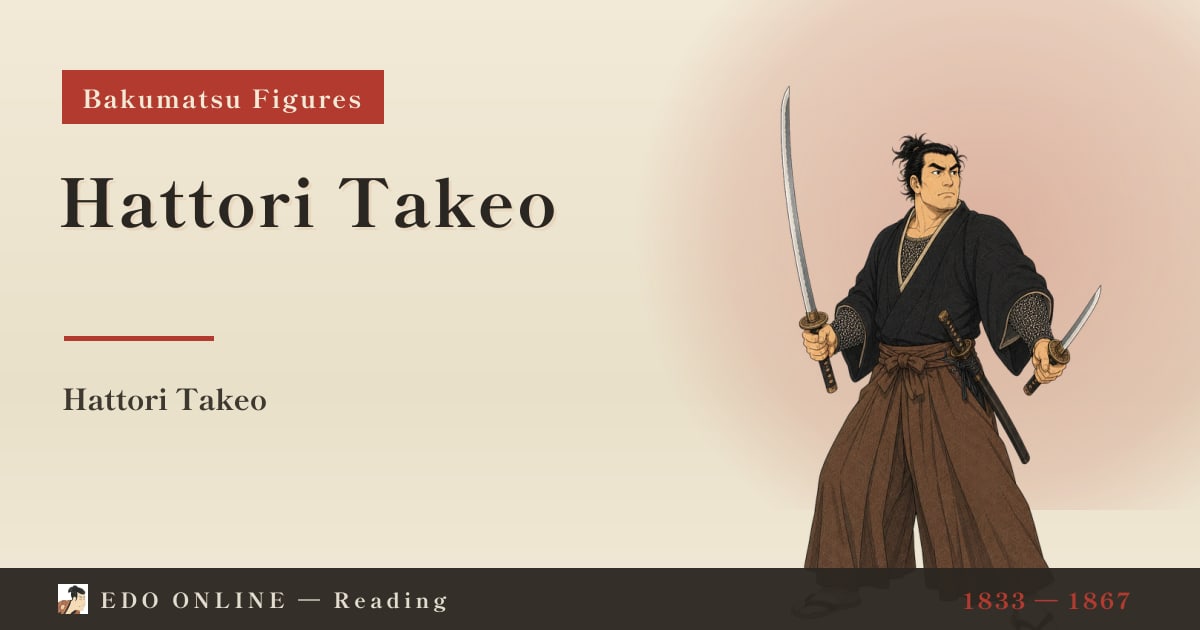
Hattori Takeo — Two Swords at Aburanokoji
A two-sword master and fencing instructor of the Shinsengumi who defected with the Goryō Eji. At Aburanokōji he alone wore mail, held a wall against the whole corps, and fell with more than twenty wounds.