Princess Kazunomiya — The Imperial Bride Sent to the Shogun
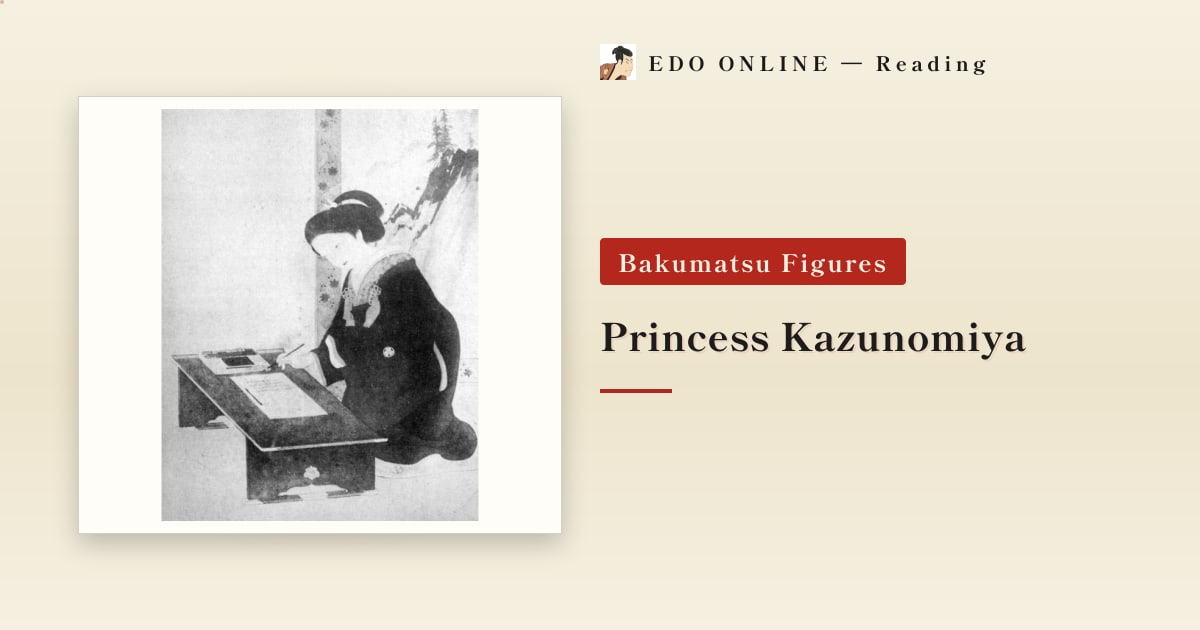
An imperial princess with a fiancé was married off to a shogun for reasons of state. Her name was Kazunomiya — and she spent the rest of her life defending the house she had been sent into.
Contents
Who Was Kazunomiya?
Kazunomiya was the eighth daughter of Emperor Ninko. Her formal name was Princess Chikako; after taking the tonsure she was known as Seikan'in-no-miya.
Her life has three chapters.
A symbol of court–shogunate union. She was married to the fourteenth shogun, Tokugawa Iemochi, to bind the imperial court to the shogunate — a political marriage in the purest sense.
Iemochi's wife. By most accounts the marriage itself was a happy one. It lasted a few years.
The protector of the Tokugawa. During the Boshin War she petitioned her own family, the imperial court, to spare the Tokugawa house, and helped bring about the surrender of Edo Castle without a battle.
She was born in 1846 and died in 1877.
Kazunomiya's Marriage as Policy
Kazunomiya had been betrothed to Prince Arisugawa Taruhito since 1851, when she was six by the traditional Japanese count — five in Western years.
Then the assassination of its chief minister left the shogunate scrambling to restore its authority. The answer it reached for was kobu gattai — a visible demonstration that court and shogunate stood together.
The most legible form of that was sending an imperial princess to marry the shogun.
She refused, hard. A princess who had never left Kyoto was being asked to break her engagement and travel to Edo. Negotiations between court and shogunate went on regardless, and she eventually consented — on the condition that the shogunate commit to expelling the foreigners.
In 1861 she travelled down the Nakasendo highway to Edo. The procession ran for tens of kilometres, and post stations along the route turned out in full to handle it. She and Iemochi were married in Edo Castle in 1862.
Kazunomiya's Years With Tokugawa Iemochi
For a match arranged this way, it went unusually well.
The two were close in age. There was friction between the Kyoto etiquette Kazunomiya insisted on and the customs of the shogun's inner palace, but the couple themselves are described as devoted.
Iemochi went west to Osaka for the campaign against Choshu. In 1866 he died in Osaka Castle.
What reached Kazunomiya was the bolt of Nishijin silk she had asked him to bring back — a souvenir that arrived as an effect of the dead. The story is widely told, though it comes down as anecdote, and the details vary between tellings.
After his death she took the tonsure and became Seikan'in-no-miya.
Kazunomiya and the Surrender of Edo Castle
In 1868 the Boshin War began. The new government's army moved east, and a date was set for the assault on Edo Castle.
Kazunomiya took the Tokugawa side.
She petitioned the court repeatedly for the survival of the Tokugawa house and for Yoshinobu's life to be spared. An imperial princess was not easy for the new government to ignore. Tenshoin Atsuhime, widow of the thirteenth shogun Tokugawa Iesada and a Satsuma woman by birth, worked the same problem from her own side.
Edo Castle was handed over without a shot. The meeting between Katsu Kaishu and Saigo Takamori is the part usually told — the groundwork with the court was Kazunomiya's.
There is a further turn: the commander of the eastern expedition was Prince Arisugawa Taruhito, the man she had once been engaged to.
Kazunomiya's Death and Grave
After the Restoration she lived in Tokyo, keeping up contact with the Tokugawa household.
She died in September 1877, while convalescing at Hakone, aged thirty-one.
By her own wish she was buried at Zojo-ji in Shiba, beside Iemochi. She did not return to Kyoto, and she did not return to Prince Arisugawa. She chose the place next to her husband.
The Photograph Found in Kazunomiya's Coffin
In 1958 the Tokugawa graves at Zojo-ji were relocated, and the remains were examined by a scholarly team.
A wet-plate photograph is reported to have been found in Kazunomiya's coffin. It showed a young man. It is thought to be Iemochi, though that has never been established.
And according to the report, the image faded away after it was removed. A wet-plate print whose fixing was incomplete will lose its image on exposure to light.
What exactly she had asked to be buried with, after thirty-one years, is now beyond checking.
Kazunomiya Timeline
| Year | Event |
|---|---|
| 1846 | Born, eighth daughter of Emperor Ninko |
| 1851 | Betrothed to Prince Arisugawa Taruhito, aged five |
| 1861 | Travels the Nakasendo to Edo under the kobu gattai policy |
| 1862 | Marries the fourteenth shogun, Tokugawa Iemochi |
| 1866 | Iemochi dies at Osaka Castle; she takes the tonsure as Seikan'in-no-miya |
| 1868 | Petitions the court for the Tokugawa house during the Boshin War |
| 1877 | Dies at Hakone, aged 31; buried at Zojo-ji beside Iemochi |
For her husband see Tokugawa Iemochi; for the negotiation that saved the city, Katsu Kaishu.
Related reading
Abe Juro — The Former Member Who Talked
He deserted the Shinsengumi and rejoined under another name, shot at Kondo Isami as one of the Goryō Eji, and then grew apples in Sapporo. His late-Meiji testimony is where the ranking of the corps' best swordsmen comes from.
Ando Hayataro — The Shinsengumi's Record-Breaking Archer
He set the standing national record in the long-range shooting at the Tōdai-ji Great Buddha Hall, sending 8,685 arrows the length of the corridor. Nearly fifty, he joined the Shinsengumi and died of wounds taken in the back garden of the Ikedaya.
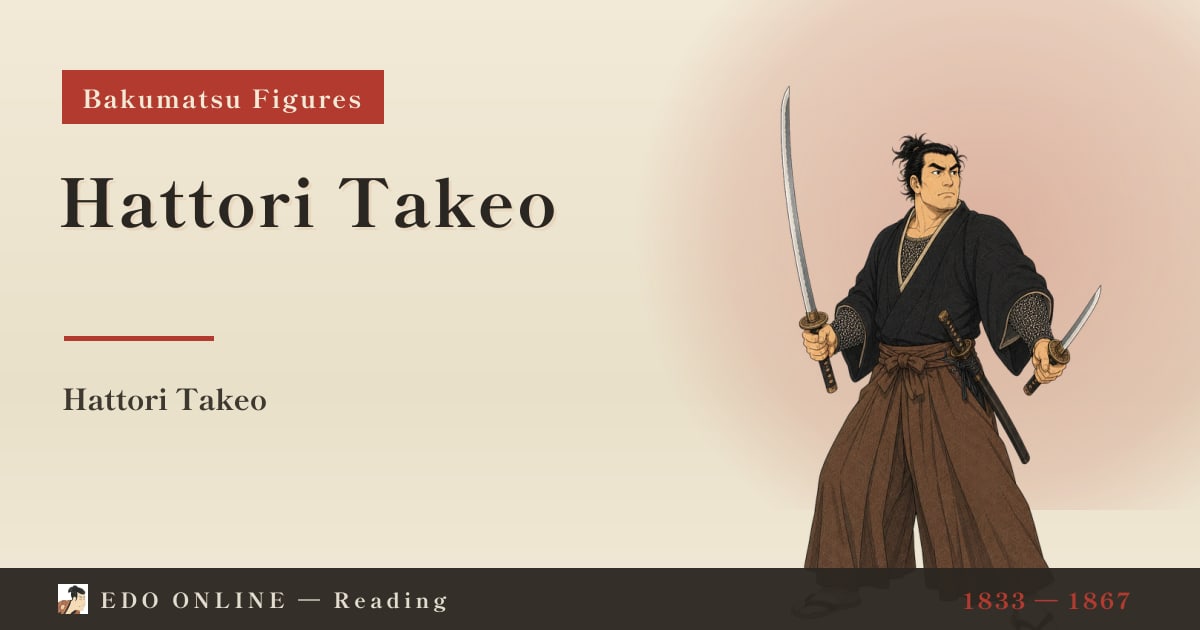
Hattori Takeo — Two Swords at Aburanokoji
A two-sword master and fencing instructor of the Shinsengumi who defected with the Goryō Eji. At Aburanokōji he alone wore mail, held a wall against the whole corps, and fell with more than twenty wounds.