Abe Masahiro — The Man in Charge When the Black Ships Came
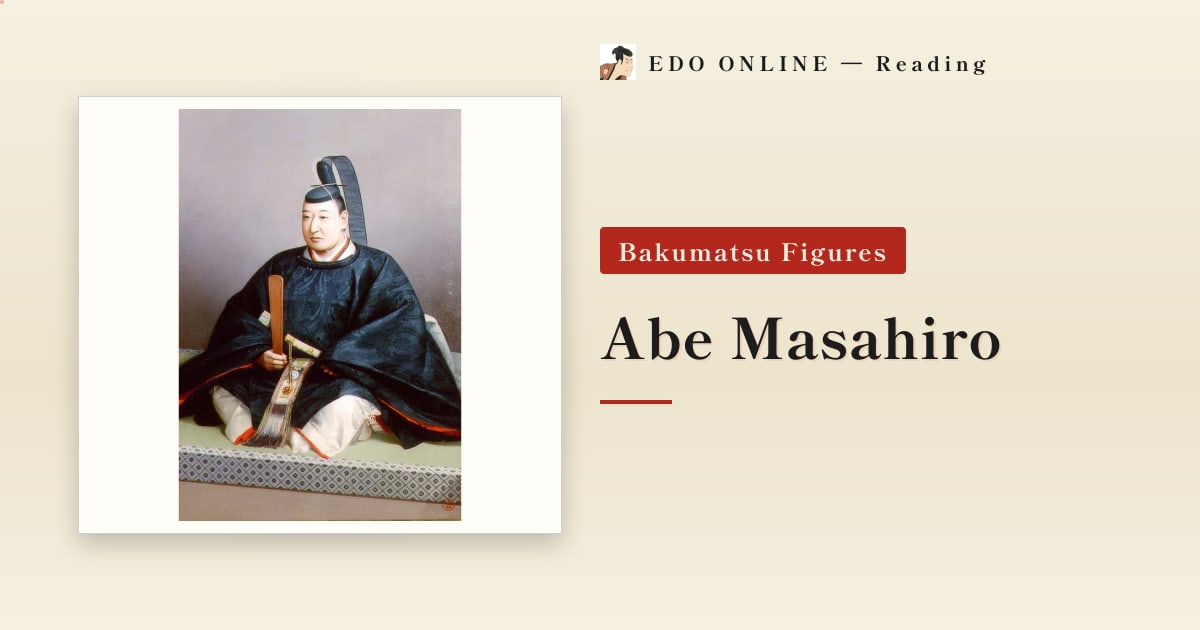
When the Black Ships arrived, this was the man in charge. Abe Masahiro, chief senior councillor of the shogunate — and he broke precedent by asking the daimyo what they thought.
Contents
Who Was Abe Masahiro?
Abe was lord of the Bingo Fukuyama domain, in present-day Hiroshima Prefecture, and rojū shuza — chief senior councillor, the top executive office of the Tokugawa shogunate.
Three things define his tenure.
He handled the arrival of the Black Ships. Following Perry's arrival he led the conclusion of the Treaty of Kanagawa.
He changed how decisions were made. He circulated the American president's letter to daimyo, shogunal officials and scholars, and asked for their opinions — extraordinary in a system whose premise was that the shogunate decided alone.
He promoted talent regardless of rank. Katsu Kaishu and others who would shape the following decade were raised up in this period.
He was born in 1819 and died in 1857, aged thirty-seven.
Why Abe Masahiro Became Chief Councillor in His Twenties
Abe entered the council in 1843 and became chief senior councillor in 1845.
He was twenty-five.
Even for the head of a hereditary vassal house, that was remarkably young for the shogunate's highest office. He then spent the twelve years remaining to him at the centre of national government. The opening of the Bakumatsu period was this young councillor's era.
Why Abe Masahiro Polled the Daimyo After the Black Ships
In July 1853 Perry's American squadron anchored off Uraga — the Black Ships.
What Abe did next departed from everything the shogunate normally did.
He had the president's letter translated, circulated it to daimyo, shogunal retainers and scholars, and solicited their views.
There was no precedent. In principle, foreign policy and national policy were the shogunate's to decide. Asking the daimyo amounted to conceding that the shogunate could not decide alone.
That consultation reshaped the politics of the following fifteen years. It opened a route for domains to speak on national questions, and made the imperial court's wishes impossible to ignore. The erosion of the shogunate's monopoly begins here.
Abe's intent was to carry a hard decision on the broadest possible base of support. The door he opened never closed again.
Abe Masahiro and the Treaty of Kanagawa
Perry returned in 1854 with a larger fleet.
After negotiations at Yokohama village, the Treaty of Kanagawa was concluded under Abe. It opened Shimoda and Hakodate, provided for the rescue of castaways, and allowed American ships to take on wood, water and provisions.
Japan's closed country ended there.
Trade was not part of it. That came with the commercial treaty a few years later, whose signature led directly to the Ansei Purge.
The Men Abe Masahiro Promoted
Much of Abe's reputation rests on whom he promoted.
Katsu Kaishu was one. Katsu was a low-ranking retainer with no prospects when he submitted a memorandum on coastal defence, and it reached Abe. Abe hired on content rather than rank.
He built institutions to match. The Nagasaki Naval Training Centre put Dutch officers to work teaching navigation; the Kobusho trained martial and Western military skills; the Bansho Shirabesho translated Western books and studied Western learning. The Nagasaki centre produced Katsu Kaishu and Enomoto Takeaki.
He did the same at home, reorganising the Fukuyama domain school as the Seishikan and allowing people outside the domain's samurai class to attend lectures.
Before the argument over opening the country or expelling the foreigners was settled, Abe was already building the people and the institutions.
How Abe Masahiro Died, at Thirty-Seven
He died of illness in August 1857, aged thirty-seven.
The year after his death, Ii Naosuke became chief minister and the Ansei Purge began. Abe's method — canvass widely, build consensus — and Ii's — crush the opposition — were exact opposites.
What if Abe had lived another decade is a standing question in accounts of the period. It has no answer, but the people he promoted demonstrably carried the shogunate through what followed.
Abe Masahiro's Legacy in Fukuyama
He was buried at the Abe family temple.
Fukuyama honours him as its foremost local figure, with a statue in the city and a school that still carries the name of the academy he reformed — the name of a school that opened its lectures beyond the samurai class, still in use more than a hundred and seventy years later.
Abe Masahiro Timeline
| Year | Event |
|---|---|
| 1819 | Born into the ruling house of Bingo Fukuyama |
| 1843 | Appointed senior councillor |
| 1845 | Becomes chief senior councillor, aged 25 |
| 1853 | Perry arrives; Abe circulates the letter and solicits opinions |
| 1854 | Concludes the Treaty of Kanagawa |
| 1850s | Founds the Nagasaki Naval Training Centre, the Kobusho and the Bansho Shirabesho; reforms his domain school |
| 1857 | Dies of illness, aged 37 |
For the arrival itself see the Black Ships; for the man he promoted, Katsu Kaishu; for his opposite number a year later, Ii Naosuke.
Related reading
Abe Juro — The Former Member Who Talked
He deserted the Shinsengumi and rejoined under another name, shot at Kondo Isami as one of the Goryō Eji, and then grew apples in Sapporo. His late-Meiji testimony is where the ranking of the corps' best swordsmen comes from.
Ando Hayataro — The Shinsengumi's Record-Breaking Archer
He set the standing national record in the long-range shooting at the Tōdai-ji Great Buddha Hall, sending 8,685 arrows the length of the corridor. Nearly fifty, he joined the Shinsengumi and died of wounds taken in the back garden of the Ikedaya.
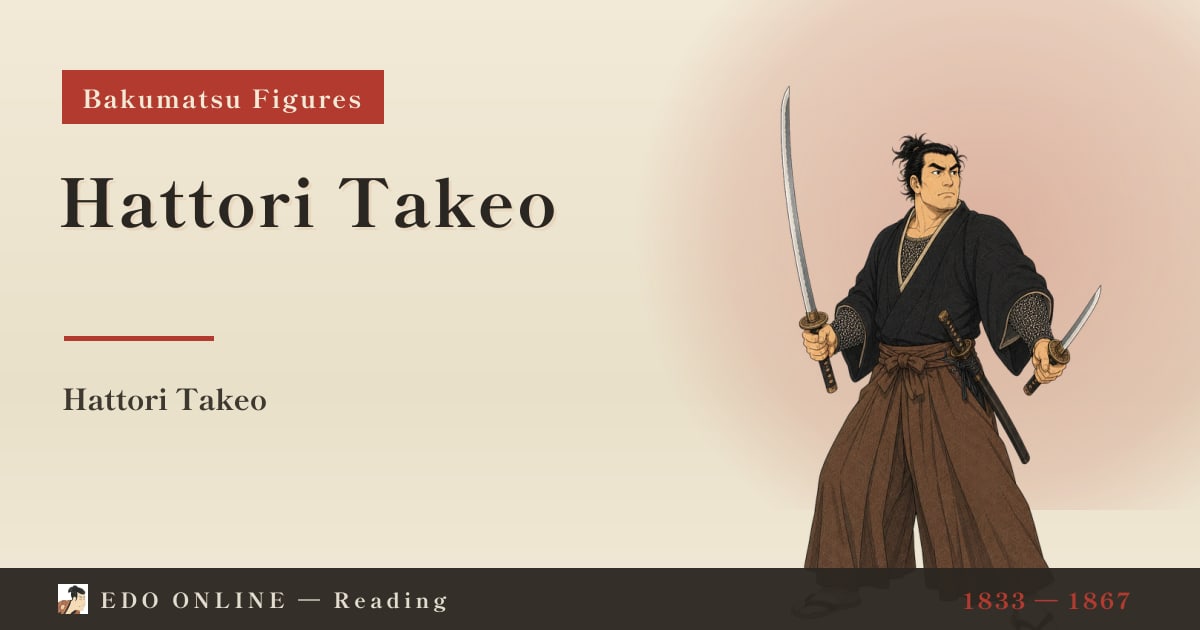
Hattori Takeo — Two Swords at Aburanokoji
A two-sword master and fencing instructor of the Shinsengumi who defected with the Goryō Eji. At Aburanokōji he alone wore mail, held a wall against the whole corps, and fell with more than twenty wounds.