
Townsend Harris — The Consul Who Negotiated Where Perry Had Threatened
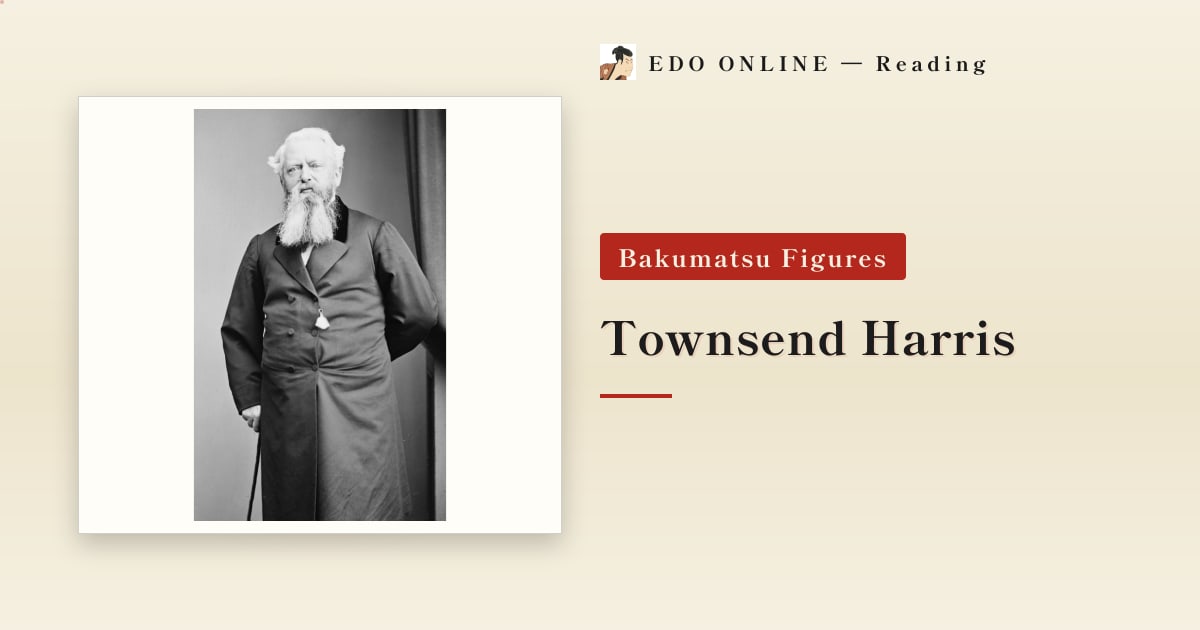
Perry opened the ports with warships. Harris moved into a temple and talked. Two Americans, two completely different operations.
Contents
Who Was Townsend Harris?
Townsend Harris was the first United States consul general to Japan.
What he did is easy to state: he negotiated the Treaty of Amity and Commerce, signed on 29 July 1858. It was a trade treaty, and it went well beyond the 1854 convention Perry had extracted — this was the opening of the country in earnest.
To get it he lived in a temple at Shimoda from 1856, with his interpreter and a few servants for company, and negotiated for close to two years.
He was born in New York State on 3 October 1804 and died in New York City on 25 February 1878, aged seventy-three.
Perry and Harris — the Difference
The two are constantly confused. Side by side, the division of labour is clear.
| Aspect | Perry | Harris |
|---|---|---|
| Role | Naval officer, commodore of the East India Squadron | Merchant turned diplomat, consul general |
| Arrival | 1853, returning 1854 | 1856 |
| Method | Pressure from a fleet | Resident negotiation |
| Treaty | Convention of Kanagawa, 1854 | Treaty of Amity and Commerce, 1858 |
| Content | Two ports opened, supplies for ships | Trade, further ports, extraterritoriality |
Perry forced the door; Harris walked in and sat down at the table. From the black ships to the commercial treaty took five years.
Townsend Harris the Educator
Before Japan, Harris was not a diplomat at all.
He was a New York china merchant and largely self-taught. As president of the city's board of education he pushed hard for a free institution of higher learning, and the Free Academy that opened in 1847 became the City College of New York.
One of the starting points of American public higher education runs through this man. A public high school in Queens still carries his name.
He later went to Asia in trade and was appointed consul at Ningbo in 1854. He is said to have asked to join Perry's expedition and been turned down.
Townsend Harris's Two Years at Gyokusen-ji
Harris landed at Shimoda on 21 August 1856 and made the temple of Gyokusen-ji his consulate.
The conditions were poor. The shogunate had not wanted a resident consul in the first place and worked to keep him out of Edo. Beyond his interpreter Heusken and a few servants, he had nobody to talk to.
He stayed anyway. And on 7 December 1857 he entered Edo Castle and presented the president's letter to the thirteenth shogun, Tokugawa Iesada.
The argument he pressed on the shogunate was the Opium War. Britain and France would come with force; better to sign something moderate with the United States first. Councillors including Hotta Masayoshi were moved by it.
On 29 July 1858 the Treaty of Amity and Commerce was signed. The decision to sign was taken by the regent Ii Naosuke — without the emperor's sanction, a choice that tore Japanese politics apart for the next decade.
How Much of the Okichi Story Is True?
Harris is bound in popular memory to Tojin Okichi — Saito Kichi, a Shimoda geisha said to have become his mistress.
What can actually be documented is far narrower. Kichi was sent by the Japanese side to nurse him during an illness and was dismissed after a short time.
Harris never married and had no children. The mistress story grew in later novels, plays and films; it is not a relationship contemporary records support.
Townsend Harris's Last Years and Grave
In 1859 Harris was raised to minister resident and established the legation at Zempuku-ji in Azabu, Edo.
The anti-foreign violence only intensified. In January 1861 his interpreter Heusken was cut down in Edo. Other ministers withdrew from the city; Harris remained.
In 1862, with his health failing, he took his leave and sailed home after about five and a half years in Japan.
He died in New York on 25 February 1878, aged seventy-three. He is buried in Green-Wood Cemetery in Brooklyn, where a stone lantern sent from Japan stands by the grave and cherry trees have been planted. Having never married, he left no direct descendants.
Townsend Harris Timeline
| Year | Event |
|---|---|
| 3 Oct 1804 | Born in New York State |
| 1846 | Serves as president of the New York City board of education |
| 1847 | The tuition-free Free Academy, later City College, opens |
| 1849 | Sails for Asia as a trader |
| 1854 | Appointed consul at Ningbo |
| 21 Aug 1856 | Arrives at Shimoda as first consul general; makes Gyokusen-ji his consulate |
| 7 Dec 1857 | Received at Edo Castle by Tokugawa Iesada |
| 29 Jul 1858 | The Treaty of Amity and Commerce is signed |
| 1859 | Promoted to minister; opens the legation at Zempuku-ji in Edo |
| Jan 1861 | His interpreter Heusken is murdered in Edo |
| 1862 | Leaves Japan |
| 25 Feb 1878 | Dies in New York, aged 73 |
For the officer who came first see Perry; for his counterparts in the shogunate, Hotta Masayoshi and Ii Naosuke; for the diplomacy that followed, Ernest Satow.
Related reading
Abe Juro — The Former Member Who Talked
He deserted the Shinsengumi and rejoined under another name, shot at Kondo Isami as one of the Goryō Eji, and then grew apples in Sapporo. His late-Meiji testimony is where the ranking of the corps' best swordsmen comes from.
Ando Hayataro — The Shinsengumi's Record-Breaking Archer
He set the standing national record in the long-range shooting at the Tōdai-ji Great Buddha Hall, sending 8,685 arrows the length of the corridor. Nearly fifty, he joined the Shinsengumi and died of wounds taken in the back garden of the Ikedaya.
Hattori Takeo — Two Swords at Aburanokoji
A two-sword master and fencing instructor of the Shinsengumi who defected with the Goryō Eji. At Aburanokōji he alone wore mail, held a wall against the whole corps, and fell with more than twenty wounds.