Matthew Perry — The Commodore Who Opened Japan
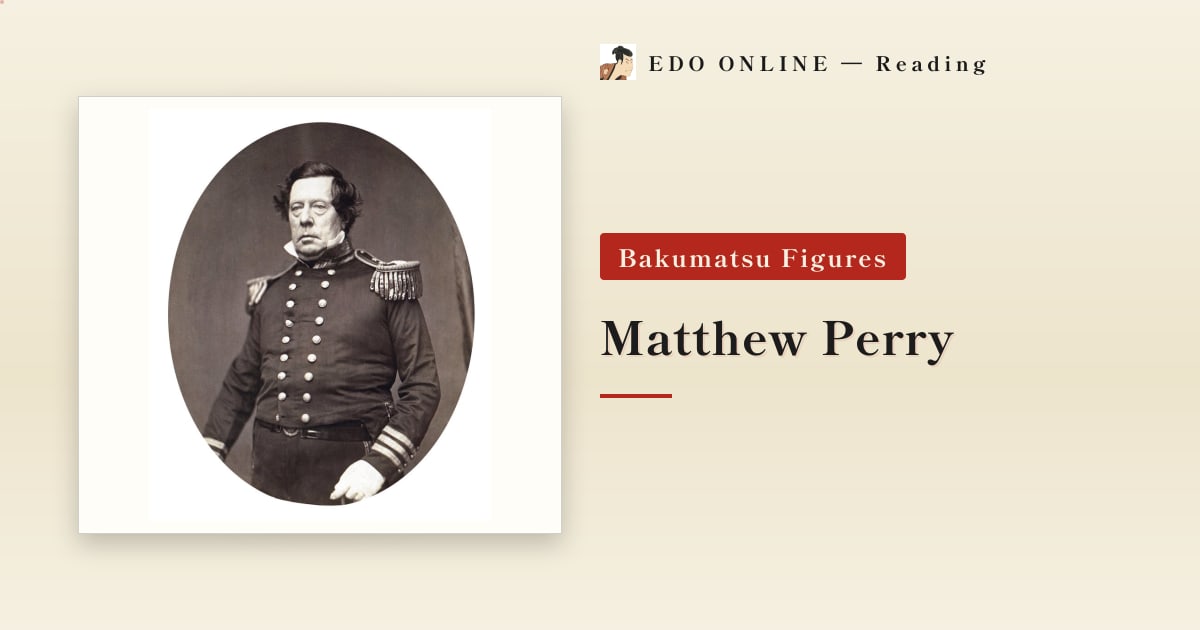
In the summer of 1853, four warships appeared at the mouth of Edo Bay. At their head was Commodore Matthew Calbraith Perry of the United States Navy.
Contents
What Did Perry Actually Do?
In one sentence: he presented Japan with a choice between opening its ports or facing a fleet.
Foreign vessels had reached Japan before. What made Perry different was that he carried a letter from the President, backed it with naval gunnery, and set a deadline for the answer. The policy Japan had maintained for more than two centuries began to come apart from that moment.
Seen from the Japanese shore, the arrival of the Black Ships was a shock out of nowhere. Seen from Washington, it was a carefully prepared national undertaking.
Why Perry Came to Japan
Three reasons, mainly.
Whaling. Whale oil lit American lamps and lubricated American machines, and American whalers worked the North Pacific in numbers. They needed shelter for shipwrecked crews and somewhere to take on water and provisions.
Coal. Steamships burn enormous quantities of it. Opening a route from America to China meant securing a port along the way where a steamer could refuel. Japan sat exactly there.
The China trade. With European powers pressing into Qing China, the United States wanted its own Pacific route. Japan lay across it.
Perry himself had spent years pushing steam propulsion on a reluctant navy, and is sometimes called the father of the American steam navy. The new kind of navy he had built needed coal, and coal is what brought him to Japan.
Where Is Uraga, Where Perry Landed?
Uraga, where the fleet first appeared, is in present-day Yokosuka, Kanagawa Prefecture — on the eastern side of the Miura Peninsula, at the entrance to Tokyo Bay.
The shogunate maintained a magistrate's office there to inspect shipping bound for Edo, which made it the standard point of contact for foreign vessels.
The presidential letter was actually handed over further south, at Kurihama, where a memorial park and monument mark the landing today.
Location was the whole point. Uraga sits at Edo's throat. Perry's ships surveyed the bay and pushed far enough in to be visible from the city itself. The pressure on the shogunate was produced by geography as much as by diplomacy — and the response was a crash program of coastal batteries at Odaiba.
Perry's 1853 Arrival and the Treaty of 1854
Perry arrived in 1853 with four ships, two of them steamers, their hulls painted black — hence kurofune, the Black Ships.
He delivered President Fillmore's letter and announced that he would return the following year for an answer.
In 1854 he came back with a larger squadron. The negotiations produced the Convention of Kanagawa: two ports, Shimoda and Hakodate, opened to American vessels; shipwrecked sailors to be protected; wood, water, and provisions to be supplied.
This was not a commercial treaty. Full trade would wait for the Harris treaty of 1858. But the framework of seclusion itself had been broken, and that was decisive.
Perry Never Said "Please Open Your Country"
A polite request is often put in Perry's mouth in modern retellings. It is a later invention, not a historical record.
The real negotiation was harder than that. When officials tried to refuse the letter, Perry made clear he was prepared to land in force, and he sent his ships deep into the bay to take soundings.
That said, intimidation was not his only instrument. He brought gifts — a working model locomotive, a telegraph set — and demonstrated them for Japanese officials. Show the power, then show the appeal of the technology. Both were part of the method.
How Perry Died
After returning home, Perry worked on the official narrative of the expedition.
He died in New York in March 1858, aged sixty-three. His last years were troubled by joint disease and liver illness, and the resulting decline is what carried him off — just as Japan was moving into its own period of upheaval.
The man who forced Japan open did not live to see what came of it.
Matthew Perry Timeline
| Year | Event |
|---|---|
| 1794 | Born in Newport, Rhode Island |
| 1809 | Enters the Navy; his brother Oliver becomes a hero of the War of 1812 |
| 1840s | Champions steam propulsion and naval modernization |
| 1852 | Sails for Japan as commander of the East India Squadron |
| 1853 | Arrives at Uraga; delivers the president's letter at Kurihama |
| 1854 | Returns and concludes the Convention of Kanagawa, opening Shimoda and Hakodate |
| 1856 | Begins work on the expedition narrative |
| 1858 | Dies in New York, aged 63 |
For what the Black Ships meant on the Japanese side, see the opening of Japan and the Odaiba batteries.
Related reading
Abe Juro — The Former Member Who Talked
He deserted the Shinsengumi and rejoined under another name, shot at Kondo Isami as one of the Goryō Eji, and then grew apples in Sapporo. His late-Meiji testimony is where the ranking of the corps' best swordsmen comes from.
Ando Hayataro — The Shinsengumi's Record-Breaking Archer
He set the standing national record in the long-range shooting at the Tōdai-ji Great Buddha Hall, sending 8,685 arrows the length of the corridor. Nearly fifty, he joined the Shinsengumi and died of wounds taken in the back garden of the Ikedaya.
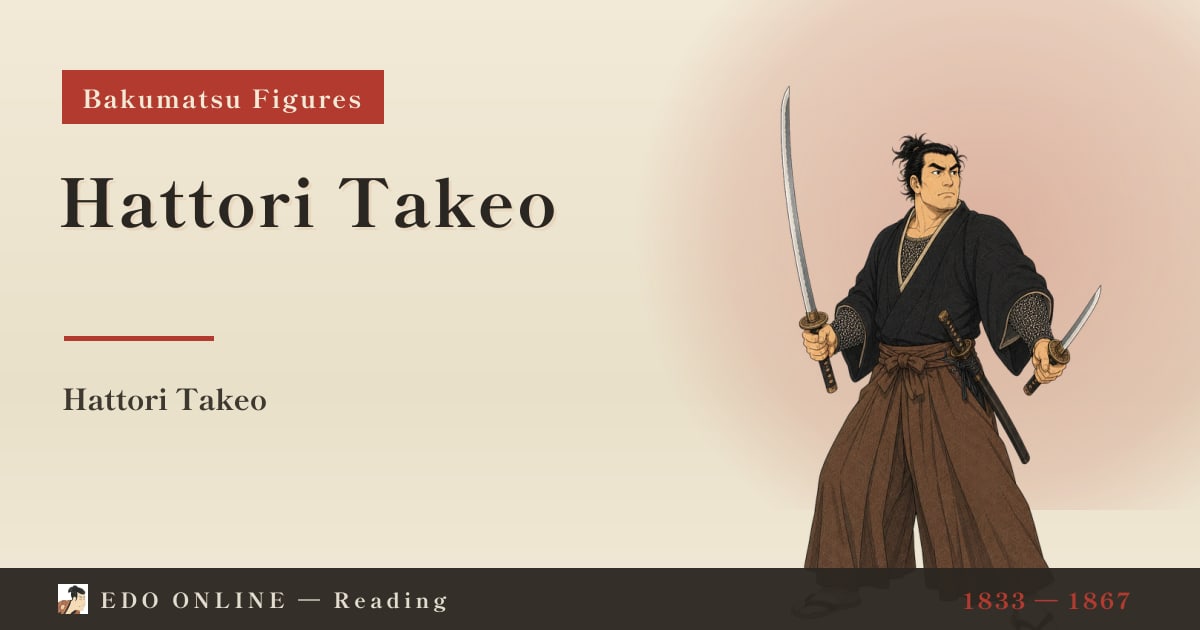
Hattori Takeo — Two Swords at Aburanokoji
A two-sword master and fencing instructor of the Shinsengumi who defected with the Goryō Eji. At Aburanokōji he alone wore mail, held a wall against the whole corps, and fell with more than twenty wounds.