Ernest Satow — The British Diplomat Who Watched the Bakumatsu Up Close
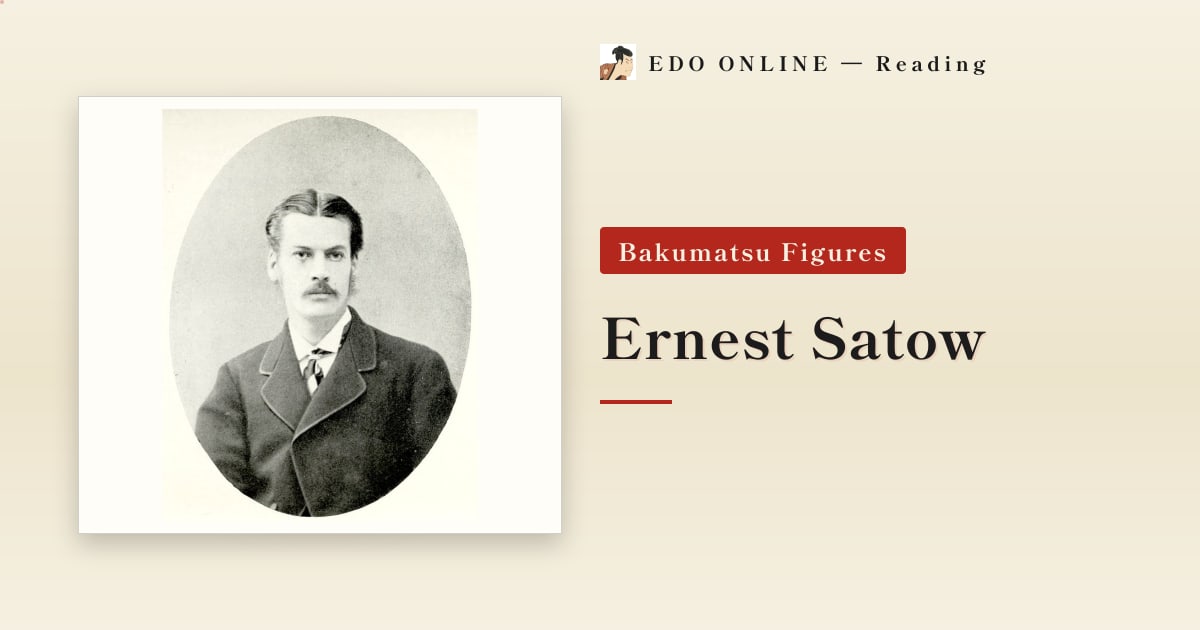
One foreigner watched the end of the Tokugawa order from the inside and wrote it down. Ernest Satow was a British diplomat.
Contents
Who Was Ernest Satow?
Three things.
Interpreter. He learned Japanese to a level almost no Westerner had reached and stood at the front of British legation negotiations.
Polemicist. An essay of his, translated into Japanese and circulated as Eikoku Sakuron, had a real effect on Japanese political argument.
Witness. His memoir remains one of the best foreign eyewitness accounts of the period.
He was born in London in 1843.
Ernest Satow's Name Is Not Japanese
A common confusion first. The surname Satow has nothing to do with the Japanese name Sato.
His father was of Swedish extraction and the name is European. He did not adopt a Japanese-sounding name for his posting.
That it happened to sound approachable to Japanese ears probably did him no harm.
Ernest Satow Arrives in Japan at Nineteen
Satow came to Japan in 1862 as a student interpreter, aged nineteen.
Almost no Westerner then spoke Japanese. Treaties existed; a means of communication did not. Business was routinely conducted at one remove, through Dutch or Chinese.
Satow threw himself at the language and reached the point of speaking, reading, and writing it, which made him indispensable to the legation.
On the strength of language alone, a man in his twenties moved into the centre of negotiations between states.
Eikoku Sakuron
In 1866 Satow contributed articles on Japanese politics to an English-language paper in Yokohama.
They were translated and circulated widely in Japanese as Eikoku Sakuron, "the British policy argument."
The core claim: the shogun was not the sovereign of Japan but one lord among many, and a realistic settlement would be a confederation of powerful domains under the emperor.
The essay is credited with giving theoretical support to the anti-shogunal side. A foreigner's writing had entered Japanese political debate.
One qualification matters. It was not a statement of British policy; it was Satow's personal view. That it was received as "Britain's argument" says a good deal about the information environment of the time.
The Japanese Ernest Satow Met
Satow dealt with both sides.
Saigo Takamori, Kido Takayoshi, Katsu Kaishu, Tokugawa Yoshinobu. He met most of the principal figures of the period in person.
And he recorded it. Where Japanese records were lost or later revised, Satow's account is sometimes consulted — the value of contemporaneous observation from outside.
His memoir, A Diplomat in Japan, is a standard source on the period.
Ernest Satow's Later Career
Satow's involvement with Japan continued into the Meiji era.
After a spell elsewhere he returned in 1895 as British minister to Japan. The young man who had arrived as a student interpreter came back representing his country.
He later served as minister to China and finished a long diplomatic career. He also published research on Japanese plants and history.
He died in Britain in 1929, aged eighty-six.
Ernest Satow's Descendants
A frequent search about Satow concerns his descendants.
During his years in Japan he formed a household with a Japanese woman, Takeda Kane. It was not a legal marriage, but they had children.
Their second son, Takeda Hisayoshi, became a botanist of standing, known for work on alpine flora and involved in the founding of the Japanese Alpine Club and in early nature conservation.
A diplomat's son became a scholar of Japan's mountains. Satow's connection to the country continued in his line.
He did not take the family with him when he left Japan. That decision sits against the position of diplomats at the time and the legal obstacles then attached to such unions.
Ernest Satow Timeline
| Year | Event |
|---|---|
| 1843 | Born in London |
| 1862 | Arrives in Japan as a student interpreter, aged 19 |
| 1866 | Publishes the articles circulated in Japanese as Eikoku Sakuron |
| 1860s | Deals with both shogunal and anti-shogunal parties |
| 1895 | Returns as British minister to Japan |
| 1900s | Serves as minister to China |
| 1929 | Dies in Britain, aged 86 |
For the Japanese figures he dealt with see Saigo Takamori and Katsu Kaishu; for the opening of the country, the Black Ships.
Related reading
Abe Juro — The Former Member Who Talked
He deserted the Shinsengumi and rejoined under another name, shot at Kondo Isami as one of the Goryō Eji, and then grew apples in Sapporo. His late-Meiji testimony is where the ranking of the corps' best swordsmen comes from.
Ando Hayataro — The Shinsengumi's Record-Breaking Archer
He set the standing national record in the long-range shooting at the Tōdai-ji Great Buddha Hall, sending 8,685 arrows the length of the corridor. Nearly fifty, he joined the Shinsengumi and died of wounds taken in the back garden of the Ikedaya.
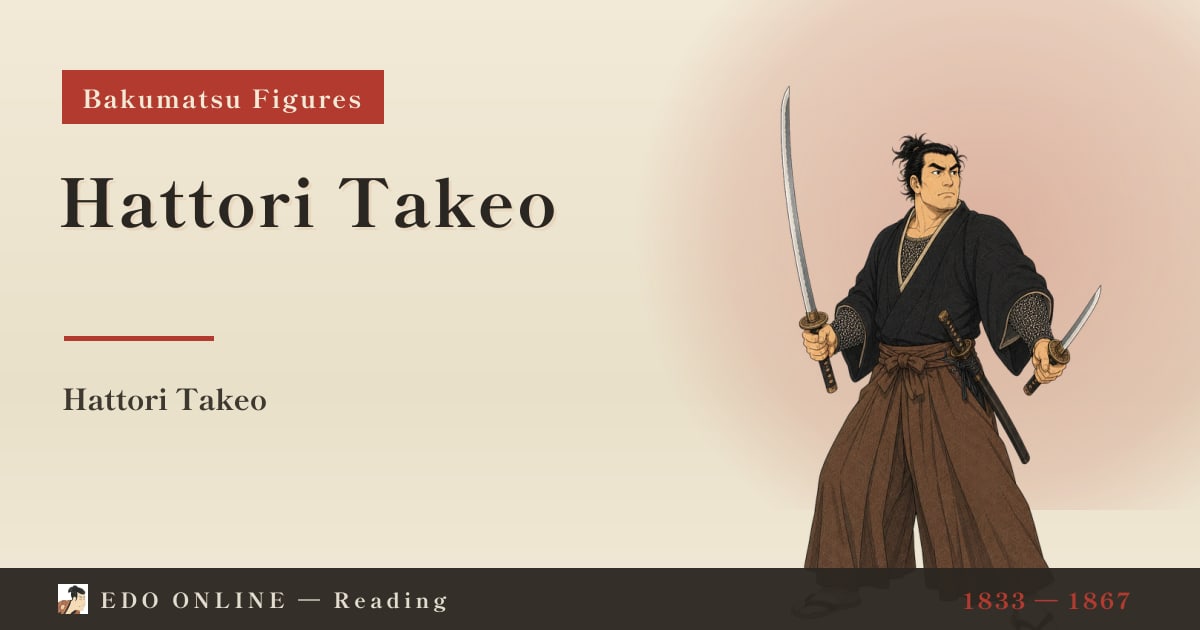
Hattori Takeo — Two Swords at Aburanokoji
A two-sword master and fencing instructor of the Shinsengumi who defected with the Goryō Eji. At Aburanokōji he alone wore mail, held a wall against the whole corps, and fell with more than twenty wounds.