Takashima Shuhan — Imprisoned on False Charges After Warning Japan
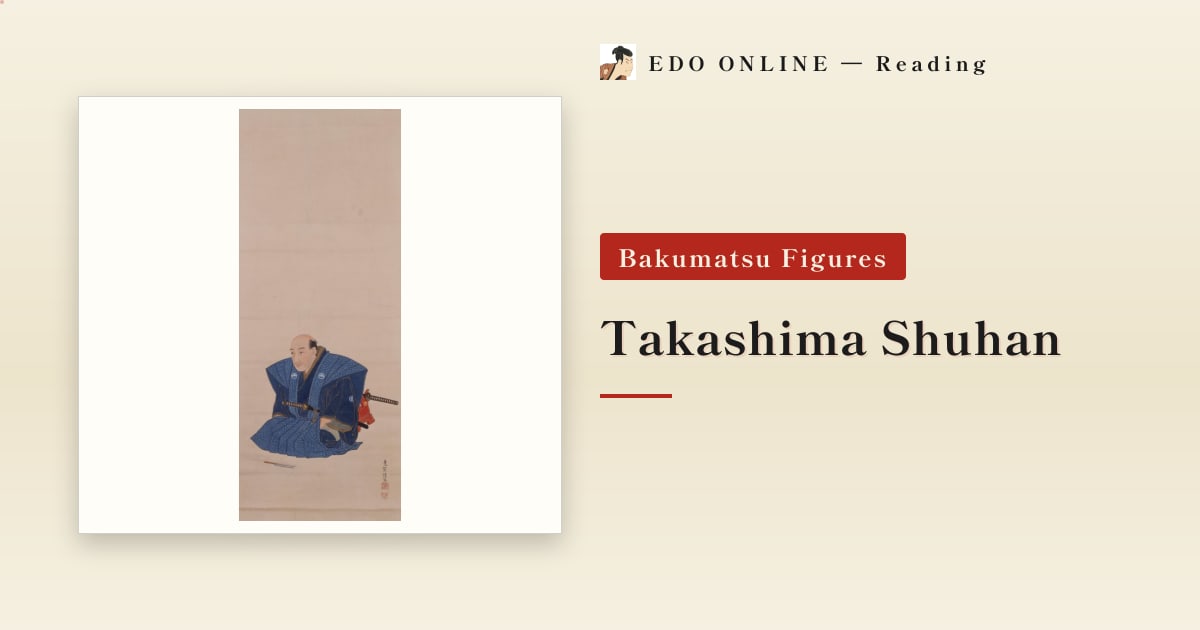
The man who warned the shogunate that Japan would end up like China was arrested the following year. Takashima Shuhan. He was pardoned twelve years later, once the Black Ships had actually arrived.
Contents
Who Was Takashima Shuhan?
Shuhan was a Nagasaki town official and an artillerist of the Western school.
He did three things.
He brought Western guns and gunnery into Japan. He studied under the Dutch at Dejima, bought Western cannon with his own money, and founded the Takashima school of gunnery.
He told the shogunate to defend its coast. After the Opium War, he submitted a memorial arguing that without Western gunnery Japan would suffer what China had suffered.
He staged Japan's first Western-style artillery drill, on the Tokumaru plain in 1841. That ground is now called Takashimadaira, after him.
He was born in 1798 and died in February 1866.
Takashima Shuhan and Nagasaki as a Window
Shuhan was born into a family of Nagasaki town elders — a post that ran the city's administration and, crucially, gave him access to the Dutch at Dejima.
There he studied Western gunnery: reading Dutch manuals, importing actual guns, and measuring the gap against Japanese practice.
Japanese artillery had barely advanced since the sixteenth century. Neither range nor accuracy was comparable. Shuhan was among the very few men in Japan who knew precisely how wide that gap was.
What the Opium War Meant to Takashima Shuhan
In 1840 war broke out between China and Britain.
Reports reached Nagasaki through Dutch shipping: China was losing.
For Shuhan this was not distant news. The same fleets, carrying the same guns, could come to Japan — and he had the technical knowledge to see it.
In 1841 he submitted a memorial to the shogunate, known afterwards as the Tenpo Memorial.
It was specific. Build Western guns, learn Western gunnery, build batteries. Reform the military system on Western lines.
More than a decade before the country began arguing over opening up versus expulsion, this was a proposal that started from the premise that Japan would lose a fight.
Takashima Shuhan's Drill at Tokumaru
The shogunate did not ignore it.
In June 1841, on the Tokumaru plain in what is now Itabashi ward in Tokyo, Shuhan staged a public demonstration of artillery and infantry drill.
It was the first Western-style gunnery exercise in Japan — Western guns in line, muskets fired in Western formation, with shogunal officials watching.
That ground was later named Takashimadaira. The name of a firing range became the name of a modern Tokyo neighbourhood.
Why Takashima Shuhan Was Imprisoned
The following year he was arrested.
In 1842 he was accused of irregularities involving the Nagasaki trade office. Advocating Western gunnery was not itself the charge — the accusations were brought on separate grounds by political opponents, immediately after the drill had made his name.
The arrest is attributed to Torii Yozo, then a city magistrate of Edo, known for his hostility to Western learning and for persecuting Dutch-studies scholars. He was also the official who ran much of Mizuno Tadakuni's reform programme and then turned on him.
Shuhan was placed in confinement in the custody of a domain in Musashi province. Itabashi ward, which administers the drill site today, describes the case as a false accusation.
That confinement lasted more than ten years.
Takashima Shuhan After the Black Ships
In 1853 Perry anchored off Uraga.
What Shuhan had warned of twelve years earlier had happened.
The shogunate changed course. He was pardoned and recalled to service in 1853, made head instructor in 1855, and appointed instructor in gunnery at the Kobusho — the military academy founded by Abe Masahiro — in 1857.
A man who had been imprisoned became the shogunate's own artillery instructor. The state had conceded he was right.
His methods spread through his students. Egawa Hidetatsu and Shimosone Nobuatsu came from his school, and the work led on to the batteries at Shinagawa and the Western-style reforms in the domains.
How Takashima Shuhan Died
He died on 28 February 1866, aged sixty-seven.
That was two years before the Boshin War, just short of the point where Japan began fighting in earnest with Western-armed forces. He did not live to see the technology he imported used in a civil war.
Takashimadaira in Tokyo still carries his name — the first ground in Japan where Western guns were lined up, now a residential district.
Takashima Shuhan Timeline
| Year | Event |
|---|---|
| 1798 | Born into a family of Nagasaki town elders |
| 1830s | Studies Western gunnery under the Dutch; founds the Takashima school |
| 1840 | Reports of the Opium War reach Nagasaki |
| 1841 | Submits the Tenpo Memorial on Western gunnery and coastal defence |
| Jun 1841 | Stages Japan's first Western-style artillery drill at Tokumaru (now Takashimadaira) |
| 1842 | Arrested over the Nagasaki trade office and confined; the case is regarded as a false accusation |
| 1853 | Pardoned after Perry's arrival |
| 1855 | Appointed head instructor |
| 1857 | Appointed gunnery instructor at the Kobusho |
| Feb 1866 | Dies, aged 67 |
For the batteries see Shinagawa's forts; for the councillor who recalled him, Abe Masahiro.
Related reading
Abe Juro — The Former Member Who Talked
He deserted the Shinsengumi and rejoined under another name, shot at Kondo Isami as one of the Goryō Eji, and then grew apples in Sapporo. His late-Meiji testimony is where the ranking of the corps' best swordsmen comes from.
Ando Hayataro — The Shinsengumi's Record-Breaking Archer
He set the standing national record in the long-range shooting at the Tōdai-ji Great Buddha Hall, sending 8,685 arrows the length of the corridor. Nearly fifty, he joined the Shinsengumi and died of wounds taken in the back garden of the Ikedaya.
Hattori Takeo — Two Swords at Aburanokoji
A two-sword master and fencing instructor of the Shinsengumi who defected with the Goryō Eji. At Aburanokōji he alone wore mail, held a wall against the whole corps, and fell with more than twenty wounds.