Kuroda Kiyotaka — Hokkaido, and the Rumour About His Wife
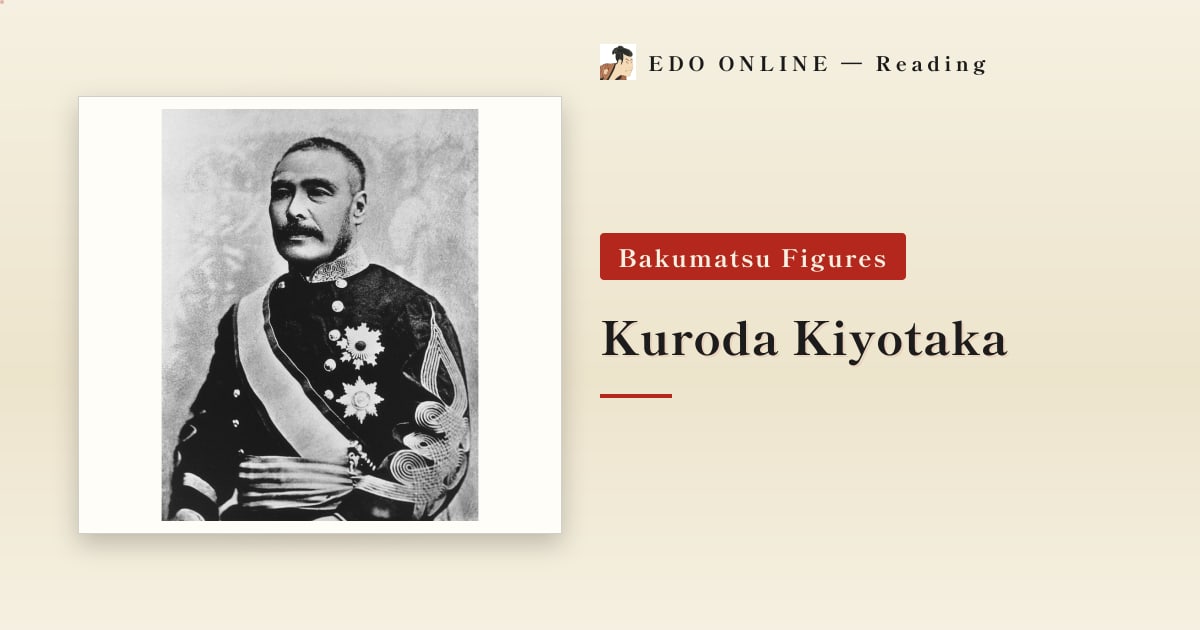
He saved an enemy commander's life, opened Hokkaido, and was prime minister on the day Japan got a constitution. He is also remembered for a rumour about his wife's death.
Contents
Who Was Kuroda Kiyotaka?
Three things.
A commander in the Boshin War. He took Enomoto Takeaki's surrender at Hakodate and then campaigned to keep him alive.
The developer of Hokkaido. As head of the Colonization Office he imported American expertise, established the tondenhei military-farmer settlements, and drove the opening of the north.
Prime minister. He was Japan's second, and the Meiji Constitution was promulgated during his term. It was granted by the emperor as a sovereign act; Kuroda's role was to countersign as a minister of state.
He was born in 1840 into a samurai family of Satsuma.
How Kuroda Kiyotaka Saved Enomoto Takeaki
Kuroda served as a staff officer of the imperial forces through the campaigns of 1868–69, ending at Hakodate.
It was Kuroda who brought Enomoto Takeaki out of Goryokaku. And having accepted his surrender, he set about saving him.
With execution the expected fate of the leader of the last armed resistance, Kuroda lobbied for clemency — reportedly shaving his head as a mark of the appeal.
Enomoto served two and a half years in prison, was released, and went on to hold four ministries. The decision to use the enemy's commander rather than kill him owes a great deal to Kuroda.
Kuroda Kiyotaka and the Opening of Hokkaido
His central task under the new government was the Colonization Office.
Developing Hokkaido was not merely internal development. It was substantially a response to Russian expansion.
Kuroda travelled to the United States and hired, at high salaries, advisors including Horace Capron, a former US commissioner of agriculture. Cold-climate farming, mining, roads, city planning: the intent was to transplant American large-scale settlement methods directly.
The tondenhei system was also his. Former samurai were settled on the land to farm in peacetime and serve as troops in war — which also absorbed a class that had lost its occupation.
The street grid of Sapporo and the forerunner of Hokkaido University both date from this period.
Kuroda Kiyotaka and the Colonization Office Scandal
In 1881 Kuroda drew severe criticism.
The Colonization Office proposed to sell the assets and enterprises it had built to a merchant from his own Satsuma at a strikingly low price. Public reaction was fierce.
The affair deepened distrust of the government and formed part of the background to the political crisis of 1881, in which Okuma Shigenobu was driven out. The achievement and the stain sit side by side in the same record.
Kuroda Kiyotaka as Japan's Second Prime Minister
Kuroda succeeded Ito Hirobumi as prime minister in 1888.
The Meiji Constitution was promulgated during his term, in 1889 — he was the head of government at the moment Japan became a constitutional state.
He used the occasion to argue that government should stand outside the political parties: that even with a constitution and a diet, the administration should not be moved by party interests.
It was an explicit brake on the drift toward party government.
The Rumour About Kuroda Kiyotaka's Wife
Searches about Kuroda frequently concern his wife.
She died in 1878, and almost immediately a rumour spread that Kuroda had killed her in a drunken rage.
His reputation as a heavy drinker who turned violent when drunk gave the story momentum.
It is said to have gone as far as the police. A later account has the chief of police, Kawaji Toshiyoshi, ordering the grave opened and the body examined — but that account rests on later writing rather than contemporary record.
What is documented is that she had been ill and her death was registered, and that no evidence has ever supported the murder rumour.
The episode is remembered less for the accusation than for what it shows: public suspicion directed at a leading politician's private life, pursued to the point of exhumation. The rumour itself has outlived the finding, which is why people still search for it.
How Kuroda Kiyotaka Died
Kuroda died in 1900, aged fifty-nine.
Kuroda Kiyotaka Timeline
| Year | Event |
|---|---|
| 1840 | Born into a Satsuma samurai family |
| 1868–69 | Serves in the Boshin War; takes Enomoto's surrender and seeks clemency for him |
| 1870s | Directs the development of Hokkaido; establishes the tondenhei |
| 1878 | His wife dies; a murder rumour spreads, unsupported by any evidence |
| 1881 | Criticized over the Colonization Office sale |
| 1888 | Becomes Japan's second prime minister |
| 1889 | The Meiji Constitution is promulgated during his term |
| 1900 | Dies, aged 59 |
See also Ito Hirobumi, Okuma Shigenobu, and Goryokaku.
Related reading
Abe Juro — The Former Member Who Talked
He deserted the Shinsengumi and rejoined under another name, shot at Kondo Isami as one of the Goryō Eji, and then grew apples in Sapporo. His late-Meiji testimony is where the ranking of the corps' best swordsmen comes from.
Ando Hayataro — The Shinsengumi's Record-Breaking Archer
He set the standing national record in the long-range shooting at the Tōdai-ji Great Buddha Hall, sending 8,685 arrows the length of the corridor. Nearly fifty, he joined the Shinsengumi and died of wounds taken in the back garden of the Ikedaya.
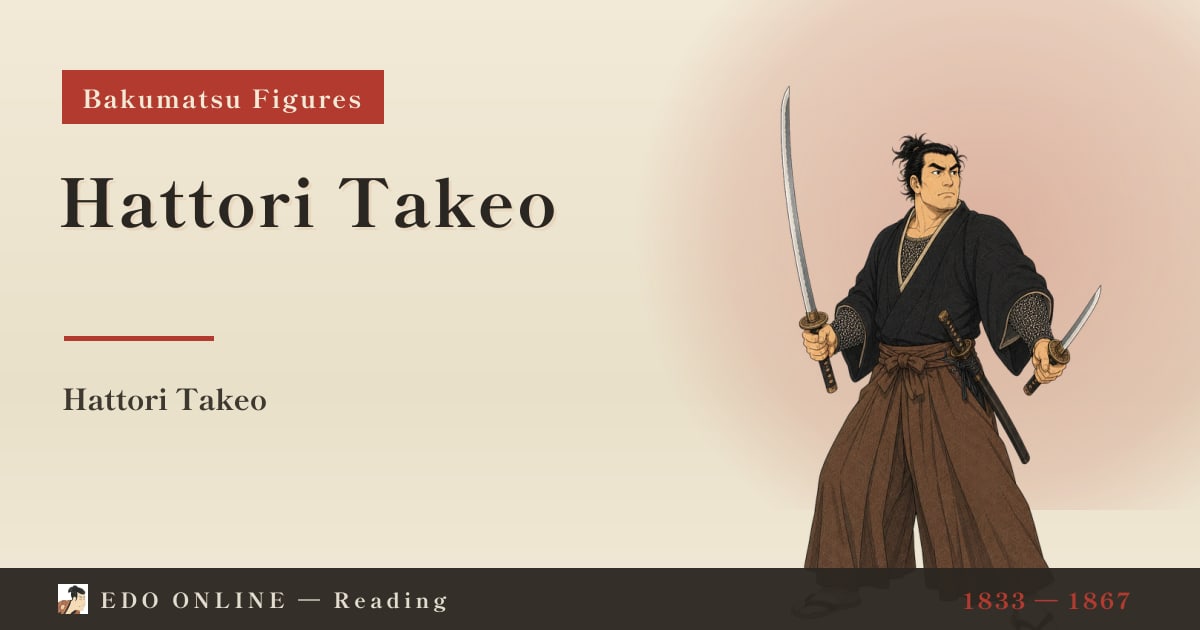
Hattori Takeo — Two Swords at Aburanokoji
A two-sword master and fencing instructor of the Shinsengumi who defected with the Goryō Eji. At Aburanokōji he alone wore mail, held a wall against the whole corps, and fell with more than twenty wounds.