Ito Hirobumi — Japan's First Prime Minister
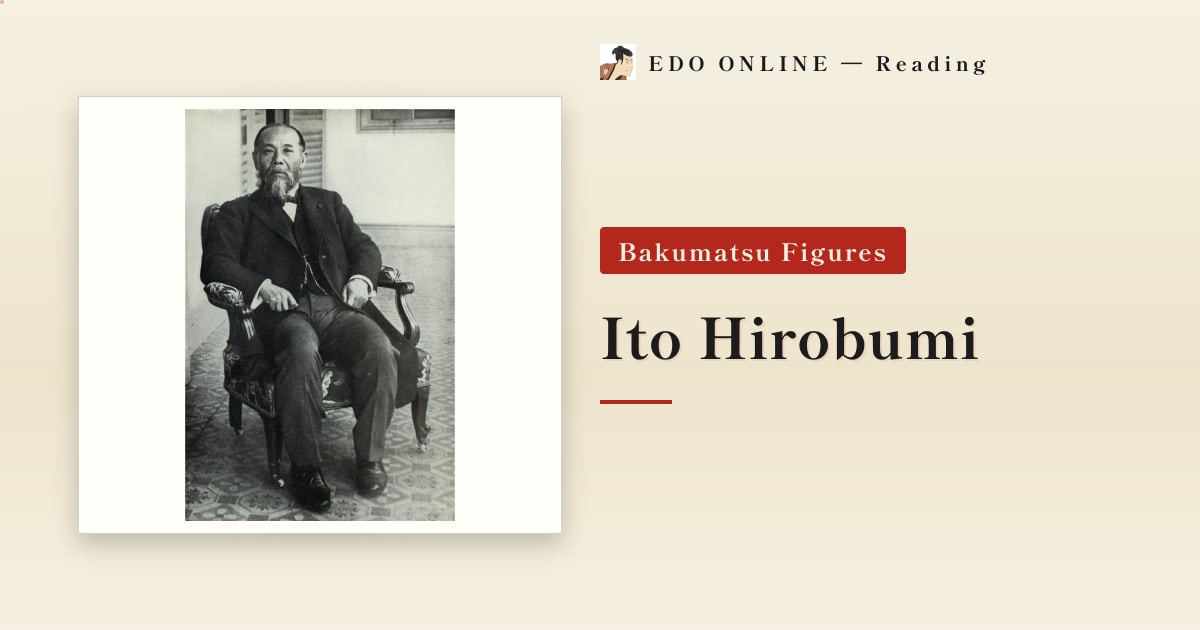
The first man to hold the title of prime minister in Japan was born into a farming family. Ito Hirobumi took office at forty-four — a record for youth that still stands.
Contents
Who Was Ito Hirobumi?
Two things, principally.
He wrote a constitution. Ito led the drafting of the Meiji Constitution, giving Japan a written constitutional order.
He built the cabinet. He replaced the older Dajokan structure with a system of a prime minister and ministers of state, and became the first prime minister under it.
If the Meiji Restoration was the work of dismantling the old order, Ito's work was assembling the frame that replaced it.
Ito Hirobumi from Farmer's Son to Prime Minister
He was born in 1841 in Suo Province, in what is now Yamaguchi Prefecture. His father, Hayashi Juzo, was a farmer.
The family was poor, and his father was adopted into the Ito household — foot soldiers, the lowest rank of samurai. That single adoption moved the family across the status line.
Trace Ito's lineage and you find no line of warriors, only that one crossing. He came up through a gap in the system rather than through blood, and his later willingness to promote men regardless of birth is hard to separate from that fact.
His wife, Umeko, was a woman he met in his youth. He was known for a lively social life and there is no shortage of anecdotes about it. The Ito peerage passed to an adopted heir, Hirokuni.
What Yoshida Shoin Saw in Ito Hirobumi
Ito studied at the Shoka Sonjuku, the academy of Yoshida Shoin. He was not among its stars.
Shoin is said to have assessed him roughly this way: modest in talent, still immature in scholarship — but possessed of a gift for moving between people. He conceded that Ito would never match Takasugi Shinsaku or Kusaka Genzui as a thinker, and then pointed at something else entirely.
The judgment held. Ito's career is one long sequence of negotiating, brokering, and closing. Neither a constitution nor a cabinet system becomes real by being argued for; someone has to convert it into institutions that people will actually operate.
Shoin had named the qualification for prime minister, decades before the office existed.
Ito Hirobumi's Voyage to Britain
In 1863 Ito and four companions travelled illegally to Britain, in defiance of the ban on foreign travel.
What he saw there changed him. Confronted with British industry and naval power, he concluded that expelling the foreigners was simply not possible.
Learning that his home domain of Choshu was about to fight a Western squadron, he and Inoue Kaoru broke off their studies and raced home to stop it. They were too late; Choshu was defeated. But that defeat is precisely what turned the domain from expulsion toward opening the country and overthrowing the shogunate.
Go out, see, come back, and change things from inside. Ito's lifelong role was set here.
How Ito Hirobumi Wrote the Constitution
Ito rose steadily in the Meiji government and moved to its center after the assassination of Okubo Toshimichi.
In 1882 he sailed for Europe to study constitutions. What he brought back was largely Prussian: a strong monarch, alongside a parliament and a written constitution. He judged this the realistic shape for Japan at that moment.
Working with Inoue Kowashi and others, he produced the Meiji Constitution, promulgated in 1889 — one of the earliest modern written constitutions in Asia.
He also became the first president of the Privy Council, the body that would interpret it. He took responsibility not only for writing the thing but for running it.
Ito Hirobumi as Prime Minister
The cabinet system was established in 1885 and Ito became its first prime minister. He would hold the office four times.
His second cabinet fought the Sino-Japanese War and negotiated the peace. Later, judging that party politics could no longer be ignored, he founded the Rikken Seiyukai — a founder of oligarchic government turning toward parties.
How Ito Hirobumi Was Assassinated at Harbin
In 1905 Ito became the first Resident-General of Korea, as Japanese control over the peninsula deepened. It is the part of his record that remains most contested.
On 26 October 1909, at the railway station in Harbin, he was shot by An Jung-geun and died. He was sixty-eight.
The farmer's son who had smuggled himself to Europe and come home to build a constitution died on a platform in a foreign country.
Ito Hirobumi Timeline
| Year | Event |
|---|---|
| 1841 | Born to a farming family in Suo Province |
| c. 1857 | Studies at Yoshida Shoin's academy |
| 1863 | Travels illegally to Britain; abandons the expulsionist position |
| 1871 | Serves as vice-envoy on the Iwakura Mission |
| 1878 | Moves to the center of government after Okubo's assassination |
| 1882 | Studies constitutions in Europe |
| 1885 | Creates the cabinet system; becomes first prime minister at 44 |
| 1889 | The Meiji Constitution is promulgated |
| 1900 | Founds the Rikken Seiyukai |
| 1905 | Becomes Resident-General of Korea |
| 1909 | Assassinated at Harbin, aged 68 |
For his fellow students, see Yoshida Shoin and Takasugi Shinsaku; for the government he helped build, see the Meiji Restoration.
Related reading
Abe Juro — The Former Member Who Talked
He deserted the Shinsengumi and rejoined under another name, shot at Kondo Isami as one of the Goryō Eji, and then grew apples in Sapporo. His late-Meiji testimony is where the ranking of the corps' best swordsmen comes from.
Ando Hayataro — The Shinsengumi's Record-Breaking Archer
He set the standing national record in the long-range shooting at the Tōdai-ji Great Buddha Hall, sending 8,685 arrows the length of the corridor. Nearly fifty, he joined the Shinsengumi and died of wounds taken in the back garden of the Ikedaya.
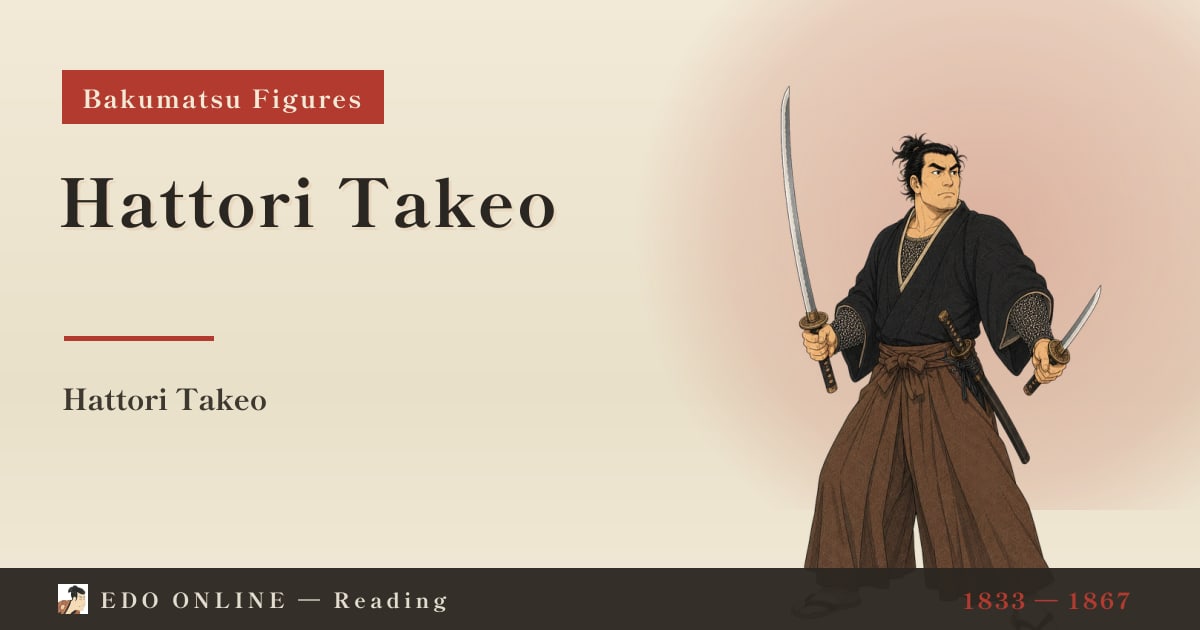
Hattori Takeo — Two Swords at Aburanokoji
A two-sword master and fencing instructor of the Shinsengumi who defected with the Goryō Eji. At Aburanokōji he alone wore mail, held a wall against the whole corps, and fell with more than twenty wounds.