Yamaoka Tesshu — The Man Who Walked Alone Into Saigo's Camp
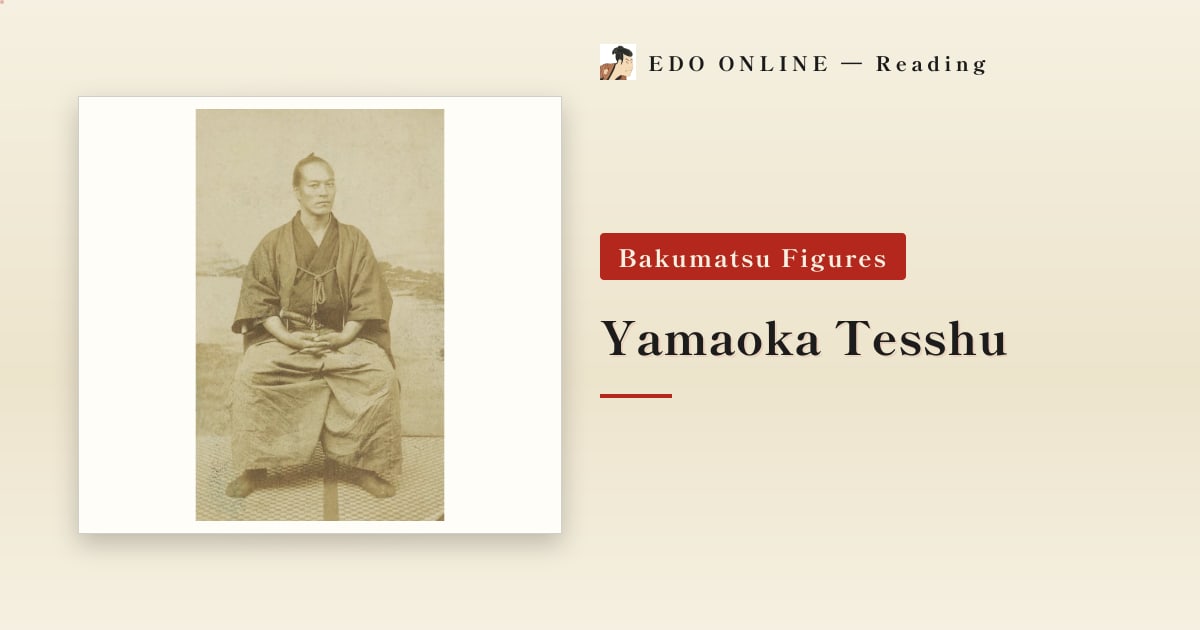
One man walked into the enemy army's headquarters alone. Yamaoka Tesshu — who faced Saigo Takamori directly and kept Edo from burning.
Contents
Who Was Yamaoka Tesshu?
Tesshu was a Tokugawa retainer, a swordsman, and a chamberlain to the Meiji emperor. He was born Ono Tetsutaro.
Three things define him.
He negotiated with Saigo Takamori. In 1868 he went alone to Sunpu and extracted concessions on Tokugawa Yoshinobu's life and the survival of the Tokugawa house — the groundwork for the bloodless surrender of Edo Castle.
He taught the unity of sword and Zen. He founded the Muto-ryu, treating swordsmanship and spiritual discipline as one practice.
He served the Meiji emperor as chamberlain for ten years.
He was born in 1836 and died on 19 July 1888.
Yamaoka Tesshu from Hida to Edo
Tesshu was born in Edo, the son of the shogunal bannerman Ono Choemon, and named Ono Tetsutaro. He spent his childhood in Takayama after his father was appointed intendant of Hida.
In his teens he went to Edo to study the sword, training at Chiba Shusaku's Gembukan among others and taking up the Hokushin Itto-ryu.
He then studied the spear under Yamaoka Seizan, a man called a prodigy with the weapon and the elder brother of Takahashi Deishu.
Seizan died suddenly in 1855. Tetsutaro married Deishu's younger sister, succeeded to the Yamaoka house, and took its name — becoming Yamaoka Tesshu.
Takahashi Deishu was thus his brother-in-law, and the two acted together for the rest of their lives.
Yamaoka Tesshu's Solo Ride to Sunpu
By April 1868 the new government's army was closing on Edo.
Tokugawa Yoshinobu had put himself into confinement at Ueno as a show of submission, but the new government had no reason to believe it. A date for storming Edo Castle had been fixed.
Someone had to settle it face to face with the enemy commander.
His brother-in-law Takahashi Deishu could not leave Yoshinobu's side, and put Tesshu's name forward.
Tesshu travelled to Sunpu — modern Shizuoka — and met Saigo Takamori on 1 April 1868.
The Argument Yamaoka Tesshu Used on Saigo
Saigo set out his terms: surrender of the castle, surrender of the warships and weapons, and — that Yoshinobu be handed into the custody of another domain.
Tesshu refused that clause.
His argument was about position, not sentiment. A retainer cannot hand his lord over to another house. If someone told you to do the same with the lord of Satsuma, would you agree? — that is the substance of what he is reported to have said.
Saigo withdrew the condition.
The exact wording varies between accounts. But that Tesshu's negotiation changed the terms regarding Yoshinobu's person, and that Katsu Kaishu's meeting with Saigo followed on that basis, is broadly accepted.
Edo Castle was surrendered without a battle.
What Tesshu brought to that negotiation was neither rank nor troops. It was walking into the enemy's camp alone, and not backing down.
Yamaoka Tesshu's Muto-ryu, the School of No Sword
After the Restoration Tesshu served the Shizuoka domain, then held prefectural posts.
From 1872 he was a chamberlain to the Meiji emperor, serving ten years.
Alongside that he worked on the sword.
What he founded was the Muto-ryu — literally "no-sword."
The idea is not to cut the opponent with technique but to reach a state in which the outcome is settled the moment you take your stance. Getting there requires training the mind rather than the hands — the doctrine known as the unity of sword and Zen.
He practised Zen seriously, treating swordsmanship and seated meditation as two faces of one thing. His hall was called the Shunpukan.
How Yamaoka Tesshu Died, and Zenshoan
In 1883 Tesshu founded a temple in Yanaka, Tokyo: the Zenshoan.
Its purpose was to hold services for those who died in the national upheaval of the late Tokugawa and Meiji Restoration years. The temple's stated dedication is not limited to the dead of the Boshin War.
He died of a stomach illness on 19 July 1888, aged fifty-one.
He is said to have died sitting in meditation posture.
His grave is at the Zenshoan — the temple he built for those the era killed.
Yamaoka Tesshu Timeline
| Year | Event |
|---|---|
| 1836 | Born in Edo, son of the bannerman Ono Choemon, as Ono Tetsutaro |
| 1850s | Studies the sword in Edo, including at Chiba Shusaku's Gembukan |
| 1855 | Succeeds to the Yamaoka house after Seizan's death, marrying Deishu's sister |
| 1 Apr 1868 | Goes alone to Sunpu and negotiates with Saigo Takamori |
| 3 May 1868 | Edo Castle is surrendered without a battle |
| 1872 | Becomes chamberlain to the Meiji emperor, serving ten years |
| Meiji era | Founds the Muto-ryu and teaches at the Shunpukan |
| 1883 | Founds the Zenshoan in Yanaka for those who died in the upheaval |
| 1888 | Dies, aged 51 |
For the other "boats" see Katsu Kaishu and Takahashi Deishu; for the man he faced, Saigo Takamori.
Related reading
Abe Juro — The Former Member Who Talked
He deserted the Shinsengumi and rejoined under another name, shot at Kondo Isami as one of the Goryō Eji, and then grew apples in Sapporo. His late-Meiji testimony is where the ranking of the corps' best swordsmen comes from.
Ando Hayataro — The Shinsengumi's Record-Breaking Archer
He set the standing national record in the long-range shooting at the Tōdai-ji Great Buddha Hall, sending 8,685 arrows the length of the corridor. Nearly fifty, he joined the Shinsengumi and died of wounds taken in the back garden of the Ikedaya.
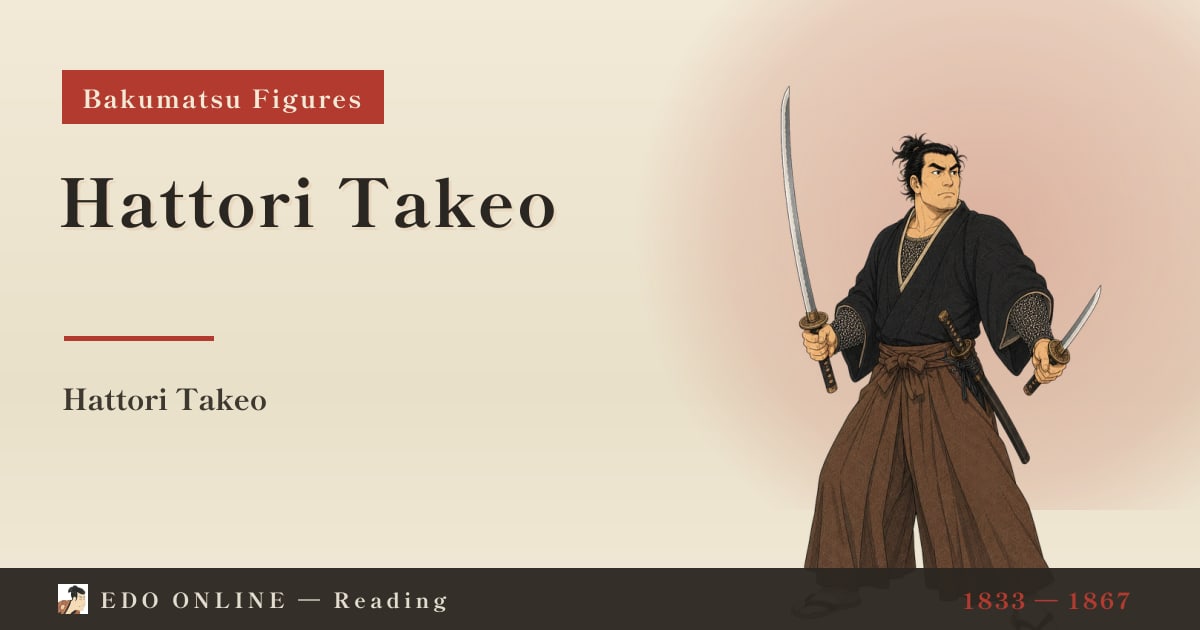
Hattori Takeo — Two Swords at Aburanokoji
A two-sword master and fencing instructor of the Shinsengumi who defected with the Goryō Eji. At Aburanokōji he alone wore mail, held a wall against the whole corps, and fell with more than twenty wounds.