Toshusai Sharaku — The Print Artist Who Vanished After Ten Months
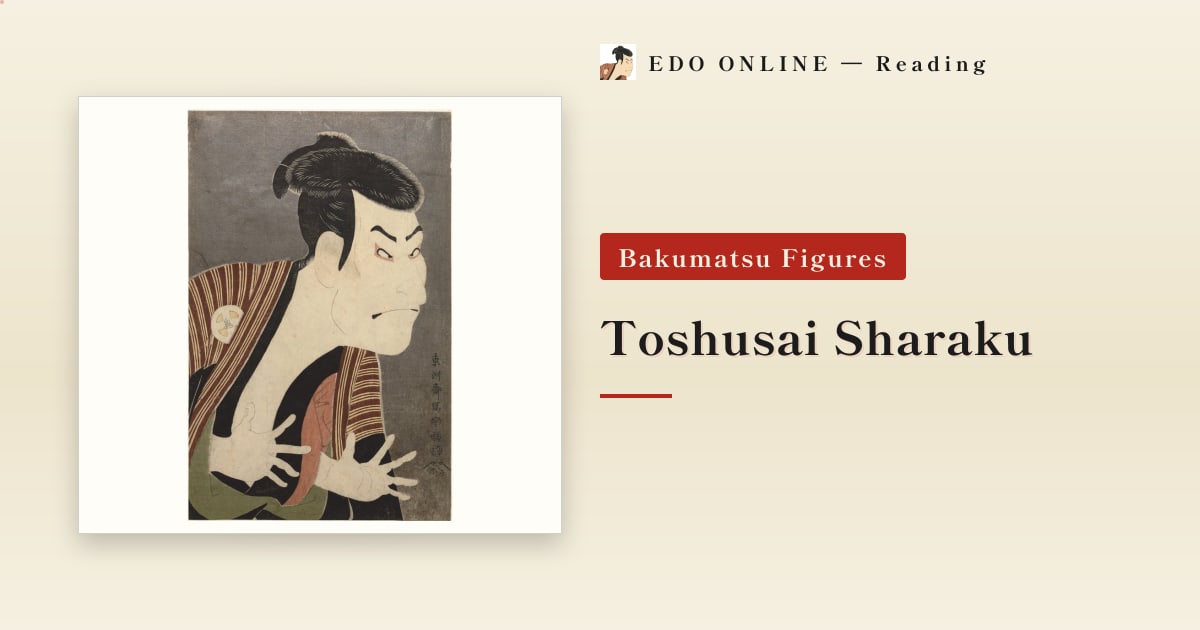
One artist published for ten months and vanished. Toshusai Sharaku. Neither his birth year nor his death year, nor even his real name, is settled.
Contents
Who Was Toshusai Sharaku?
Sharaku was an ukiyo-e print artist of the late Edo period.
His output is startlingly short and startlingly concentrated.
He worked for about ten months, from the fifth lunar month of 1794 — 29 May to 26 June in the Gregorian calendar — to early 1795.
He left some 140 prints, nearly all actor portraits of kabuki performers.
Then he stopped. Nothing appeared under the name again. Why he quit, and what became of him, are unknown.
Why Toshusai Sharaku Debuted at Full Strength
His arrival was abnormal.
In the fifth month of 1794 he published twenty-eight actor prints at once — large-format okubi-e, "large-head pictures," with the actor's face filling the sheet.
The grounds were black mica: powdered mica strewn to make a dark, glittering field against which the face stands out. It is expensive, labour-intensive work.
Publishers do not normally spend that much on an unknown artist's debut.
The publisher was Tsutaya Juzaburo, the man who launched Kitagawa Utamaro and Jippensha Ikku and the most aggressive publisher in Edo. Sharaku is understood to have been a Tsutaya project.
Why Toshusai Sharaku's Actor Prints Look Different
Actor prints came with an understood contract: make the actor look handsome.
They functioned as fan merchandise. The buyer was that actor's admirer, and the print had to flatter to sell. Faces were standardised, and everyone came out as a variation on the same beauty.
Sharaku did not do this.
What he drew was the narrowness of an eye, the shape of a nose, the set of a jaw, the twist of a mouth — the idiosyncrasies of a particular face. And he drew them exaggerated.
The result fixes the actor's expression at one instant: the raw face of a person in the middle of performing.
It is the power of caricature, and commercially dangerous — an actor print that does not flatter.
Why Toshusai Sharaku Stopped After Ten Months
Nobody knows, because the records do not exist.
Several guesses circulate: the prints did not sell, actors or theatre management disliked them, illness or death, he returned to a day job. None is established.
One common explanation can be ruled out: that Tsutaya was penalised and Sharaku lost his backer does not fit the chronology. Tsutaya's property was halved by order in 1791, three years before Sharaku appeared; he then expanded his print business and published every known Sharaku. The 1791 penalty may have constrained him, but no source shows Sharaku losing his publisher mid-career.
What can be said is that the style shifts in the later work. The fierce large-head portraits give way to full-length figures and smaller formats, and the exaggeration softens.
That can be read as being sanded down by commissions, or as looking for another direction.
Who Toshusai Sharaku Really Was
"Who was Sharaku?" is among the most famous puzzles in Japanese art history.
For a long time the candidates were Utamaro under another name, Hokusai under another name, Maruyama Okyo, a kabuki actor himself, Jippensha Ikku — a long series of attempts to fit a famous contemporary to the name.
The leading identification today is Saito Jurobei.
Saito Jurobei is recorded as a Noh actor in the service of the Awa Tokushima domain. The basis is documentary: Saito Gesshin's Zoho Ukiyo-e Ruiko names Sharaku as Saito Jurobei, resident in Hatchobori.
A near-contemporary record giving an actual name puts this on different footing from the guesswork. Materials confirming Saito Jurobei's existence and career have since been identified, and it is the leading view in Japanese ukiyo-e scholarship — though not universally accepted.
What it does not explain is why a Noh actor would have drawn kabuki actor prints. Having a name does not dissolve the puzzle.
Why Toshusai Sharaku Was Recognised Abroad First
Sharaku became a world name from outside Japan.
Ukiyo-e left the country in bulk after 1868, and among it Sharaku's actor prints made a strong impression on European collectors.
The decisive event was the German scholar Julius Kurth's study Sharaku, published in 1910, which placed him alongside Rembrandt and Velázquez as a portraitist.
That verdict was re-imported into Japan and set off a Sharaku boom.
An artist who sold for ten months in Edo was being treated, more than a century later, as a world master.
Toshusai Sharaku Timeline
| Year | Event |
|---|---|
| Birth | Unknown |
| May–Jun 1794 | Debuts with twenty-eight black-mica large-head prints for Tsutaya Juzaburo (fifth lunar month) |
| 1794–95 | Some 140 actor prints in about ten months; the style shifts late |
| early 1795 | Nothing further appears under the name |
| Death | Unknown |
| 1910 | Julius Kurth's Sharaku establishes his reputation abroad |
For contemporaries see Katsushika Hokusai, Utagawa Hiroshige and Utagawa Kuniyoshi; for another Tsutaya author, Jippensha Ikku.
Related reading
Abe Juro — The Former Member Who Talked
He deserted the Shinsengumi and rejoined under another name, shot at Kondo Isami as one of the Goryō Eji, and then grew apples in Sapporo. His late-Meiji testimony is where the ranking of the corps' best swordsmen comes from.
Ando Hayataro — The Shinsengumi's Record-Breaking Archer
He set the standing national record in the long-range shooting at the Tōdai-ji Great Buddha Hall, sending 8,685 arrows the length of the corridor. Nearly fifty, he joined the Shinsengumi and died of wounds taken in the back garden of the Ikedaya.
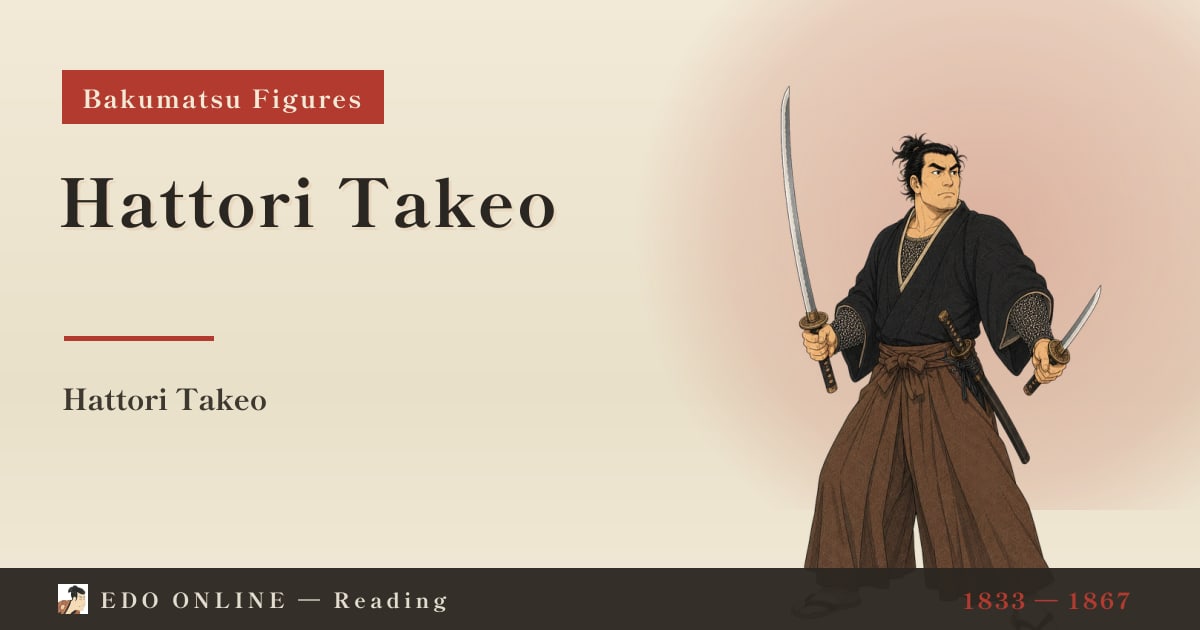
Hattori Takeo — Two Swords at Aburanokoji
A two-sword master and fencing instructor of the Shinsengumi who defected with the Goryō Eji. At Aburanokōji he alone wore mail, held a wall against the whole corps, and fell with more than twenty wounds.