Utagawa Hiroshige — The Fireman's Son Who Made Landscape Art
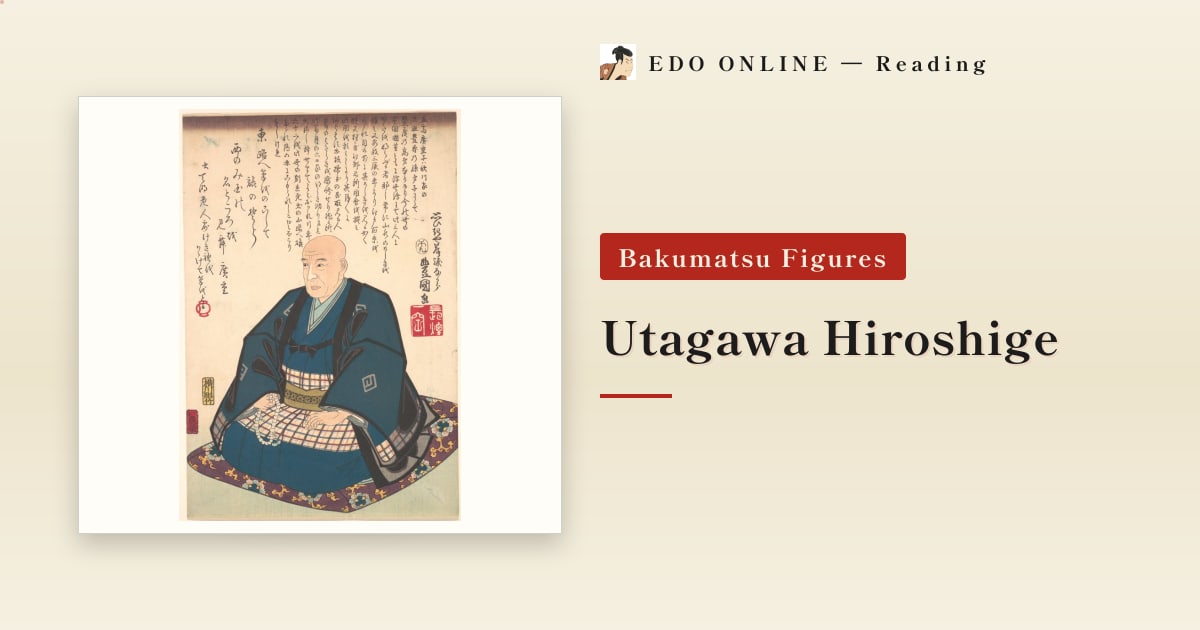
Ukiyo-e meant beautiful women and kabuki actors — until an artist rebuilt the genre around landscape. That was Utagawa Hiroshige.
Contents
Who Was Utagawa Hiroshige?
Hiroshige made landscape the main subject of Japanese printmaking.
His two great series, the Fifty-three Stations of the Tokaido and One Hundred Famous Views of Edo, take places themselves as their subject. Figures are incidental. He established the idea that looking at scenery — a road, a bridge, a corner of the city — was itself entertainment.
He was born in Edo in 1797. His father was an officer of the jobikeshi, the shogunal firefighting service in a city that burned constantly. This was not an artist's household.
He lost both parents in 1809 — aged eleven or twelve by modern reckoning, thirteen by the traditional count — inherited the post, and served as a fire officer while studying painting under Utagawa Toyohiro.
Utagawa Hiroshige's Major Works
Fifty-three Stations of the Tokaido
Published in the early 1830s to enormous success, the series works station by station along the highway from Nihonbashi in Edo to Kyoto.
Its distinguishing feature is weather and hour. Rain, snow, mist, dusk. The same road is drawn again and again under changed conditions.
The best known are the travellers hurrying through slanting rain at Shono, the buried village at Kanbara, and the crowded morning at Nihonbashi. The subject is less the journey than the air you meet on it.
One Hundred Famous Views of Edo
The great work of his last years, running past a hundred plates of the city.
Here the defining feature is compositional nerve. Something enormous sits in the foreground with the distance behind it; a bridge is seen from directly above; a tree trunk cuts the picture in half. The viewpoints anticipate a camera lens, and he returns to the device repeatedly.
Sudden Shower over Shin-Ohashi Bridge and Plum Garden at Kameido are where these experiments go furthest.
The Hiroshige Prints Van Gogh Copied
A large part of Hiroshige's international reputation rests on his effect on European painters.
In the later nineteenth century Japanese objects reached Europe in quantity and produced the vogue known as Japonisme. The flat colour areas, the daring framing, and the treatment of outline in ukiyo-e were unlike anything in European practice.
Van Gogh copied Hiroshige in oil. His versions of the Shin-Ohashi shower and the Kameido plum garden reproduce the original compositions almost directly.
Prints made for ordinary Edo buyers ended up inside a turning point in Western art.
Hiroshige Compared With Kuniyoshi and Hokusai
The same Utagawa school produced Utagawa Kuniyoshi, of his own generation, known for warriors and for visual invention. Hiroshige worked in quiet landscape. One school, two opposite temperaments.
The precedent in landscape was Katsushika Hokusai, whose Thirty-six Views of Mount Fuji preceded Hiroshige's series and opened the market.
The two are constantly compared. Hokusai seizes nature through structure; Hiroshige settles into a scene. Fuji as a form against travellers in the rain — put the prints side by side and the difference is immediate.
How Utagawa Hiroshige Died
Hiroshige died in Edo in 1858. He is traditionally said to have died at sixty-two; because the day of his birth is not recorded, his age by modern reckoning was either sixty or sixty-one and cannot be fixed.
Cholera swept the city that year, and his death came during the epidemic.
A farewell poem attributed to him has him leaving his brush behind in the eastern provinces and going to see the famous places of the western land. Even the journey out of this world is framed as sightseeing — which is about as Hiroshige as it gets.
Utagawa Hiroshige Timeline
| Year | Event |
|---|---|
| 1797 | Born in Edo, son of a shogunal fire officer |
| 1809 | Loses both parents and inherits the post |
| c. 1811 | Enters the studio of Utagawa Toyohiro |
| c. 1833 | Publishes the Fifty-three Stations of the Tokaido |
| 1856–58 | Produces One Hundred Famous Views of Edo |
| 1858 | Dies in Edo, aged 60 or 61 (62 by traditional count) |
For the medium see ukiyo-e in the Bakumatsu era, and for his great predecessor, Katsushika Hokusai.
Related reading
Abe Juro — The Former Member Who Talked
He deserted the Shinsengumi and rejoined under another name, shot at Kondo Isami as one of the Goryō Eji, and then grew apples in Sapporo. His late-Meiji testimony is where the ranking of the corps' best swordsmen comes from.
Ando Hayataro — The Shinsengumi's Record-Breaking Archer
He set the standing national record in the long-range shooting at the Tōdai-ji Great Buddha Hall, sending 8,685 arrows the length of the corridor. Nearly fifty, he joined the Shinsengumi and died of wounds taken in the back garden of the Ikedaya.
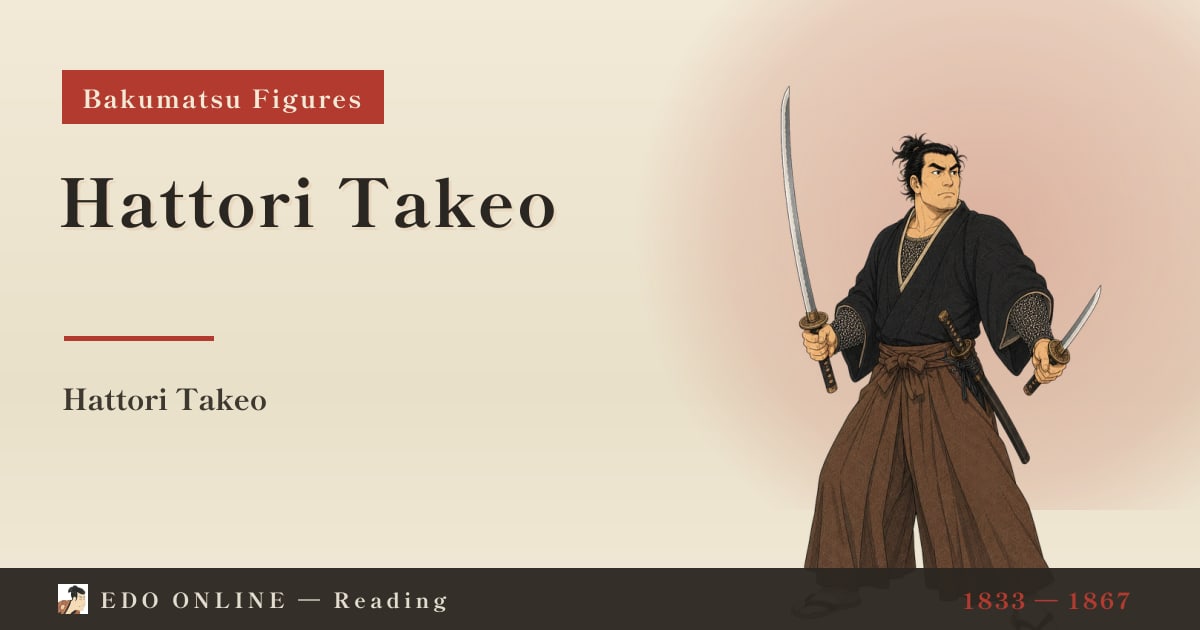
Hattori Takeo — Two Swords at Aburanokoji
A two-sword master and fencing instructor of the Shinsengumi who defected with the Goryō Eji. At Aburanokōji he alone wore mail, held a wall against the whole corps, and fell with more than twenty wounds.