Utagawa Kuniyoshi — Warriors, Cats, and Political Satire
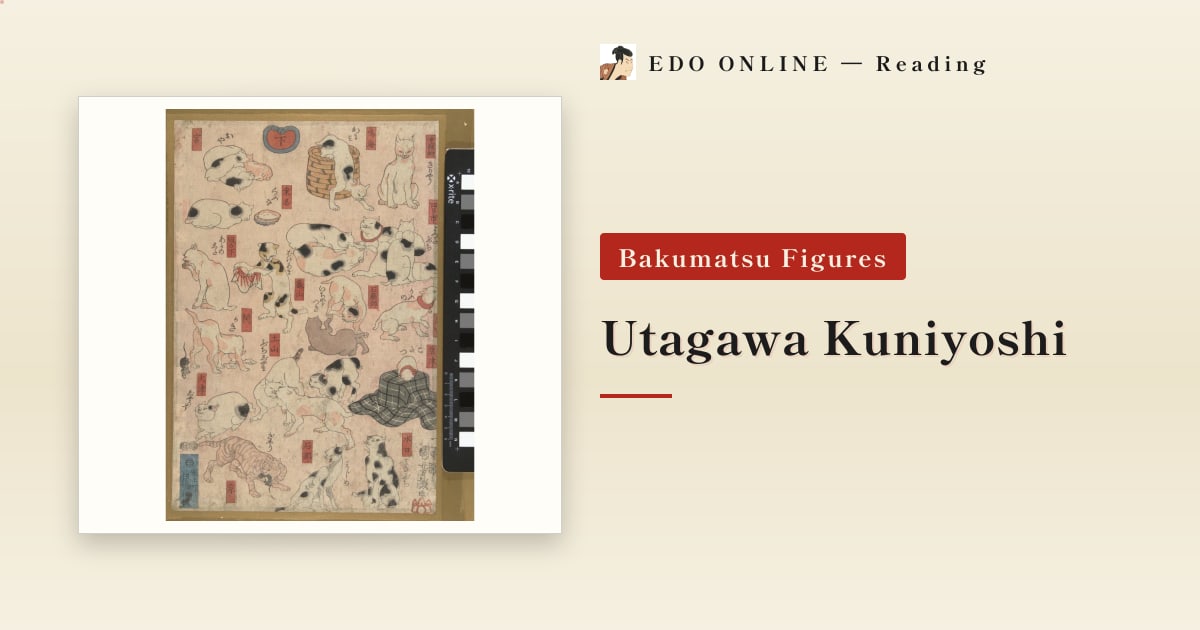
He drew cats, drew monsters, and made pictures that Edo read as attacks on the shogunate. Utagawa Kuniyoshi was a complete temperamental opposite to Utagawa Hiroshige, of the same school.
Contents
Who Was Utagawa Kuniyoshi?
Four bodies of work.
Warrior prints. A series on the heroes of the Chinese novel Water Margin made his name — heavily muscled figures covered in tattoos, pressing out of the picture plane in a way nothing had before.
Comic prints. Cats, raccoon dogs, goldfish, skeletons. He produced a torrent of pictures in which animals and monsters behave like people.
Assembled figures. Faces that turn out, on inspection, to be composed of small human bodies. He liked visual tricks of this kind.
Prints read as satire. In a period when politics could not be depicted, he produced work set in history and legend that audiences took as commentary on the present.
He was born on 1 January 1798 in Nihonbashi, Edo, the son of a silk dyer — the fifteenth day of the eleventh month of Kansei 9 by the old calendar, which is why 1797 is often given.
How Utagawa Kuniyoshi Made His Name
Kuniyoshi entered the studio of Utagawa Toyokuni and spent years going nowhere.
The turn came around 1827 with his series One of the 108 Heroes of the Popular Water Margin, each hero given a full sheet. Despite the title, the surviving series runs to 74 prints covering 75 heroes, not the full 108.
It sold. "Kuniyoshi of the warrior prints" became his reputation, and his designs were taken up as patterns for tattoos across Edo.
Utagawa Kuniyoshi's Cats
Kuniyoshi was seriously fond of cats.
He is said to have drawn with a cat inside his robe, kept several at once, and given them posthumous Buddhist names when they died.
They appear throughout his work: cats behaving as people, cats assembled into written characters, the stations of the Tokaido rendered as cat puns.
These are not animal pictures; they are cats performing human society. That is why they still land. It is a large part of why his reputation has climbed in recent decades.
Utagawa Kuniyoshi's Satire and the Tenpo Reforms
In the Tenpo era the shogunate imposed harsh controls: bans on luxury, censorship of publishing. Prints of actors and courtesans were prohibited.
For a print designer, that removed the commercial core of the trade.
Kuniyoshi's answer was substitution. If actors could not be drawn, draw cats, or scrawled caricatures. If politics could not be attacked, set the attack in legend.
The famous case is a print of a giant earth spider and a swarm of monsters. Nominally a warrior scene from ancient legend, rumour held that the monsters stood for the officials and the victims of the reforms, and it became the talk of Edo. The publisher withdrew the blocks.
Whether Kuniyoshi intended any of that is unknown. What is certain is how it was read — a case of a picture acquiring its meaning at the viewer's end, under censorship.
Utagawa Kuniyoshi's Students
His studio produced the next generation.
Tsukioka Yoshitoshi in particular carried into the Meiji era, working across grisly battle scenes, historical subjects, and beauties. They were the last flourishing of the medium.
How Utagawa Kuniyoshi Died
Kuniyoshi died in Edo in 1861, aged sixty-three.
It was eight years after the Black Ships and seven years before the Meiji Restoration. He lived as an artist of Edo and died before Edo ended.
Utagawa Kuniyoshi Timeline
| Year | Event |
|---|---|
| Jan 1798 | Born in Nihonbashi, Edo, son of a silk dyer |
| 1810s | Enters the studio of Utagawa Toyokuni |
| c. 1827 | Wins success with his Water Margin series |
| 1840s | Works under the censorship of the Tenpo Reforms; produces work read as satire |
| 1850s | Produces many comic prints of cats and assembled figures |
| 1861 | Dies in Edo, aged 63 |
For the medium see ukiyo-e in the Bakumatsu era, and for his contemporary, Utagawa Hiroshige.
Related reading
Abe Juro — The Former Member Who Talked
He deserted the Shinsengumi and rejoined under another name, shot at Kondo Isami as one of the Goryō Eji, and then grew apples in Sapporo. His late-Meiji testimony is where the ranking of the corps' best swordsmen comes from.
Ando Hayataro — The Shinsengumi's Record-Breaking Archer
He set the standing national record in the long-range shooting at the Tōdai-ji Great Buddha Hall, sending 8,685 arrows the length of the corridor. Nearly fifty, he joined the Shinsengumi and died of wounds taken in the back garden of the Ikedaya.
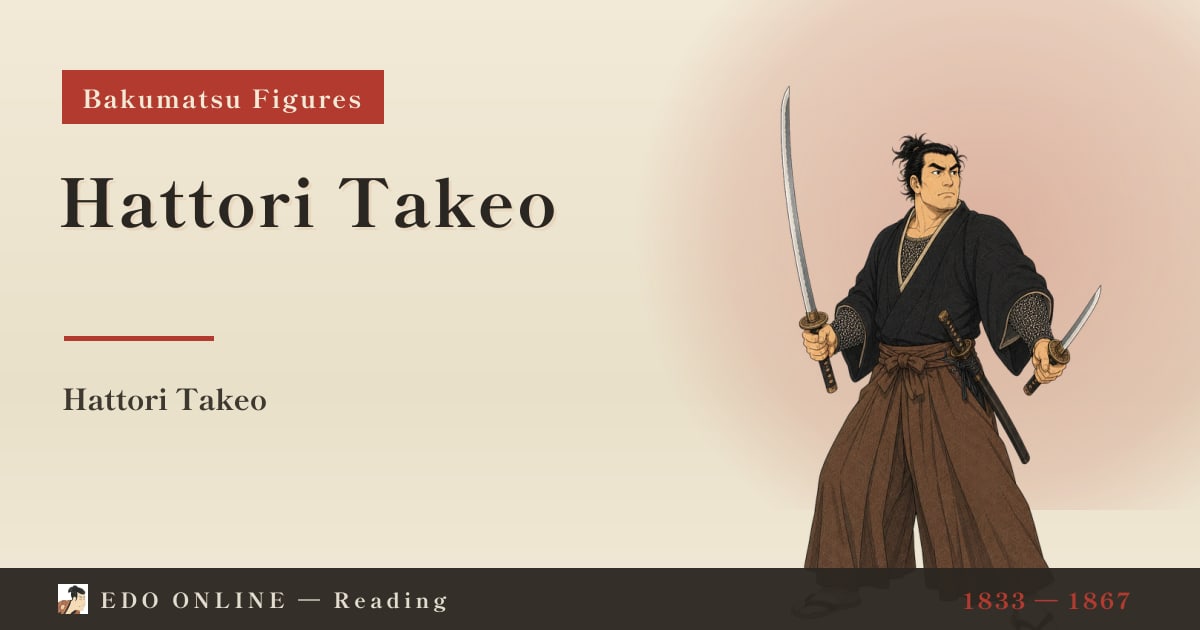
Hattori Takeo — Two Swords at Aburanokoji
A two-sword master and fencing instructor of the Shinsengumi who defected with the Goryō Eji. At Aburanokōji he alone wore mail, held a wall against the whole corps, and fell with more than twenty wounds.