
Sakuma Shozan — "Eastern Ethics, Western Science"
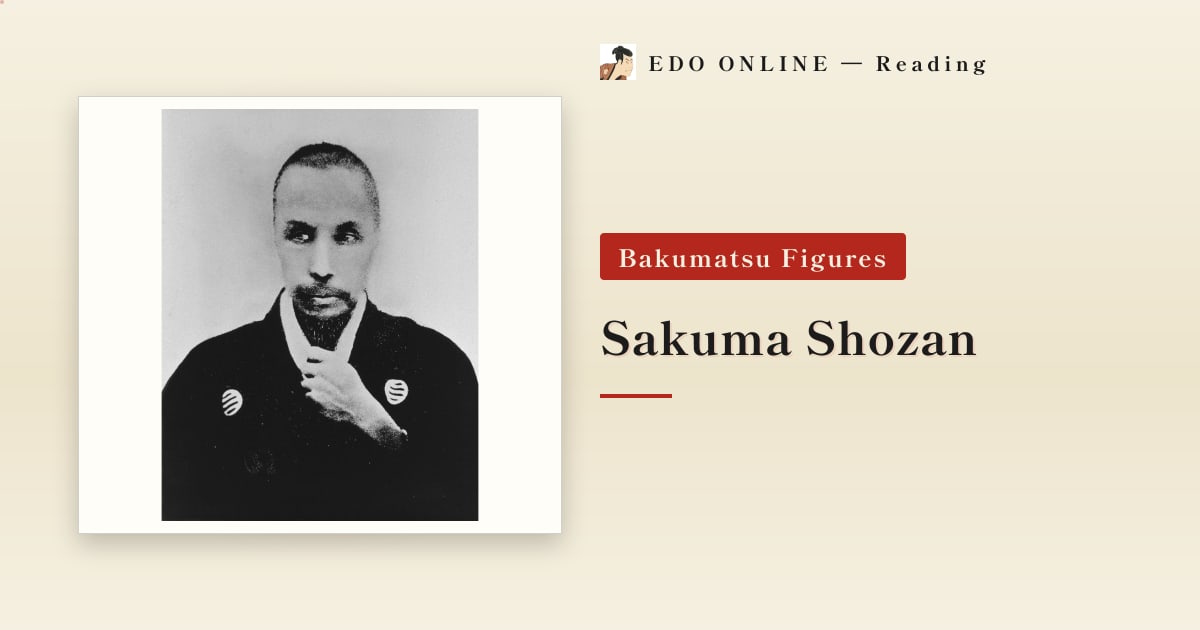
Keep Japan's spirit, and take up the West's technology. That was the argument of Sakuma Shozan, who trained many of the era's finest minds and was assassinated.
Contents
Who Was Sakuma Shozan?
Shozan was a leading thinker and military scientist of the Bakumatsu.
His argument, in a phrase, was "Eastern ethics, Western science" — building on Eastern morality and spirit while adopting Western science and practical learning. "Science" here means technology and applied knowledge, not the modern sense of art.
Neither expulsion nor unconditional opening: keep Japan's spirit and strengthen the country with Western technology. That was Shozan's position, and it spread through the Bakumatsu by way of his many students.
He was born in 1811 into a low-ranking samurai family of Matsushiro domain in Shinano.
Sakuma Shozan's Students
Shozan's influence worked through his students.
His school produced a remarkable number of important figures. Katsu Kaishu, Yoshida Shoin, Hashimoto Sanai, Sakamoto Ryoma for a time, and others who would move the Bakumatsu, learned Western military science under him.
Yoshida Shoin is the best known. Behind Shoin's attempt to smuggle himself aboard a Black Ship lay Shozan's teaching. Shoin was putting into practice Shozan's idea of seeing the West with one's own eyes.
When the attempt failed, Shozan was punished as an accomplice — a teacher bearing the consequences of a student's act.
What Sakuma Shozan Was Like
Shozan was a man of intense self-regard.
He was certain of his own gifts and did not hide it. He often behaved as though he looked down on others, and made many enemies. An anecdote has him declaring openly that the great talents of the realm numbered himself and a mere handful of others.
That arrogance was the reverse side of the advancement of his thought. The awareness that he had seen the importance of the West earlier than anyone made him haughty — and, in fact, much of what he foresaw was right.
The trait may also have put him in danger. But the recorded motive for his killing was political and ideological — his advocacy of opening the country, of Western learning, and of court-shogunate cooperation — and no source establishes his character itself as the cause.
Sakuma Shozan's Case for Opening the Country, and His Assassination
After the arrival of the Black Ships, Shozan argued for opening the country: expulsion was impossible, and there was no course but to learn from the West and grow strong.
But it was the very height of the cry for expulsion. To argue for opening the country meant risking one's life.
In 1864 Shozan was assassinated in Kyoto, aged fifty-three (fifty-four by the traditional count). His killers were believers in expulsion.
A man who preached "Eastern ethics, Western science" and argued for opening to the West was cut down by men who hated it. Yokoi Shonan was later assassinated by expulsionists for the same views. It was an age in which thinkers who advocated opening the country fell to expulsionist blades.
How Sakuma Shozan Is Judged
Shozan occupies the unusual position of being eclipsed by the very magnitude of his students.
Katsu Kaishu and Yoshida Shoin each carved their own names into history. Their teacher is often spoken of simply as "the man who trained them."
Yet the reach of his own thought was large. Thinking of spirit and technology as separable, and trying to join them — this became one template for Japan's later modernization. The posture of adopting Western technology while trying to keep something Japanese is a theme that recurs again and again after Meiji.
Shozan set out its prototype early in the Bakumatsu.
Sakuma Shozan Timeline
| Year | Event |
|---|---|
| 1811 | Born into a low-ranking Matsushiro samurai family in Shinano |
| 1840s | Masters Western military science; opens a school in Edo |
| 1850s | Trains Katsu Kaishu, Yoshida Shoin, and others |
| 1854 | Punished as an accomplice in Shoin's smuggling attempt |
| 1864 | Assassinated in Kyoto for his advocacy of opening the country, aged 53 |
For his students see Katsu Kaishu and Yoshida Shoin; for a thinker assassinated for the same views, Yokoi Shonan.
Related reading
Abe Juro — The Former Member Who Talked
He deserted the Shinsengumi and rejoined under another name, shot at Kondo Isami as one of the Goryō Eji, and then grew apples in Sapporo. His late-Meiji testimony is where the ranking of the corps' best swordsmen comes from.
Ando Hayataro — The Shinsengumi's Record-Breaking Archer
He set the standing national record in the long-range shooting at the Tōdai-ji Great Buddha Hall, sending 8,685 arrows the length of the corridor. Nearly fifty, he joined the Shinsengumi and died of wounds taken in the back garden of the Ikedaya.
Hattori Takeo — Two Swords at Aburanokoji
A two-sword master and fencing instructor of the Shinsengumi who defected with the Goryō Eji. At Aburanokōji he alone wore mail, held a wall against the whole corps, and fell with more than twenty wounds.