Yokoi Shonan — The Thinker Who Moved the Bakumatsu from Behind
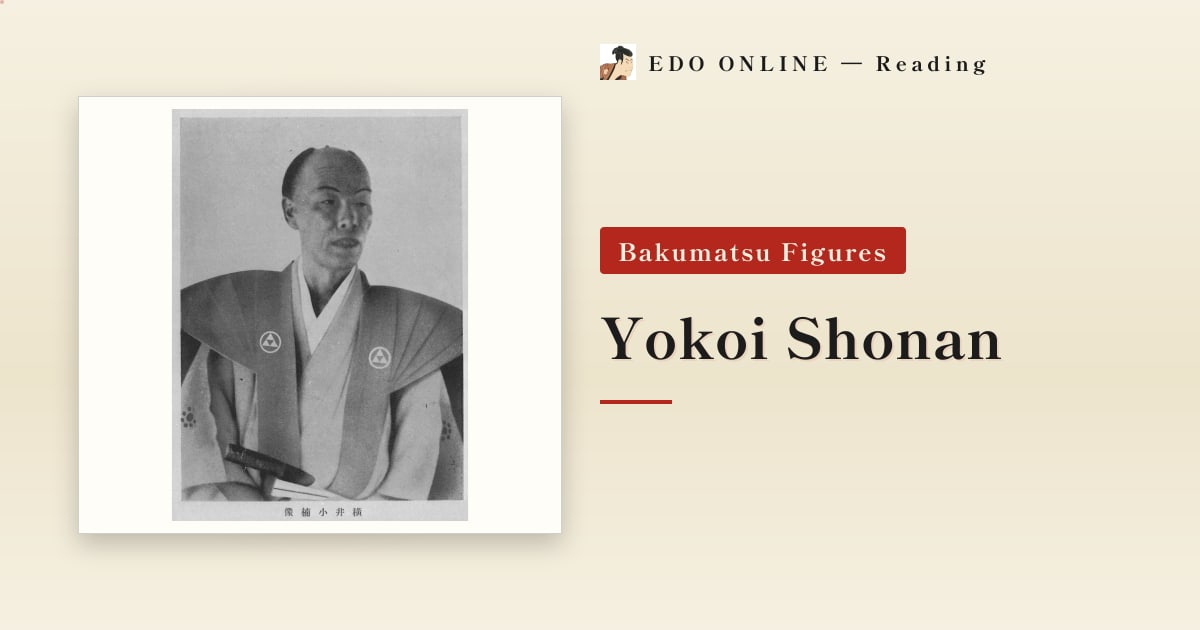
A thinker who moved the era not by leading a domain but by handing his ideas to those who did. Yokoi Shonan influenced both Katsu Kaishu and Sakamoto Ryoma.
Contents
Who Was Yokoi Shonan?
Shonan was one of the leading thinkers and political advisers of the Bakumatsu.
He never became a lord or a head of government. His power lay in conceiving programmes and handing them to men in a position to carry them out.
Two things, concretely. He guided the reforms of Fukui domain, invited by its lord Matsudaira Shungaku to shape both domain and, later, shogunal policy.
And he spread the argument for opening the country and for consultative government — that Japan should abandon seclusion, enrich itself through trade, and govern by gathering opinion broadly.
He was born in 1809 into a family of Kumamoto domain.
Why Yokoi Shonan Was Neglected in Kumamoto
Shonan distinguished himself young in scholarship, but he was passed over for years in his native Kumamoto.
An incident at a drinking party while studying in Edo brought a penalty that dogged him. And his reformist ideas did not suit the conservative temper of his domain; Kumamoto had no place for them.
He opened a private school and trained students, but never reached the domain's leadership. His talent went unused at home.
Why Fukui Called Yokoi Shonan
The turn came with an invitation from Fukui.
Its lord, Matsudaira Shungaku, was seeking outside talent for reform. Learning of Shonan's thought, Fukui took him on as a guest adviser.
The ideas Kumamoto had refused were put into practice in Fukui.
Shonan guided the domain's fiscal recovery and the promotion of industry, and shaped its policy substantially. Fukui's strength in this period rests in part on his conceptions.
When Shungaku took high shogunal office, Shonan's ideas reached the debate over national policy as well.
Yokoi Shonan, Katsu Kaishu and Sakamoto Ryoma
His thought travelled beyond Fukui.
Katsu Kaishu rated him highly and learned from him. Katsu is said to have remarked that the only two men he had ever truly found formidable were Saigo Takamori and Yokoi Shonan.
Sakamoto Ryoma visited Shonan directly at Nuyamazu in Kumamoto in 1864. Some read the influence of Shonan into Ryoma's own vision of a new state.
Behind the men on the stage, supplying the conceptions — that was Shonan's position.
What Yokoi Shonan Argued
The core of his thought was opening the country and government by consultation.
Not to defend seclusion but to open to the world and grow rich through trade; not to let a few monopolize politics but to govern by collecting opinion widely. It was advanced for its day, and also practical.
His thought joined Confucian ideals to Western knowledge — using an old scholarship as the ground for meeting a new world.
How Yokoi Shonan Was Assassinated
In the Meiji era Shonan was invited into the new government and given high office. The long-neglected thinker had reached the centre of national politics at last.
But in 1869 he was assassinated in Kyoto, aged fifty-nine (sixty-one by the traditional count).
His attackers were believers in expulsion. The stated motive was suspicion that Shonan advocated opening the country and was spreading Christianity — the Christian charge being a rumour on the attackers' part.
A man who had argued all his life that opening the country was Japan's road was killed by men who hated it — at the very threshold as the Meiji government turned toward exactly that.
Yokoi Shonan's Descendants
Among his family, his eldest son is well known.
Yokoi Tokio became a Christian leader and educator and was associated with Doshisha. Given that a Christian charge served as the pretext for his father's murder, that the son took the Christian path is a striking turn.
Yokoi Shonan Timeline
| Year | Event |
|---|---|
| 1809 | Born into a Kumamoto domain family |
| 1830s–40s | Distinguishes himself in scholarship but is neglected in Kumamoto |
| c. 1858 | Invited to Fukui; guides its reforms |
| 1860s | Reaches shogunal policy debate through Shungaku; influences Katsu and Ryoma |
| 1868 | Invited into the new government and given high office |
| 1869 | Assassinated in Kyoto, aged 60 |
For the lord who brought him in see Matsudaira Shungaku; for those he influenced, Katsu Kaishu and Sakamoto Ryoma.
Related reading
Abe Juro — The Former Member Who Talked
He deserted the Shinsengumi and rejoined under another name, shot at Kondo Isami as one of the Goryō Eji, and then grew apples in Sapporo. His late-Meiji testimony is where the ranking of the corps' best swordsmen comes from.
Ando Hayataro — The Shinsengumi's Record-Breaking Archer
He set the standing national record in the long-range shooting at the Tōdai-ji Great Buddha Hall, sending 8,685 arrows the length of the corridor. Nearly fifty, he joined the Shinsengumi and died of wounds taken in the back garden of the Ikedaya.
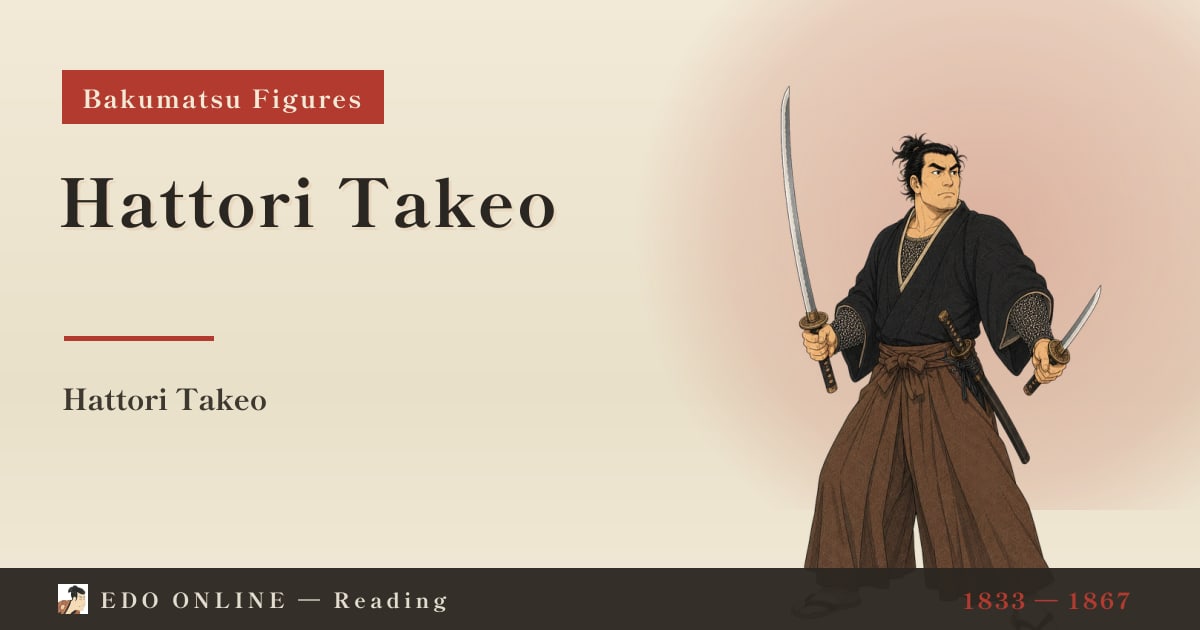
Hattori Takeo — Two Swords at Aburanokoji
A two-sword master and fencing instructor of the Shinsengumi who defected with the Goryō Eji. At Aburanokōji he alone wore mail, held a wall against the whole corps, and fell with more than twenty wounds.